



Waseda University surveys advances in terahertz biophotonics
Emerging approaches will translate THz technology from proof-of-concept to practical applications.
10 June 2026
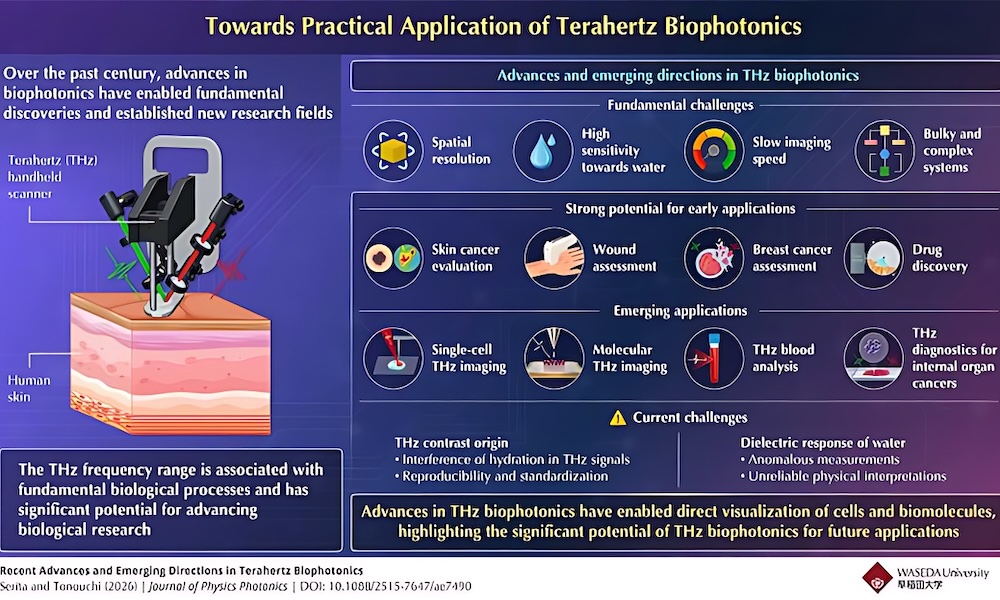
Researchers highlight the potential of THz biophotonics as an emerging interdisciplinary research field. Credit: Kazunori Serita/Waseda University.
A group from Japan's Waseda University and Okayama University has surveyed the field of terahertz biophotonics, to identify the factors holding THz technology back from wider clinical use.
Published in J Phys Photonics, the review positions the THz region of the electromagnetic spectrum as a promising frontier for advancing biological research.
The ability of THz radiation to provide spectroscopic data about living tissues in vivo is attractive, due to its largely non-ionizing and non-invasive nature. A number of research projects have studied how the technology could be useful, including work at Queen Mary University of London to develop a THz sensor able to identify early-stage skin cancer.
However, despite steady advancements the adoption of THz biophotonics still lags behind visible light-based techniques in directly observing cellular and molecular dynamics. Time-domain THz spectroscopy (THz-TDS) is the most common THz technique, but it remains unable to directly observe cellular behavior under physiological conditions in the same way that optical microscopy can.
According to the Waseda University team, this is largely due to several challenges: relatively low spatial resolution (a consequence of the longer THz wavelengths), high sensitivity to water that complicates measurements, slower imaging speeds, and bulky instrumentation. Addressing these issues is essential for meaningful progress in the field, commented the Waseda group.
"THz biophotonics is a fascinating research area for next-generation biomedical technologies," said Waseda's Kazunori Serita. "Currently, THz biomedical applications are restricted to a few niche domains with many technical limitations. Recent developments in emerging THz technologies have greatly increased the potential for overcoming these technical limitations."
Tumor margins and wound assessment
One route to improvement identified in the study is the incorporation of metamaterials into THz sensors to improve sensitivity. Arrays of split-ring resonators can lead to measurable shifts in resonance frequency in the presence of an analyte material, potentially revealing subtle molecular modifications. With continued advances in micro- and nanofabrication technologies, THz metamaterial sensors have been extended to biological samples of increasingly smaller size and complexity.
Assessing those clinical applications that could most readily benefit from improved THz platforms, the Waseda report echos the Queen Mary University study in identifying skin cancer diagnosis as a significant sector, one where work is now progressing toward clinical trials.
"Margin assessment in breast cancer is also a key area where THz technology has high potential for practical clinical application, offering a pathway to simplify current procedures," wrote the team. "Wound assessment is another field where THz imaging is being increasingly applied."
New and emerging directions include single-cell THz imaging, molecular-scale THz studies, diagnostics for internal organs and THz-based blood analysis.
"For more than two decades, THz biophotonics has alternated between high expectations and limited practical adoption," said the project in its review. "Recent years have brought substantial advances in THz source technologies, measurement speed, near-field methodologies, and system miniaturization. Several of these developments have begun to overcome long-standing technical barriers."
Terahertz biosensor spots early signs of skin cancer
February 27 2024
Leica and Cognex launch AI software module Aivaro to improve inspection
September 30 2026

Photonic monitoring to identify food safety, quality, and animal welfare
September 30 2026
Advances in optics and computation boost coronary intravascular imaging
September 30 2026
Australia’s SKA tests antenna layout for Low telescope
September 30 2026