



Volantis raises $88M with AI memory breakthrough claim
Photonic interconnects based around integrated VCSELs said to solve compromise between model speed and sophistication.
06 October 2026
Volantis Semiconductor, a San Francisco startup claiming that its photonics technology will solve a key bottleneck in AI computation, says it has raised $88 million in a series A round of venture funding.
Founded by CEO Tapa Ghoush in 2022, the company reckons that its novel architecture - based around micro-VCSELs - eliminates the typical trade-off between memory capacity and bandwidth.
“We're solving Al's memory bottleneck by using optics, enabling chips with huge amounts of fast and cheap memory,” Ghoush posted on LinkedIn. “Initially, this will enable insanely fast agents - think coding agents that finish in minutes or even seconds instead of hours.”
Memory trade-off
According to Volantis, running large AI models at high speeds demands both an enormous memory capacity to hold the model, and enormous bandwidth to continuously feed data into the compute engine.
Current architectures either use on-chip static RAM to provide high bandwidth but limited capacity, or GPUs to provide higher capacity but lower bandwidth - ultimately meaning high costs and energy consumption, or relatively slow compute performance.
New chip technology like three-dimensional dynamic RAM is not expected to change that fundamental trade-off, adds the firm.
Volantis has designed its initial “A-1” system to increase memory capacity and bandwidth by nearly two orders of magnitude simultaneously, which should enable increasingly large and complex models to run at much higher inference speeds.
That system is based around what the firm describes as a “new category of photonic interconnect”, which has been designed specifically to connect compute chips to memory.
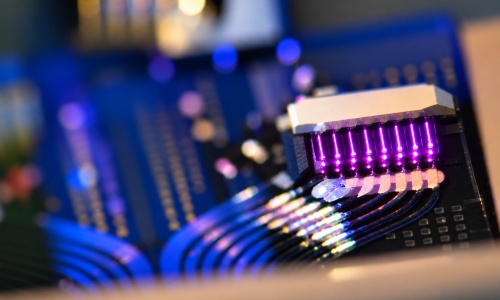
Stressing that this means optical “wires” using tiny micro-VCSELs and integrated waveguides rather than interconnects based on external lasers and optical fiber, the A-1 fabric connects large numbers of memory chips into a unified pool, aggregating their bandwidth as memory is added.
“This allows A-1 to increase memory capacity and bandwidth together while using lower-cost off-chip memory,” says the firm. “While photonics is already used to move data inside data centers, existing technologies have largely focused on chip-to-chip connections.
“Chip-to-memory connections require more than 100 times as much data to travel over much shorter distances, creating different requirements for energy and cost.”
Unconstrained GaAs VCSEL supply
One advantage of using micro-VCSELs instead of external indium phosphide (InP) sources is that the approach is able to draw on the plentiful gallium arsenide (GaAs) VCSEL supply chain at a time when InP laser supplies are highly constrained.
“The micro-VCSELs are small, temperature-stable and low power, enabling end-to-end links consuming less than one picojoule per bit,” Volantis states, adding that it plans to unveil details of further innovations behind the approach as A-1 moves toward commercialization.
One company working on micro-VCSELs is PicoJool, the Silicon Valley startup that has also just closed a substantial series A round of funding.
While PicoJool can name-check former Intel CEO Pat Gelsinger as one of its primary backers, Volantis is supported by OpenAI CEO Sam Altman, a leading figure in the industry.
Co-led by Physical Intelligence co-founder Lachy Groom and Abstract Ventures, the Volantis fundraising also included participation from John Doerr, VXI Capital, Triatomic and Susa Ventures, alongside numerous high-profile angel investors.
The company plans to deliver its first integrated inference engines to customers next year.
MKS sells Ophir Optics division to PCB maker TTM for $650M
October 22 2026

Photon Bridge lands €10M to scale lasers for data centers
October 21 2026