



Virginia Tech develops biosensor that cleans itself - by laser
Ultrafast laser pulses generate bubbles to dislodge blocking materials, such as blood.
29 July 2026
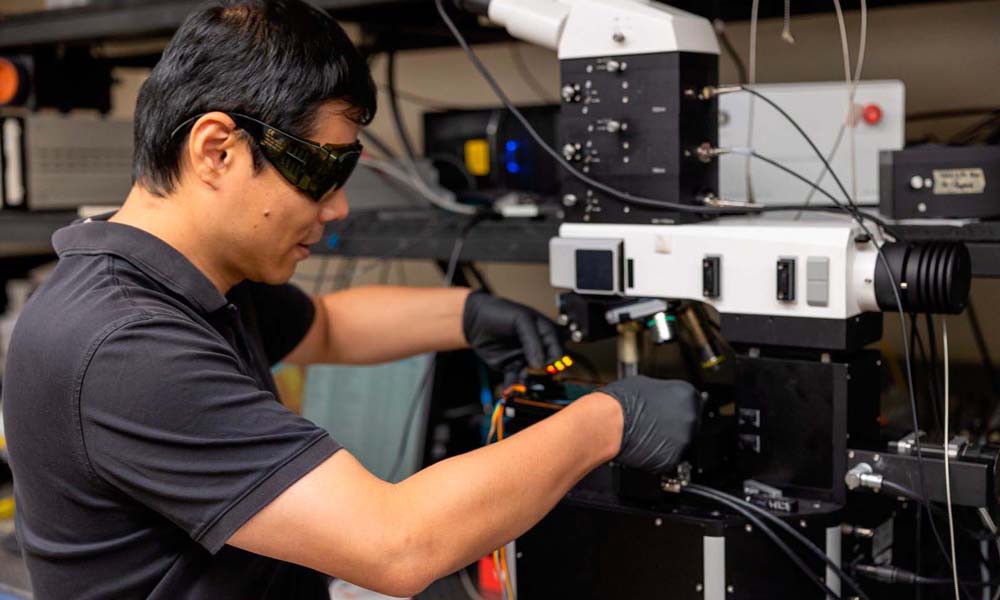
Associate Professor Wei Zhou evaluates the self-regenerating biosensor using an ultrafast laser microscope. Photo by Nathaniel Cranfield for Virginia Tech.
Imagine a smart optical bandage that could continuously monitor an infected wound, alerting doctors when bacteria spread or when treatment begins to work. That vision is one step closer to reality with new research from Virginia Tech, Blacksburg, VA. An interdisciplinary team has developed a new biosensor that can clean itself after being covered by biological materials like blood that would normally stop it from working.
The achievement is described in Advanced Science.
“Our self-regenerating sensor paves the way for smart bandages and bedside tools that can detect early signs of infection and guide timely, personalized treatments,” said Wei Zhou, director of Virginia Tech’s Micro-/Nanofabrication Cleanroom and Laboratory.
The research was inspired by conversations with wound care clinicians, who highlighted a major challenge: after patients leave the clinic, there is no easy way to track what is happening beneath a wound dressing until the next clinical visit.
“Many chronic wounds, like diabetic ulcers or severe burns, fail to heal because underlying bacterial infections are difficult to monitor continuously,” said Zhou. “Traditional sensors lose their accuracy because proteins clog up their surfaces.”
While existing molecular sensors can detect disease-related molecules with remarkable sensitivity, many lose that ability within hours as they become coated with proteins and other biological materials naturally present in blood, bodily fluids, and tissue.
Nanoscale regeneration
To address the problem, researchers built a soft, nanoscale sensor consisting of tiny pockets that are less than 10 nm wide. “The extreme sensitivity comes with a major challenge,” said Dr. Aditya Garg, who is now a postdoctoral researcher at Massachusetts Institute of Technology. “Proteins and other biological materials quickly accumulate inside these tiny spaces, blocking them and preventing the sensor from working.”
The team engineered the sensor so that when its sensing pockets are exposed to ultrafast laser pulses, they generate microscopic cavitation bubbles. Those bubbles produce localized heat that gently dislodges accumulated proteins and other biological materials to preserve the sensor’s function.
In laboratory testing, the sensor was exposed to human serum for 24 hours, but it successfully regained its sensitivity and detected pyocyanin — a molecule produced by the bacterium Pseudomonas aeruginosa that can signal infection.
Just as importantly, the sensor continued to perform reliably after repeated regeneration cycles, monitoring the molecular changes that can signal disease progression in wound models over 24 hours.
 Personalized medicine
While the study focused on chronic wound infections, the researchers said the technology could have applications far beyond wound care. “Our approach has potential wide utility in any environment where long-term monitoring is important,” said Peter Vikesland, the Pryor Professor of civil and environmental engineering;. “Self-cleaning makes deployment in environmental settings feasible. This approach has potential for use in ensuring water is safe to drink and use.”
The same sensor could be used alongside implanted medical devices to flag early signs of complications or help surgeons distinguish healthy from cancerous tissue during treatment. In infections, continuous sensing could reveal how pathogens and their molecular signals shift in response to treatment over time, offering a level of insight that current tools cannot capture.
The team envisions pairing the sensor with machine learning tools that can sift through the constant stream of molecular signals and translate them into information that clinicians can use in the moment.
“Our long-term vision is to transform healthcare from reactive to proactive,” said Garg. “Instead of waiting for symptoms to appear or relying on periodic tests, we hope to continuously monitor the molecular signals of disease and help clinicians intervene earlier to make informed decisions.”

Syntec swings to profit as sales climb
August 19 2026



Hesai goes ‘full-stack’ with extended robotics offering
August 19 2026