



UK team hails satellite laser link success
Compact optical ground station from Archangel Lightworks expected to find use in defense and commercial markets.
28 May 2026
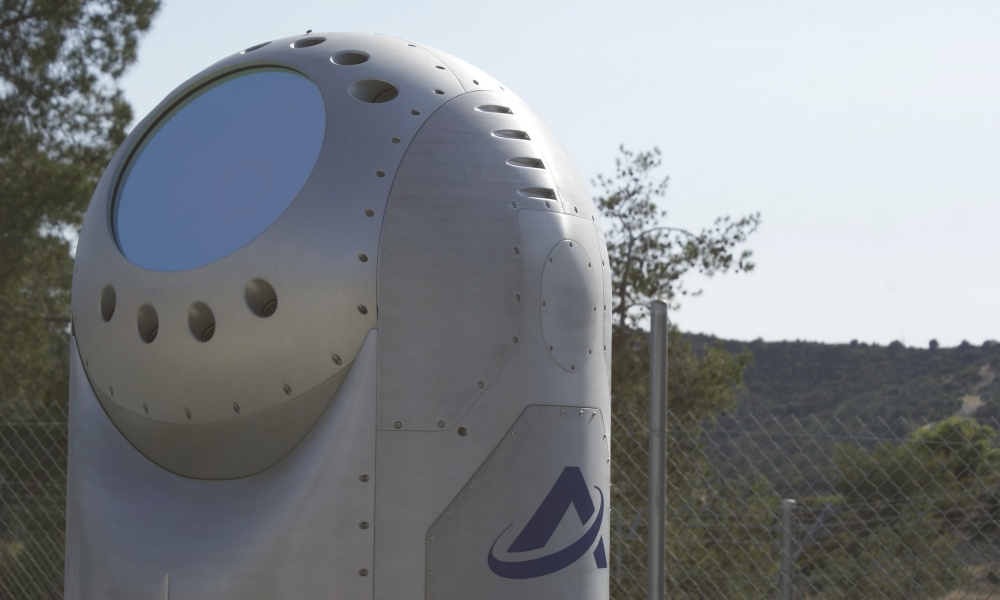
Archangel Networks' 'TERRA-M' optical ground station stands just over a meter tall, requires no dome, and is said to be readily deployable at the point of need. Photo: Archangel Networks.
The UK government has announced details of a successful download of data using a free-space optical link between a satellite and ground station - said to be the first UK project to achieve such a connection.
“During a 90-second satellite pass, many gigabits of data were downloaded from a satellite in low Earth orbit (LEO) to an optical ground station located in the Mediterranean region,” reported the UK’s Defence Science and Technology Laboratory (DSTL), comparing the optical technology to conventional radiofrequency links as “like moving from very slow internet to superfast fiber broadband”.
Readily deployable
The DSTL-sponsored field trials, which used the US Space Development Agency laser communication standard and were repeated across multiple passes to prove reliability, featured a compact new optical ground station developed by UK startup Archangel Lightworks known as “TERRA-M”.
Claimed to be the world’s smallest deployable operational ground station, it is a fraction of the size of a typical telescopic receiver, with an optical head standing just over a meter tall and only 70 cm in diameter.
Oxford-based Archangel says it does not require an external dome, is easily transportable by light vehicle or aircraft, and can be readily deployed on the roof of a building. The startup, which recently raised more than £10 million in a series A funding round, says that units and ground-station-as-a-service contracts are already being bought by and delivered to customers.
Archangel CEO Richard Johanson said of the latest trials: “The TERRA-M is uniquely capable of rapid, secure data transfer with satellites while also being small enough to be deployed and redeployed at the point of need.
“We are on a pathway to providing resilient, large-scale deployable networks of optical ground stations. The demand for space-based information and connectivity solutions continues to grow exponentially, and we are pleased that our technology will play a role in this exciting new global communications infrastructure.”
Subsea vulnerabilities
DSTL’s CEO Paul Hollinshead added: “Laser communications will vastly improve the speed, size and security of data between our forces, whether they are in the air, on land, at sea or in space. This will greatly increase the security of our forces who will be able to convey critical information faster than their adversary.”
Archangel indicates that the technology will have both commercial and defense applications, and by-passes the vulnerabilities now associated with subsea cables threatened by hostile regimes.
“It also has the potential to bring high-volume satellite communications to communities and thereby reduce the digital divide,” stated the startup. “As compute moves into orbit through the use of orbital data centers, optical ground infrastructure will play an increasingly important role in seamless connectivity between networks in space and networks on the ground.”
The firm’s series A fundraising round was led by Santander Alternative Investments, with participation from the UK’s National Security Strategic Investment Fund (NSSIF), Blackfinch Ventures, Oxford Capital, Lycka Limited, and Oxford Science Enterprises (OSE).
MKS sells Ophir Optics division to PCB maker TTM for $650M
October 22 2026




Photon Bridge lands €10M to scale lasers for data centers
October 21 2026