


UK military satellite Titania launched following £3 bn investment in space defense...
...and Mitsubishi Electric collaborates with four companies on Japan’s ‘Mega-Constellation Initiative’
10 November 2026
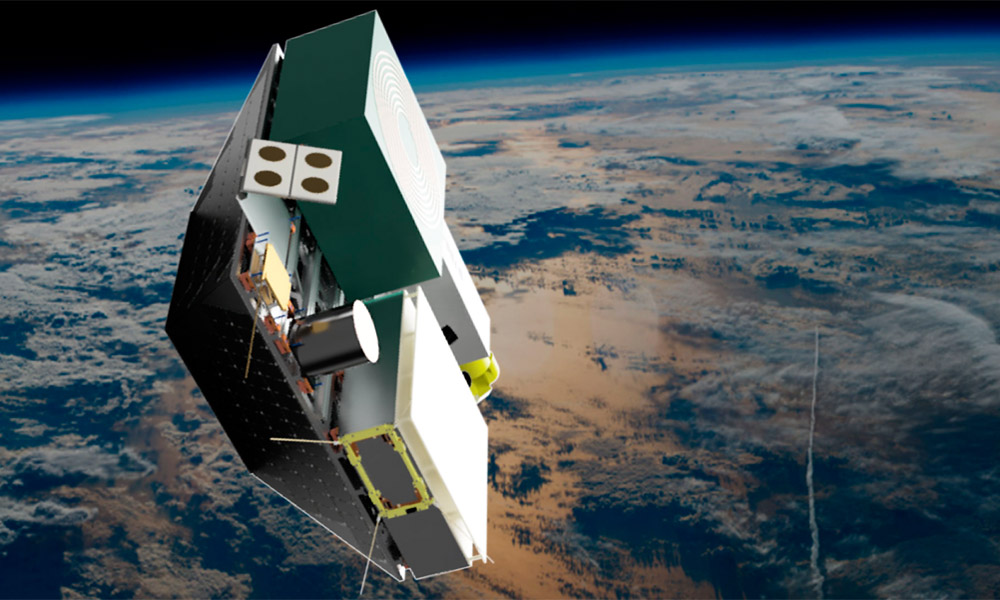
Artist’s impression of satellite Titania in space. It is intended to give the military improved observation, alongside a network of ground sensors. Image: BAE systems.
The UK has a new pair of eyes in space, with the successful launch of UK-built military satellite Titania. The launch, completed in October, 2026, is intended to help the UK armed forces to coordinate its efforts on and above Earth, by improving their ability to observe military activity on Earth from space.
Titania is the second satellite in the UK’s growing constellation of military satellites in orbit, following the successful launch of Tyche, also in October, and will be operated by UK Space Command as part of the ISTARI program.
Like Tyche, Titania weighs around 100kg and is about the size of a washing machine. It orbits the Earth every 90 minutes, travelling at 27,000 kmh.
The successful launch comes as the Ministry of Defence (MOD) also launches Project Inaros, a new trial of an advanced network of sensors designed to monitor space from three sites around the world.
UK Secretary of State for Defence Wes Streeting MP commented: “The new space age is here. Space underpins everything from weather forecasts and financial transactions to sat-navs and mobile phone connections, and it is critical for our national security and military operations. Having Titania now in orbit and Project Inaros stepping up how we watch over our satellites means we can see threats sooner, making the UK safer.
“Titania and Inaros are UK-built and designed, backed by more than £3 billion of investment in space capabilities. That means highly skilled jobs across the UK, a stronger industrial base, and a more secure United Kingdom,” Streeting added.
Air Chief Marshal Sir Harv Smyth, the Chief of the Air Staff, said: “The ability to observe the Earth from space is critical to both national resilience and military advantage. This will be demonstrated by Tyche and Titania, alongside Juno and Oberon in the years ahead. We will monitor these vital satellites using state-of-the-art technology around the world, including our Inaros sensors – to ensure our Armed Forces can fight and win wherever they are.”
Under the ISTARI programme, the MOD is delivering satellites and supporting ground systems to expand space-based intelligence, surveillance and reconnaissance, intended to give UK troops around the world an operational advantage.
Titania was designed and built in Hampshire by the partnership of Defence Science and Technology Laboratory (Dstl) and BAE Systems as part of a £9.5 million ($12.7 M) contract, and will be followed by satellites Juno, with SSTL, and Oberon, with Airbus Defence and Space.
Andrea Thompson, Managing Director, BAE Systems Digital Intelligence & Land, said: “This programme highlights the strength of the UK’s sovereign space capability and the critical role it plays in protecting the nation. As a trusted partner to the UK Government, we remain committed to delivering innovative space solutions that enhance national security and prosperity for the long term.”
Dr Paul Hollinshead, CEO, Dstl, said: “Dstl has been at the heart of Titania, from the original concept, through investment, technical development, and successful launch. The achievement reflects the expertise of the Dstl team and showcases the value of long-term Defence Science and Technology investment, delivering mission success for our armed forces.”
Ground-based sensors
Project Inaros will trial three ground-based neuromorphic sensors, developed by British-Australian company Optera in partnership with the National Security Strategic Investment Fund, to monitor movements in space from sites in the UK, Australia, and British facilities on Cyprus.
The technology, which mimics biological processes by detecting changes in light, could be developed to be an early warning system to spot unusual or threatening activity near UK satellites. Information gathered by Inaros will help UK Space Command units to safeguard the UK satellites which guide UK ships, connect mobile phones and warn of missile attacks.
Titania and Inaros will help deliver on the recognition in the Strategic Defence Review that space is increasingly vital to the UK’s national security and daily life. The work is part of the £3 billion committed by the Defence Investment Plan for space-based capabilities to protect UK assets in space and strengthen deterrence on Earth. The DIP has committed £298 billion of spending over the next four years.
 Mitsubishi Electric collaborates with four companies on ‘Mega-Constellation Initiative’
Mitsubishi Electric Corporation has entered into a memorandum of understanding (MOU) with NTT, NTT Docomo, MUFG Bank, and the Development Bank of Japan, to explore comprehensive collaboration on the development and operation of a “mega-constellation”. They define this as an integrated system in which numerous satellites operate in coordination to provide services covering broad areas of the Earth—and on the provision of services utilizing the constellation.
Under the MOU, the five partners will examine the technical and business feasibility of commercializing a diverse range of services enabled by mega-constellations, including communications, Earth observation, satellite-based positioning, navigation, and timing (PNT), and space data centers.
Under the MOU, Mitsubishi Electric will leverage its technologies and expertise in satellite and ground facility development and manufacture, as well as system integration cultivated over many years in its defense and space systems business. The company will conduct technical studies on the overall system design and integration of the mega-constellation. Based on user needs, the company will examine methods for integrating satellites, ground stations, communications networks, and operations systems.
Mitsubishi Electric will also explore the application to mega-constellations of the Digital Space Interface (DSI), an open common interface for satellite information processing that the company is developing in collaboration with other space development companies. Through the use of DSI, the companies aim to facilitate the addition and updating of large software packages on satellites in orbit, thereby improving the efficiency of satellite development and enabling flexible responses to the addition and updating of services.

nLight still hampered by optics supply chain
November 10 2026

Chip industry momentum boosts Jenoptik order book
November 10 2026

University of Tokyo captures new details of cell organization...
November 10 2026

Trumpf forms strategic partnership with Cutlite...
November 09 2026

Holes convert silicon wafers into flat ultraviolet-focusing mirrors
November 09 2026

SPIE names 2027 Prism Awards finalists for best photonics products
November 05 2026