



Tunable device features multiple lasers synchronizing as coherent light source
European group develops source based on liquid crystals and organic dyes, at room temperature.
25 June 2026
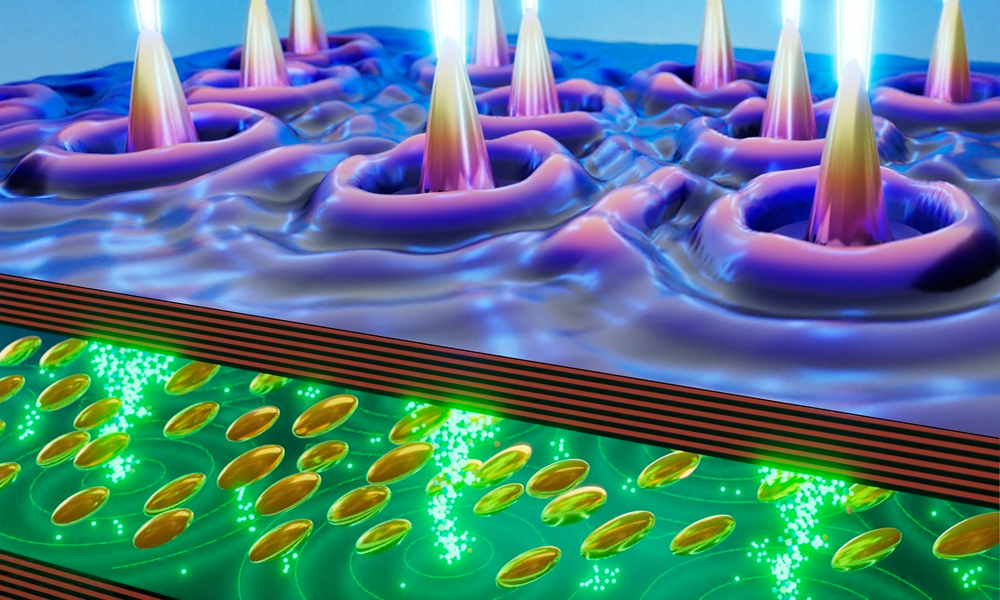
Several spatially separated laser spots spontaneously synchronize and emit as a single coherent supermode in a liquid-crystal microcavity. Visualisation: Marcin Muszyński, Faculty of Physics University of Warsaw.
A team of physicists across Europe has developed a new class of tunable photonic devices in which multiple tiny laser beams spontaneously synchronize and behave as a unified, spatially extended, and coherent light source. The group comprises scientists from University of Southampton, UK, University of Warsaw and Military University of Technology, Poland, the Institut Pascal, Université Clermont Auvergne, CNRS, France, and CNR, Italy,
Remarkably, say the team, this effect is achieved at room temperature using a simple system based on liquid crystals and organic dye molecules, “opening new possibilities for low-cost and reconfigurable optical technologies.”
The study demonstrates that spatially separated laser spots inside an optical microcavity can spontaneously phase-lock – that is synchronize their oscillations – and form a collective state known as a “supermode”. Traditionally, such behavior has only been observed in highly specialized semiconductor systems operating at cryogenic temperatures and in the so-called strong light-matter coupling regime.
“Our results show that you don’t need complex quantum materials or low temperatures to achieve this kind of collective behavior of light,” said Dmitriy Dovzhenko from the University of Southampton, the first author of the article, who conceived the experiment. “We can obtain similar effects in a much simpler and more practical platform, which offers all-optical reconfigurability, electrical tuneability and robust operation under ambient conditions with the benefit of unconventional operation regimes, unattainable in the previously reported platforms,” he added.
Optical cavity filled with liquid crystal
“The device consists of a microscopic optical cavity filled with a liquid crystal mixed with a standard laser dye – a technological masterpiece fabricated in Warsaw”, said Wiktor Piecek from the Military University of Technology. When excited by the spatially structured light, corresponding small regions of the cavity begin to lase – emitting coherent light like tiny lasers. Instead of acting independently, these regions can interact through light propagating inside the cavity plane. This interaction leads to the emergence of a macroscopic coherent state extending across multiple laser spots. In this regime, the system behaves like a network of coupled oscillators that spontaneously synchronize.
“Surprisingly, this occurs in the weak light-matter coupling regime, where light and matter interact only weakly, and do not form hybridized light-matter state – contrary to previous studies where such hybrid nature of excited state was considered essential,” said Dmitry Solnyshkov, a theorist from CNRS France.
A key advantage of the new platform is its electrical tunability. By applying a small voltage, researchers can reorient the liquid crystal molecules inside the cavity. This changes how light propagates and allows them to switch the interaction between laser spots on and off and control the strength of coupling between them. It also modifies the direction and polarization of the emitted light by inducing effects analogous to spin-orbit coupling of photons. This level of control enables dynamic reconfiguration of the lasing “supermode” in real time.
‘Subtle physical process’
“The mechanism behind the effect relies on a subtle physical process,” said Dovzhenko. “When the laser is excited, the optical properties of the material shift slightly (“blueshift”), creating a localized effective potential within the excited area of the sample that causes photons to propagate away from the lasing spot within the cavity plane.
He added, “These propagating coherent photons mediate the interaction between the distant laser spots, allowing them to synchronize – even when separated by tens of micrometers.”
Luciano Ricco, currently a post-doc at the University of Warsaw, said, “We show that such behavior, previously only observed in strongly-coupled light-matter systems, can be theoretically explained and numerically verified with semi-classical approach of Maxwell-Bloch equations, which are commonly used in laser physics to describe the dynamics of a two-state quantum system interacting with the electromagnetic mode of an optical resonator.”
“This is a fundamentally different way of coupling lasers,” said Jacek Szczytko from the Faculty of Physics at the University of Warsaw. “Instead of relying on strong interactions between light and matter, we use the propagation of light itself. The findings open a new route toward scalable and re-programmable photonic systems, with potential applications in optical computing and neural networks allowing photonic simulators of complex systems.
“Additional control can be crucial in beam shaping and advanced laser technologies. It also opens new possibilities in integrated optical circuits. Because the system operates at room temperature and uses well-established materials, it offers a promising path toward practical devices.”
The work challenges a long-standing assumption in photonics – that complex collective states of light require strong light-matter coupling and cryogenic environments. Instead, it shows that similar physics can emerge in simpler, semiclassical systems, provided the right conditions for light excitation and propagation are met.
Invisible tattoos that appear when illuminated
October 15 2026


Xiver picks up €28M debt finance to aid photonic chip production
October 15 2026
U.S. Army Research Office awards $19.2 million to Florida team
October 14 2026
ASML looks to add more capacity as chip boom continues
October 14 2026