


Trumpf forms strategic partnership with Cutlite...
...and new LaVa process accelerates welding rate of thick steel components.
09 November 2026
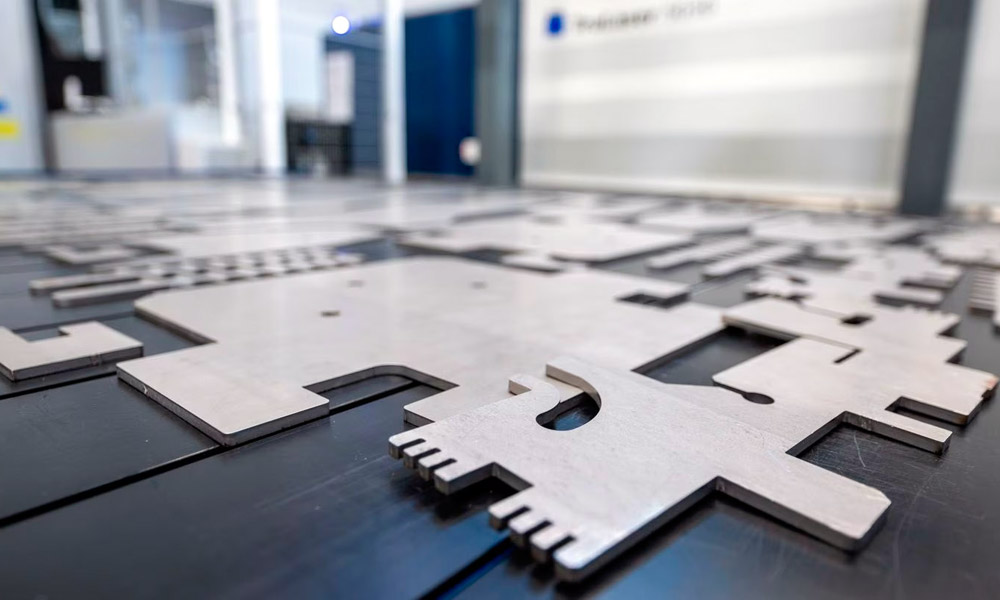
With the acquisition of Cutlite, Trumpf is expanding its portfolio in 2D laser cutting and tube processing. Credit: Trumpf.
German high-tech and industrial laser systems developer Trumpf has completed the acquisition of the business of Cutlite Penta S.p.A. from its parent company, the Italian firm El.En. S.p.A. With the closing of the transaction, Cutlite becomes part of the Trumpf Group. The Cutlite brand will remain in place.
Cutlite develops and manufactures customized, large-format laser cutting systems and machines for large-format tubes. These include systems with laser powers ranging from 30 to 60 kilowatts.
Trumpf stated that it intends to further develop Cutlite’s expertise in a targeted manner and expand its offerings for customers in the sheet metal processing industry. The plan is to integrate Cutlite solutions more closely with Trumpf lasers and the Group’s global supply chain. Trumpf also aims to further expand and improve its service offerings. Its goal is to combine European manufacturing quality with the Group’s technological expertise and international network.
Cutlite customers will retain access to their familiar products and services and will be able to benefit in the long term from the wider ecosystem – the intelligent interplay of machines, software, and services. Trumpf customers will gain additional options for customized, large-format cutting applications.
Cutlite’s Prato site, in Italy, with approximately 190 employees including production staff, as well as the existing product portfolio, will continue to operate stated Trumpf.
 Trumpf accelerates welding rate of thick steel components
In related news, Trumpf, in collaboration with research partners from RWTH Aachen University, has set a new world record in laser-based deep welding. Using a high-power laser, the team succeeded in joining steel to a depth of 14 cm. (5.51 in.) in a single welding operation. Until now, comparable laser processes had only achieved welding depths of 6 cm (2.36 in).
The new process, known as laser welding in a vacuum (LaVa), can significantly speed up the production of large steel and aluminum structures, such as those used in wind turbines or shipbuilding.
“With this record, we are demonstrating that the boundaries of industrial laser welding can be significantly pushed,” said Simon Olschok, who is responsible for the deep welding experiments at RWTH Aachen University. The experiments are based on a 50kW high-power laser from Trumpf. “What still requires many individual weld passes today could be achieved in significantly fewer steps in the future.”
“Welding often dictates the pace of the entire manufacturing process today. If we drastically reduce the number of weld passes, manufacturers gain valuable time and increase productivity,” said Business Development Manager Marc Hummel, who is responsible for applications involving high-power lasers.
Until now, manufacturers often had to produce thick-walled steel components using many individual weld passes, building up the weld seam layer by layer – a process that is both expensive and time-consuming. The new laser process significantly reduces the number of weld passes required.
“For us, the world record is not an end in itself. What matters is the benefit to the industry. If users can manufacture thick steel components with significantly fewer weld passes in the future, they will save energy, time, and costs while increasing their productivity. This is precisely where the potential of this technology lies,” said Hummel.
The record was achieved using a 50-kW laser. Thanks to the BrightLine Weld beam shaping technology, users can precisely distribute the energy in the laser beam, making the welding process more stable and precise. Under reduced ambient pressure (50 mbar), the laser beam was also able to penetrate significantly deeper into the material than under normal pressure. Unlike electron beam welding, however, no technically complex high vacuum is required. This makes the process more attractive for industrial applications.
“With increasing laser power, we expect further advances in deep welding. The experiments are already demonstrating the potential that modern high-power lasers, in combination with beam shaping, open up for industrial manufacturing,” added RWTH Aachen University’s Olschok.
Holes convert silicon wafers into flat ultraviolet-focusing mirrors
November 09 2026

SPIE names 2027 Prism Awards finalists for best photonics products
November 05 2026
AI-driven sales boom continues at Coherent
November 05 2026
Varifocal display smooths user experience of VR
November 05 2026

