



SPIE Sensors + Imaging talks focus on space, earth observation, drones
Photonics is at the heart of ESA missions, explaining earthquakes, and tackling the latest military scourges.
By By Matthew Peach in Edinburgh 15 September 2026
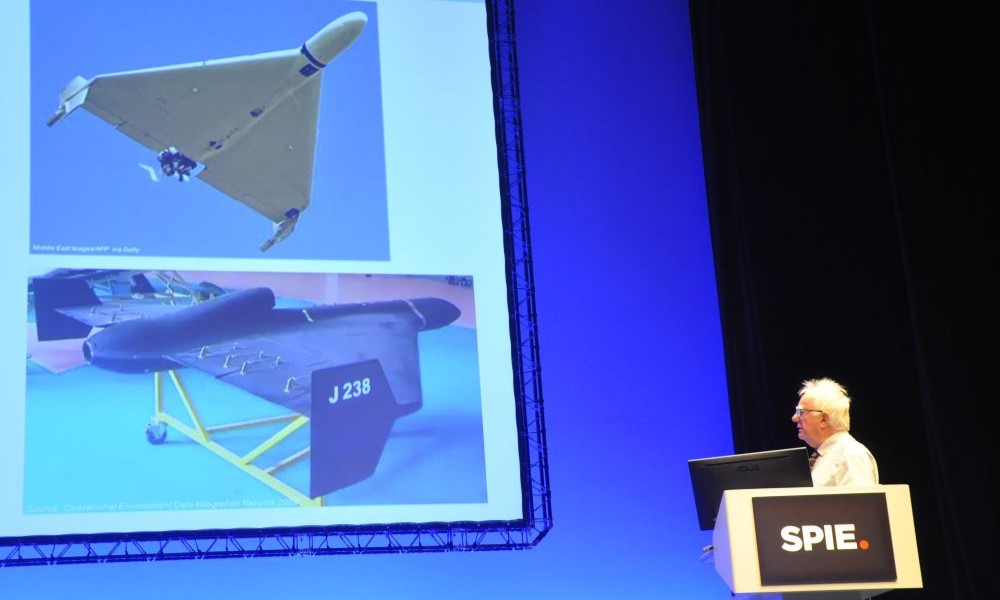
Roy Bookham gives his ESI 2026 plenary talk, entitled “Detection, tracking, and Identification of Uncrewed Systems”. Photo: Matthew Peach, optics.org.
Session Chairs Chantal Andraud (Ecole Normale Supérieure de Lyon) and Thilo Erbertseder (Deutsches Zentrum für Luft und Raumfahrt) presented the “award for significant contribution” to Thomas Luhmann (of Jade University, Germany), alongside Stuart Robson, Stephen Kyle, and Jan Boehm (all UCL, London).
 Space optics plenary
A review of space optics projects led by the European Space Agency was delivered by Kyriaki Minoglou, head of the Optics, Robotics and Life Sciences Division, at ESA, and based in The Netherlands. She has more than 20 years of experience in space imaging systems.
She said that “space optics stands at the very core of Europe’s most ambitious space endeavors, serving as the enabling technological foundation for next-generation Earth observation, deep-space exploration, and secure navigation.” She gave a comprehensive overview of ESA’s latest optical mission portfolio, technology development roadmaps, and recent highlights. These included the sub-millimeter precision required for gravitational wave detection to the high-throughput demands of global optical communication networks. She said, “ESA continues to push the boundaries of what is scientifically and structurally possible in optoelectronics, imaging sensors, and complex payload instrumentation.”
Her presentation also addressed how ESA’s optical roadmap supports the broader strategic requirements of security and defense, including an overview of dual-use technology developments aimed at enhancing European resilience, protecting critical infrastructure, and ensuring technological sovereignty. “By linking civil innovation with strategic readiness, ESA's investments in optical capabilities continue to safeguard and advance Europe's position in space,” said Dr. Minoglou.
 Monitoring Earth by satellite
Neatly following the ESA space optics projects review, Prof. Tim Wright, of the University of Leeds, NERC COMET, and SatSense Ltd. (UK), gave his plenary on satellite radar interferometry — of Earth. Wright is Professor of Satellite Geodesy at Leeds, where he works in the School of Earth and Environment, and is co-Director of NERC COMET, the UK Natural Environment Research Council’s Centre for the Observation and Modelling of Earthquakes, Volcanoes and Tectonics.
Prof. Wright’s research has been at the forefront of developing satellite radar interferometry (“InSAR”) to measure deformation associated with earthquakes, volcanoes, tectonic strain, landslides, and subsidence, helping to transform the way scientists monitor hazardous processes from space. InSAR is transforming our ability to detect and monitor subtle ground and structural motion over remarkably different scales, from individual assets to entire tectonic plate boundaries,” he said. “Open-access satellite missions, from Sentinel-1 to NISAR, are now making routine, high-resolution deformation monitoring possible over our entire planet.”
Frequently illustrated by dramatic videos showing landslips and earthquakes, taken from CCTV in fault zones, were examples of related satellite-collected data sets showing surface and sub-surface movements of landforms, spanning landslides and volcanic unrest worldwide, including notable recent examples such as in the Tibetan Plateau and Myanmar, both in 2025.
He also discussed how radar wavelength, resolution, and revisit time determine what can be measured and where. Prof. Wright concluded by looking ahead to what he described as “a rapidly expanding satellite ecosystem, including publicly and privately funded missions, and what these developments mean for our ability to live safely on our hazardous planet.”
Detecting and identifying drones
Next up, Roy Bookham, recently retired from C-UAS (“counter-drones”) Platforms Division, DSTL, UK, gave his plenary talk entitled “Detection, tracking, and Identification of Unmanned Aerial Systems” (aka drones).
Bookham is a former Royal Air Force Aero systems Engineering Officer who served for more than 30 years on front line Fast Jet and Helicopter Squadrons and on research and demonstration projects in the UK and overseas. On leaving the RAF in 2001, Roy joined the UK Defence Science and Technology Laboratory as a Team Leader in the Air and Weapons Systems Department at Farnborough, UK. He explained: “The UAS threat is widespread, rapidly evolving, and increasingly sophisticated with modified commercial and military drones being used in a range of mixed attack vectors, often at low cost and in large numbers, in contested environments.”
He also noted that advances in UAS technology are making these threats harder to sense and identify with current generation systems whilst rapid adaptation cycles and the proliferation of cheap threats raise concerns for both battlefield and domestic security. “The counter-UAS detection capability needs to keep pace and needs to be able to work against modern threats and in complex environments; significant innovation is currently underway, with a key challenge being to harness and integrate new capabilities in the detection chain.”
Bookham then went on to explain how photonic and other electromagnetic sensing technologies, across different wavebands, could be deployed to counter the challenges posed by drones. He said: “We conventionally rely on a number of sensor options to provide C-UAS DTI (detection – tracking – identifying) elements: radar, electro-optical, infrared, radio frequency, acoustic, and human intelligence. None of these are standalone silver bullets. Whilst they all deliver something to the mix, they all have significant limitations.”
Conclusions
Bookham stressed that, as a recent retiree, he was not speaking as a representative of DSTL nor the UK Ministry of Defence, but his significant experience validates his conclusions. “C-UAS systems must integrate with wider air defense networks and national structures. The electronic warfare environment is now so demanding that active systems will not last long on the modern battlefield. RF detection is still useful for some drones, but it must move with the times and new data link technology. Positive visual identification is still required in many cases; could this be improved with Al?” he asked.
“Increased automation brings a host of moral and ethical questions that will need to be addressed [and] C-UAS detection capability and acquisition needs to keep pace with rapid threat adaptation cycles and the mass proliferation of cheap threats.”
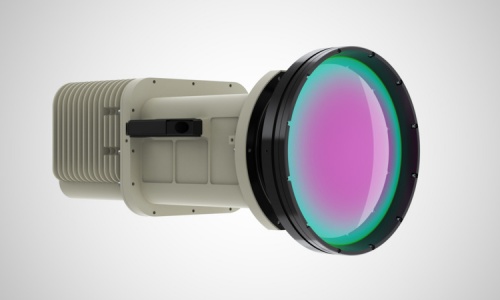
MKS sells Ophir Optics division to PCB maker TTM for $650M
October 22 2026
Photon Bridge lands €10M to scale lasers for data centers
October 21 2026