



SPIE Optical Systems Lab part of new Sydor Optics Advanced Technology Center
New York's Monroe Community College reflects on “ripple effect” of $150,000 SPIE investment.
22 September 2026
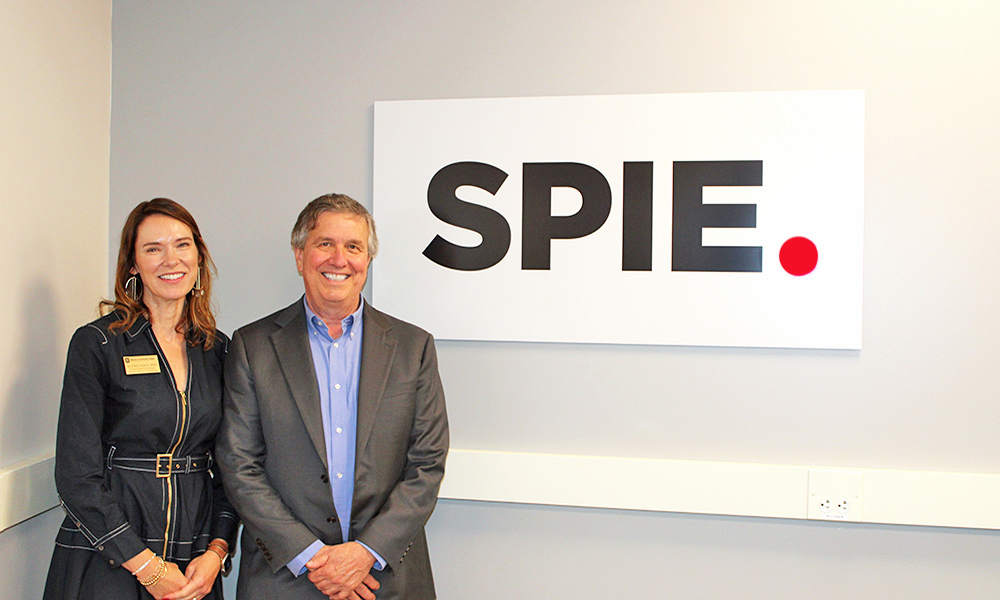
Prof. Alexis Vogt with SPIE CEO Kent Rochford in the Sydor Optics Advanced Technology Center at Monroe Community College. Photo: SPIE.
Monroe Community College (MCC) in Rochester, New York, had already left a lasting mark in the optics industry when they became the first institution of its kind to award associate degrees in optical systems technology. Now, the MCC has marked a major milestone in workforce development by building the Sydor Optics Advanced Technology Center (ATC), a state-of-the-art facility that includes the SPIE Optical Systems Lab.
In an effort to build robust technician-training opportunities by partnering with institutes and organizations, SPIE invested $150,000 in the lab. With its ribbon-cutting ceremony held on 14 September, the ATC and SPIE Optical Systems Lab is ready to provide students with hands-on opportunities to learn and train for future careers as optic technicians, a field currently facing a shortage in skilled workers.
“I see the SPIE Optical Systems Lab as a catalyst for solving that shortage,” commented Alexis Vogt, professor and endowed chair of Optical Systems Technology at Monroe Community College and an SPIE Fellow and Board Member. “I envision our graduates going on to develop the next generation of medical devices that detect cancer earlier and save lives, defense systems that protect our troops, and telecommunications infrastructure that finally connects underserved communities.”
Excitement building
The excitement around the Sydor Optics Advanced Technology Center builds daily. The new facility has caught the attention of industry partners who have reached out to donate equipment, send adjuncts to teach courses, and even discuss hiring opportunities after graduation. Vogt and her colleagues have also seen a noticeable increase in interest from prospective and current students alike, including some who hadn’t previously shown curiosity in the field.
“When students see a state-of-the-art facility built for them, it sends a powerful message: optics is a field with a future and Monroe Community College is serious about preparing them for it,” said Vogt.
In October 2025, MCC sent students in the optical systems technology program to SPIE Optifab to experience the scale of the global optics industry. Students were able to see more than 170 exhibitors, talk with experts, and be directly involved in the larger optics community.
“The students came back from that experience energized,” said Vogt. “When we announced the SPIE Optical Systems Lab, they did not need an introduction to the name on the lab. They knew exactly what it meant. Seeing SPIE’s investment in their education is deeply affirming. It tells them that the world’s premier optics society believes in you and in this field.”
The Sydor Optics ATC and SPIE Optical Systems Lab roughly doubles the capacity of MCC to train optics technicians. Over the past decade, the program has grown from only five students to more than 150, with the number of labs increasing throughout the years. The new facility will be critical to meeting both regional and national workforce needs, allowing MCC to serve a broader and more diverse student population.
Committed to building a more inclusive and representative optics workforce, MCC partners with 23 dual enrollment schools across the region, allowing area high school students to earn college credits. Vogt and her team also actively recruit in communities of color and work with organizations that serve diverse student populations to ensure scholarships and apprenticeship opportunities reach the students who need them most. Through intentional outreach and mentorship for girls, they have grown their female enrollment by 25%.
‘Measurable results’
Vogt added, “the results are measurable. Today, 37% of our students are students of color, and we continue to push that number higher. First-generation college students are well represented in our cohorts, and once students enter the program, we see strong retention and job placement outcomes across all demographics.”
The Sydor Optics ATC and SPIE Optical Systems Lab will strengthen these outreach and retention efforts. Vogt says that the new structure and equipment are the “ultimate infrastructure leap” that MCC has been working toward over the last ten years.
“A flagship facility sends an unmistakable signal to every student,” she said. “Regardless of your background, there is a place for you in precision optics, and that place looks like this.”

MetaOptics looks to expand US production with $10M warrant deal
September 22 2026

Attalon invests $15M in high-energy laser capacity
September 16 2026

ams Osram unveils imaging-to-display sensor for smart phones
September 16 2026

Spectroscopy can enable earlier detection of pelvic organ prolapse
September 16 2026

AI-guided laser carves pyramids to give robots ‘gentler’ grasp
September 16 2026