


SPIE Astro 2026 plenaries: from infrared opportunities to instrument innovations
Opening talks by Caltech’s Mansi Kasliwal and DTU’s John Leif Jørgensen enthrall.
By By Matthew Peach in Copenhagen 07 July 2026
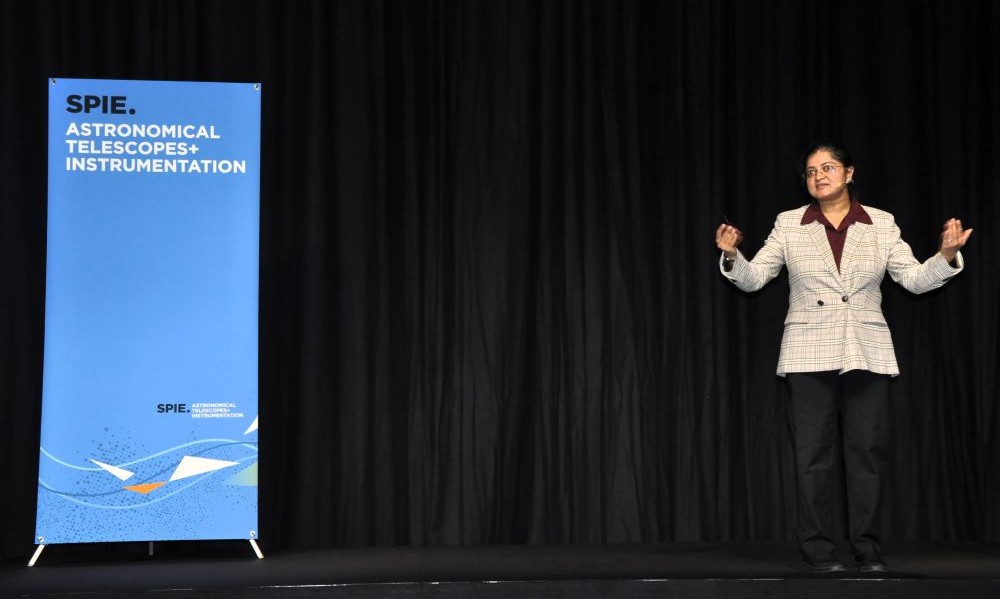
Mansi Kasliwal, a Professor of Astronomy at Caltech as well as Director of the Palomar Observatory. She noted: “Many astronomical events shine the brightest in the infrared range.” Photo: Matthew Peach, optics.org.
The plenary sessions at SPIE Astronomical Telescopes + Instrumentation 2026 opened on Monday, following a joint welcome to the conference at the Bella Center in Copenhagen, Denmark by Desirée Della Monica Ferreira, of DTU Space (Denmark), and Anna Moore of The Australian National University.
Ferreira reminded attendees of some of the city’s significant astronomical breakthroughs achieved just a few kilometers from the venue: Tycho Brahe, a Danish astronomer working in the sixteenth century became famous for his accurate astronomical observations that were foundational to the modern science; and, a century later, fellow astronomer Ole Rømer became head of the Observatory on the city’s Round Tower, one of the first such in Europe.
The first plenary speaker was Prof. Mansi Kasliwal from California Institute of Technology, whose talk was entitled “Unveiling Our Dynamic Infrared Sky with Roman RAPID and Cryoscope”. Kasliwal is a Professor of Astronomy at “Caltech” as well as Director of the Palomar Observatory. She is a recognized world expert in time-domain astronomy and multi-messenger astrophysics.
She said, “Many astronomical events shine the brightest in the infrared range due to atomic opacity, self enshrouding, dust extinction, or low temperature. When we saw the first electromagnetic counterpart to gravitational waves from a neutron star merger, it was the rapid reddening and IR spectral features that confirmed the synthesis of heavy elements by the r-process.
“Neutron star black hole mergers may shine brightest in the infrared range,” she added. “Stellar mergers, planet-star engulfments and mass-losing stars are also extremely red due to self obscuration.”
But Kasliwal pointed out that the IR time-domain is “hitherto largely unexplored”. She therefore presented a status update on the Nancy Grace Roman Space Telescope scheduled to launch in Fall 2026. She also described the associated RAPID project, standing for Roman Alerts Promptly from Image Differencing — a project infrastructure team she leads that is committed to enabling time-domain astronomy with Roman. She also presented details of her group’s plans for an “IR dream machine” to leverage two breakthrough technologies: Cryoscope in Antarctica.
She concluded with a summary of the further potential for infrared exploration of space and her group’s various projects: “Our dynamic sky is now wide open for exploration and unveiling fun, unique transients; Roman will be exciting and RAPID will help find the highest redshift supernovae, mergers and solve the cosmic dust budget; the ZShooter on Keck will deliver timely and sensitive spectroscopy across 0.3 to 2.5 micron range; and finally the Crysoscope will be the ultimate dream machine to explore our dynamic infrared sky — including kilonovae from neutron star black hole mergers.”
 Life on Mars?
The second plenary talk — entitled “PIXL, the Perseverance Autonomous XRF Instrument Suite” — was given by Prof. John Leif Jørgensen of the Technical University of Denmark (“DTU”), just north of Copenhagen. Jørgensen is Professor of spacecraft technology at DTU-Space since 2005, and head of the Measurement and Instrumentation Section since 2000.
He has developed several measurement systems for spacecraft, now in widespread use worldwide. His research, focused on electro-optical systems, and uses onboard spacecraft, targets the increased value of space missions through increased robustness, autonomy and accuracy.
Having delivered instruments for more than 140 international spacecraft, he is presently Co-investigator on several spacecraft, including PIXL o-n Perseverance and the MAG on NASAs Jupiter probe Juno.
He said, “PIXL, the Perseverance autonomous X-Ray fluorescence microscope, is optimized to perform mineralogy of rocks down to the grain size, including compositions and morphology. Mounted on the boom-tip of the robotic arm, operating in unknown terrain, at rough surfaces, the instrument is highly autonomous.
“One of the key tasks of Perseverance, to detect and map areas of potential habitability of the Martian distant past, necessitated a specialized instrument portfolio,” he said.
“Another objective is to map the evolution path from an ancient wet mild climate to the present-day desert planet conditions. PIXL is the first instrument of its class to Mars, and has made several surprising observations, from igneous rock formation to reaction fronts closely resembling Earthly formations altered by paleo-bacterial life.”
Leica and Cognex launch AI software module Aivaro to improve inspection
September 30 2026

Photonic monitoring to identify food safety, quality, and animal welfare
September 30 2026
Advances in optics and computation boost coronary intravascular imaging
September 30 2026
Australia’s SKA tests antenna layout for Low telescope
September 30 2026