



Source Energy and Fraunhofer ISE create cheaper power source for satellites
Silicon PV to make power generation in space more cost-effective, say the developers.
11 August 2026
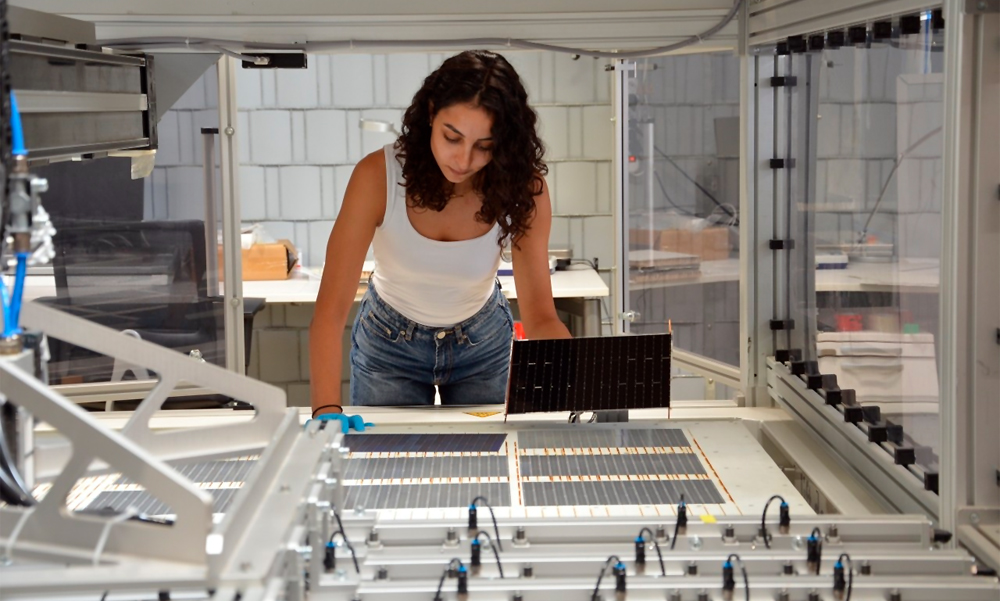
Najwa Abdel Latif, project manager at Fraunhofer ISE, inspects the interconnected solar cells on Fraunhofer ISE’s shingle-matrix stringer. © Fraunhofer ISE / Photo: Sophia Baechle.
U.S. company Source Energy and the Fraunhofer Institute for Solar Energy Systems (ISE) have jointly developed a new power source range for space satellites based on silicon solar cells. The solar arrays are using a special interconnection technology.
Combined with inexpensive silicon solar cells, the system enables modules at much lower costs compared to standard “III-V” semiconductor technology that currently dominates the space sector. The automated production process, utilizing the M10 Solar Equipment’s Shingle-Matrix Stringer, allows Source Energy to delivery their products in under six months from time of order.
“Together with Source Energy, we have developed silicon-based solar modules for space applications, similar to those already in successful and cost-effective use on Earth,” said Dr. Achim Kraft, head of the PV Module Technologies department at ISE.
The resulting solar modules are compact and lightweight: 64 grams and 629 cm2, (321 by 209 mm). The average power output of the prototypes was 15.6 watts – with modules achieving 16.1 watts – and an average active area efficiency of 18.8 percent (AM0 at 25°C). At 252 watts per kilogram, the module’s specific power is competitive with other silicon modules in its class.
Shingle-matrix technology
The silicon solar cells are interconnected using shingle-matrix technology, where individual solar cells are cut into strips and arranged with certain overlap and spacing relative to one another, like brickwork. An electrically conductive adhesive bonds the solar cells together.
 The machine manufacturer M10 Solar Equipment has developed an industrial stringer for shingle-matrix technology. Following a successful prototyping phase at the Module-TEC facility at ISE in Freiburg, Source Energy installed the system at its own manufacturing facility in Colorado in June 2026.
“As the heart of our production, it enables us to manufacture PV panels for less than $5 per watt,” said Bryan Mazor, CTO at Source Energy. “The automated manufacturing process not only makes us more cost-effective but also significantly faster than is currently the case with III-V PV products for space.”
“Three features make the shingle-matrix interconnection perfect for space,” said Najwa Abdel Latif, project manager at ISE. “Resilience to localized physical damage from impacts by small objects in space, flexibility in layout, and tolerance to extreme temperature differences.”
If the solar panel is damaged – for example, by a small meteorite or space debris – the matrix arrangement of the solar cells allows the current to simply flow around the damaged area. At the same time, the rows and columns of solar cells in the layout can be flexibly adjusted depending on the satellite’s voltage and current requirements.
“The shingle-matrix technology is compatible with wafer-based solar cells featuring front and back contacts, such as PERC or silicon heterojunction, without having to adapt the production line,” said Abdel Latif.

MetaOptics looks to expand US production with $10M warrant deal
September 22 2026

Attalon invests $15M in high-energy laser capacity
September 16 2026

ams Osram unveils imaging-to-display sensor for smart phones
September 16 2026

Spectroscopy can enable earlier detection of pelvic organ prolapse
September 16 2026