


RTX’s Raytheon to develop new optical signal process for defense...
...and Leonardo to produce lightweight photonics-based system to protect military aircraft.
16 November 2026

Raytheon has won a contract from DARPA to develop an all-optical processing system for the PICASSO program. Image: RTX.
Raytheon, a U.S. based developer of military-focused technologies, has been awarded a “phase one” contract from the U.S. Defense Advanced Research Projects Agency (DARPA) to develop an all-optical processing system for the Photonic Integrated Circuit Architectures for Scalable System Objectives, or PICASSO, program.
Under the contract, Raytheon’s Advanced Technology team will design and demonstrate new photonic circuit technology that uses light rather than electricity to process signals. This means operators can detect threats sooner, respond more quickly and maintain better situational awareness in contested environments.
“This program recognizes a fundamental shift in how processing can be achieved,” said Colin Whelan, president of Advanced Technology at Raytheon. “By moving critical processing entirely into the optical domain, we can enable significantly faster response times for a broad range of applications.”
Modern photonic circuits require converting optical signals back into electrical signals to refine and process data. By removing that conversion step, all-optical processing maintains signal strength and integrity, even as circuits scale dramatically smaller in size and higher in complexity.
Raytheon said it will build on its experience in photonics process development, radio frequency design and fielded military solutions to accelerate the maturation of all-optical processing techniques for the PICASSO program. It is collaborating with commercial industry partner Synopsys, headquartered in Sunnyvale, CA, which will provide design and simulation tools to support development.
Raytheon added that it is currently “actively hiring to support critical military programs across domains.”
 Leonardo to produce lightweight system to protect military aircraft
The U.S. Naval Air Systems Command (NAVAIR) has awarded Leonardo DRS (“DRS”) a three-year indefinite-delivery/indefinite-quantity (IDIQ) contract for low-rate initial production of the AN/AAQ-45 Distributed Aperture Infrared Countermeasure, or DAIRCM, aircraft survivability system. Financial terms were not disclosed.
The DRS DAIRCM system is described as “a combat-proven lightweight aircraft survivability suite designed for small- and medium-sized aircraft with demanding size, weight and integration requirements.”
The integrated modular system combines advanced missile warning, directed infrared countermeasures, laser warning and hostile-fire indication to help protect aircraft and crews from surface-to-air threats in contested environments.
Under the contract, DRS will provide hardware production, aircraft integration, systems engineering, program management and associated logistics support. DAIRCM hardware will be manufactured at DRS’ facilities in Dallas, Texas, and San Diego, California. Aircraft-integration and logistics activities will be conducted from the company’s Fort Walton Beach, Florida site.
To date, DAIRCM has been deployed on aircraft operating under a Joint Urgent Operational Need Statement. The low-rate initial production award follows the program’s Engineering and Manufacturing Development phase, during which DRS incorporated capability and production enhancements into the system configuration.
“This award moves the DRS DAIRCM System into low-rate initial production and expands our ability to provide critical integrated aircraft survivability capabilities to our military customers,” said John Baylouny, president and chief executive officer of DRS.
For more information about DRS aircraft sensing and aircraft survivability technologies, visit Leonardo DRS Aircraft Sensing.


Photonics business round-up 12 November 2026
November 12 2026
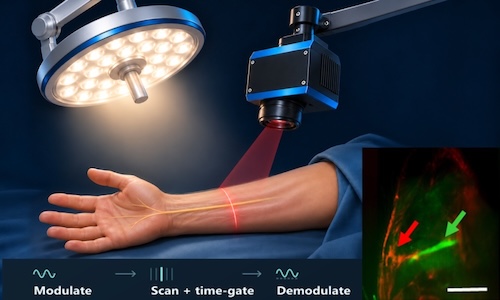
Physical Sciences Inc helps surgeons identify nerves during surgery
November 12 2026
Optics11 secures €50M for expansion
November 11 2026