Rice University AI-powered imaging probe detects hallmarks of cancer
Device suggests the potential of computational endomicroscopy for cancer diagnosis.
13 May 2026

A project team from Rice University and the University of Texas MD Anderson Cancer Center has developed a compact artificial intelligence-powered imaging device that the researchers believe could transform how clinicians detect cancer
The platform, called PrecisionView and described in PNAS, is a handheld endomicroscope that "overcomes limitations in medical imaging by combining advanced optics with deep learning," said the project. The system enables clinicians to visualize both subcellular structures and underlying blood vessels across large tissue areas without the need for invasive biopsies.
PrecisionView has been designed to tackle the limitations of in vivo microscopy (IVM) as a technique for early detection of epithelial cancers, where the morphological hallmarks of the disease can provide predictive evidence of illness.
"Clinical translation of in vivo microscopy is hindered by fundamental limitations of conventional optics," wrote the project in its paper. "The field-of-view of current IVM is too small relative to typical size of suspicious lesions. Another challenge is that the depth-of-field of current systems is inherently coupled to the numerical aperture and therefore spatial resolution."
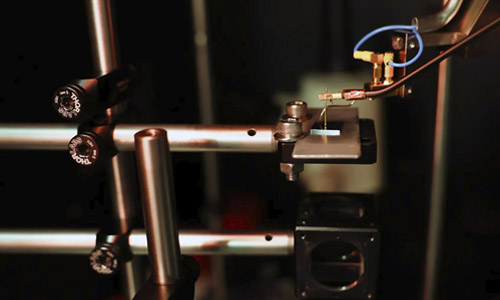
The optical elements of PrecisionView include 14 optical fibers symmetrically positioned around the lens housing providing illumination from blue and green LEDs. Paired with appropriate filters and combined via a dichroic mirror, the set-up enables rapid switching between blue and green illumination for fluorescence and reflectance imaging.
Computational analysis of the optical data is handled by a deep learning framework optimized to incorporate dual-modality fluorescence and reflectance imaging, along with image deconvolution and deblurring to restore fine image details.
Diagnosis at the point of care
The device can generate detailed maps of tissue areas spanning several square centimeters and display results in real time at up to 15 frames per second, visualizing two critical hallmarks of cancer: cellular changes in epithelial tissue and microvascular patterns beneath the surface.
"By integrating deep learning, end-to-end optimization and simple off-the-shelf optics, PrecisionView achieves approximately a fivefold increase in field-of-view and eightfold improvement in depth-of-field compared to conventional IVM systems of similar resolution," wrote the project.
In tests on samples of healthy tissue and precancerous lesions, the device was used to scan the oral cavity of volunteers and produce high-resolution maps of tissue structure and blood vessels. In a further trial, it successfully identified precancerous changes in cervical tissue, clearly distinguishing abnormal regions from surrounding healthy tissue.
"Traditionally, machine learning and artificial intelligence tools are used to enhance images in terms of resolution or contrast, after the images have been acquired by conventional imaging systems," commented Ashok Veeraraghavan from Rice University. "In stark contrast, this work utilizes AI approaches to redesign the optics of a microscope. The AI-designed optics not just improves resolution/contrast but breaks the conventional trade-off between depth of field and resolution."
Rice University believes PrecisionView has the potential to bring high-quality diagnostic capability directly to the point of care, particularly in medically underserved areas where access to pathology services may be limited or delayed, leading to missed or late diagnoses.
"Early detection is one of the most critical factors in improving cancer outcomes, but today’s tools often force clinicians to choose between detail and coverage," said Rice's Rebecca Richards-Kortum. "With PrecisionView we no longer have to make that trade-off."
Rice University smartphone imaging spots oral cancer rapidly
October 20 2025
Mount Sinai AI improves analysis of cancer tissues
August 27 2025


RTX’s Raytheon to develop new optical signal process for defense...
November 16 2026

Photonics business round-up 12 November 2026
November 12 2026
Physical Sciences Inc helps surgeons identify nerves during surgery
November 12 2026