


Q-Factor grabs $24M to kick-start development of million-qubit quantum computer
Tel Aviv startup looking to commercialize Weizmann Institute quantum optics and laser research.
09 April 2026
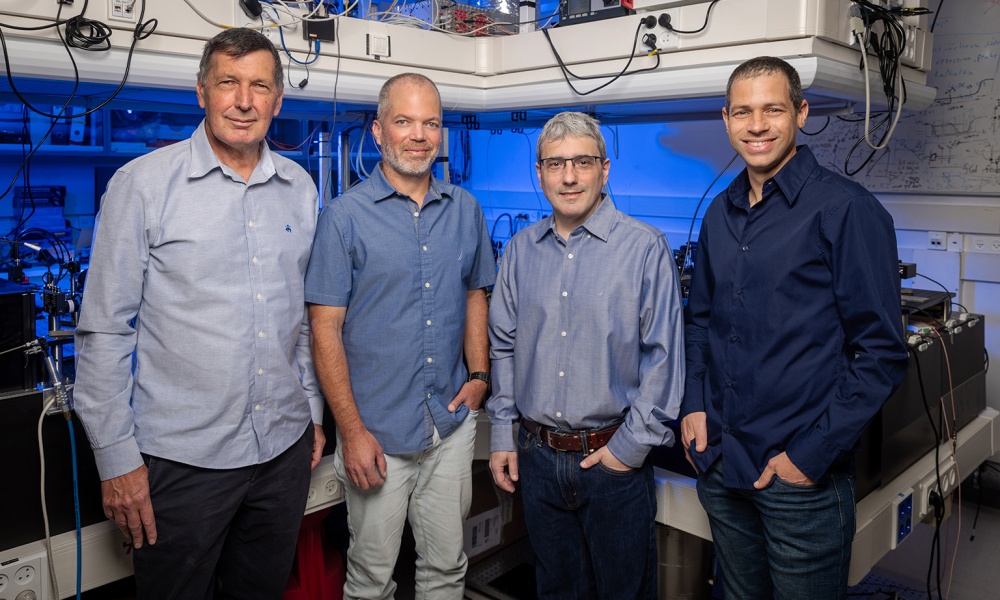
Q-Factor founders (l-r): scientific strategist Nir Davidson; CEO/CTO Guy Raz, CSO Yoav Sagi; and chief scientist Ofer Firstenberg. Photo: Intel Capital.
Intel Capital is among the backers of Israeli quantum computing startup Q-Factor, which has just raised $24 million of seed funding in pursuit of a million-qubit system based around cooled neutral atoms.
Co-founded by four researchers at Tel Aviv’s Weizmann Institute and Technion facilities, Q-Factor’s approach relies heavily on quantum optics and advanced laser techniques and the company is currently looking to hire electro-optical engineers to design and integrate the laser and optical systems at the heart of the platform.
“Neutral atoms have rapidly emerged as one of the most promising approaches to quantum computing,” stated the startup. “They are naturally inert, capable of holding quantum information for extended periods, yet precisely controllable using light alone, without the need for extreme cooling or complex wiring.
“However, current quantum computers across all modalities remain too small by orders of magnitude to deliver real commercial value. Breaking past a few thousand qubits to the hundreds of thousands or millions required for useful computation demands not incremental improvement, but a fundamental architectural leap.”
‘Revolution not evolution’
Q-Factor was founded by physicists Nir Davidson, Ofer Firstenberg, Yoav Sagi, and Guy Raza, with chief scientist Firstenberg saying in a release announcing the firm’s emergence from stealth mode that the nascent quantum computing industry was in need of a revolution.
“Current systems are too small to deliver on the promise of quantum computing, and incremental improvements alone aren't going to close that gap,” he remarked.
“We've developed an architecture designed for continuous scalability, a Moore's law-like trajectory that can take neutral atom systems from thousands of qubits to millions and beyond.”
That plan has won backing from NFX and TPY Capital, who co-led the seed funding alongside participation from Intel Capital, Korea Investment Partners, Deep33, and the Matias family, while the Israel Innovation Authority has provided grant funding.
“Neutral atoms are emerging as the leading modality for scalable quantum computing, and Q-Factor is entering the race with a distinct architectural advantage,” said Dekel Persi, Partner at TPY Capital.
“TPY has been investing in quantum computing for seven years and has evaluated dozens of companies across modalities and geographies. What the Q-Factor team achieved stood out immediately. Their architectural approach to scale made this a clear must-do for us.”
Intel Capital’s investment director Lisa Cohen added: “Q-Factor's founding team combines world-class scientific depth with a clear-eyed understanding of what it will take to build a commercially viable quantum computer.
“They've watched the field evolve, learned from the challenges others have encountered, and assembled the right expertise to tackle the hardest remaining problem in quantum computing: scale.”

Multi-spot OCT tracks cornea deformations
July 29 2026

Gooch & Housego poised for private equity buyout
July 29 2026