PsiQuantum launches optical circuit switch based on silicon photonics
With losses as low as 1 dB, the 8×8 platform is suitable for AI infrastructure.
03 November 2026
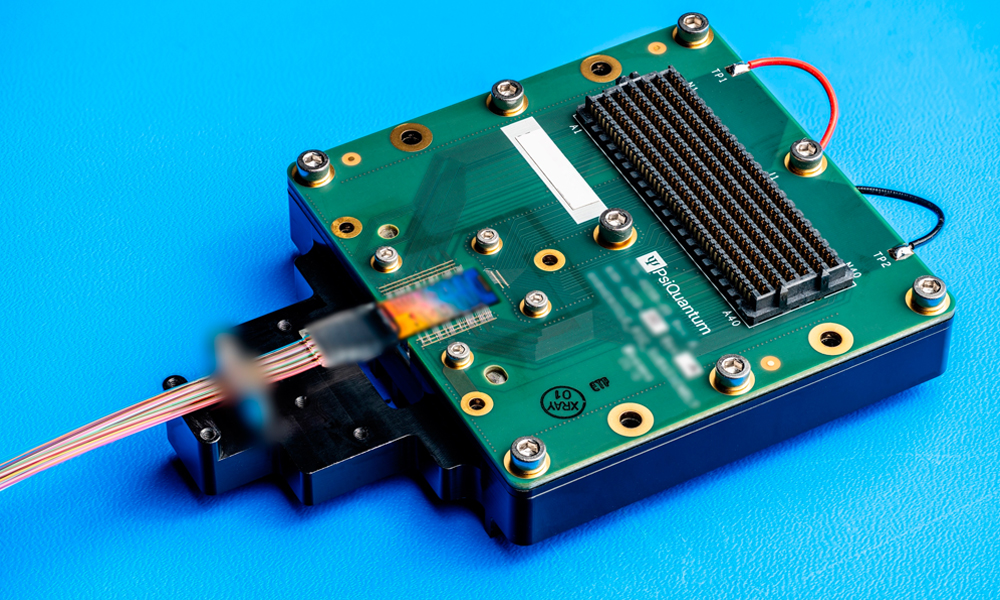
An 8×8-radix demonstration vehicle built on a low-loss, silicon photonics platform. Credit: PsiQuantum.
Quantum computing company PsiQuantum, based in Palo Alto, California, which is developing quantum computers based on silicon photonics, has launched its Optical Circuit Switching (OCS) technology. This is said to demonstrate how the company’s a low-loss silicon photonics platform can be applied to some of the most significant scaling challenges facing AI infrastructure.
AI systems are said to be scaling faster than computing infrastructure, with increasingly large pools of compute placing enormous demands on the networks connecting them. As moving data efficiently between these systems becomes a fundamental constraint for continued AI scaling, the computing industry is increasingly turning to optics to provide faster, more efficient, and scalable connectivity.
PsiQuantum’s first released OCS is an 8 × 8-radix demonstration vehicle based on the low-loss, silicon photonics platform that the company has spent nearly a decade developing for utility-scale quantum computing. Testing conducted in PsiQuantum’s labs has shown typical results of 1.2 dB of insertion loss, 40 dB cross talk, and less than 3 ms of reconfiguration time, all exceeding initial targets set for these devices and without amplification.
The company is now sharing samples of its demonstration vehicle with select prospective customers and advancing the platform toward commercial products that will be announced in the coming months.
PsiQuantum stated that it has pursued performance requirements for fault-tolerant quantum computing that exceed many of those required for optical switching in AI data centers. AI and quantum computing are complementary technologies: more efficient AI infrastructure can accelerate the development and operation of quantum systems, while some advances made for quantum computing can help remove bottlenecks in AI infrastructure. As optics make AI infrastructure more efficient, stronger AI infrastructure can in turn support the design, control, and operation of increasingly capable quantum systems.
“This opportunity exists because we chose to solve the hardest scaling problems at the beginning of our roadmap to utility-scale quantum computing,” said Victor Peng, Chief Executive Officer of PsiQuantum. “As AI computing pushes infrastructure to its limits, we now have an opportunity to put our state-of-the-art technology to work today while continuing toward our ultimate goal: building and deploying the world's first useful, fault-tolerant quantum computers.”
Growth sector
Rob Soderbery, Executive Vice President, added, “AI is driving extraordinary growth in the scale and complexity of computing infrastructure, and optics will play an increasingly important role in enabling that growth. We have spent nearly a decade developing silicon photonics against some of the most demanding requirements imaginable. What we are demonstrating today is that this platform can deliver exceptional performance for optical circuit switching for AI computing.”
PsiQuantum has also developed barium titanate (BTO) integration at the 300mm wafer scale and uses a 64 × 64 BTO switch in its quantum systems. BTO is not required for the demonstration vehicle or initial products announced today, highlighting the performance of the underlying silicon photonics platform while preserving an additional path to faster, more advanced future products.
The announcement comes amid growing recognition of the transformative potential of PsiQuantum’s breakthroughs in high-performance optical switching. In September 2026, PsiQuantum announced that the company had signed definitive documentation with the U.S. Department of Commerce to accelerate the research and development, domestic manufacturability, and performance of its state-of-the-art critical components, including high-performance optical switches.


Europe-Japan group to industrialize flexible perovskite solar cells
November 03 2026

Marvell set to acquire Lumentum in $115BN all-stock deal
November 03 2026

Fiber business powers sharp sales uptick at Corning
October 29 2026