


Penn State mirror development controls light in 3D – to make microscopes smaller
MEMS micromirror can steer laser in two directions while changing mirror shape to refocus light at different depths.
03 September 2026
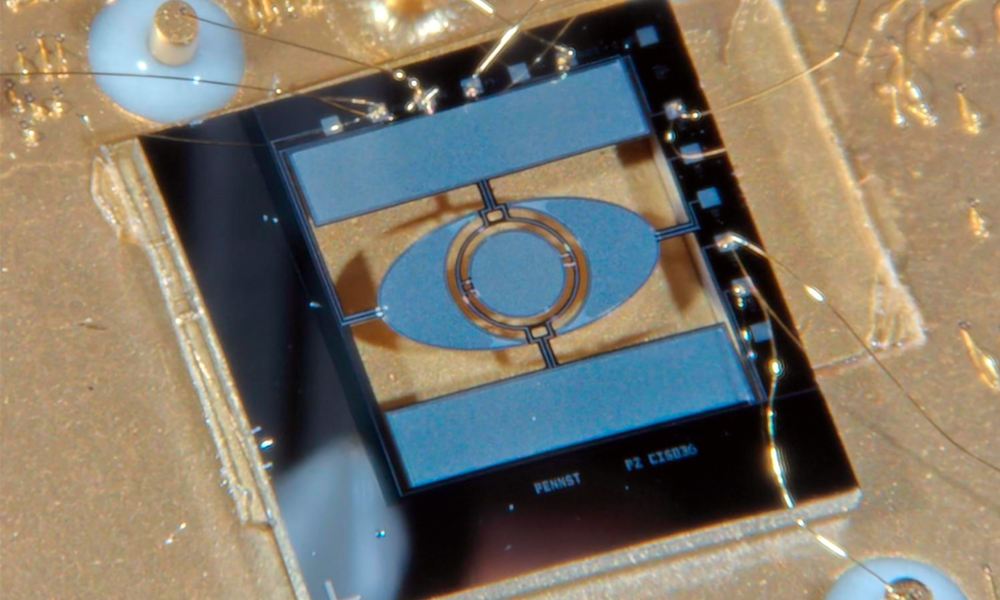
MEMS micromirror steers a laser beam in two directions while also changing the mirror’s shape to refocus light at different depths. Credit: Hunter Shillingburg / Penn State.
Researchers at Penn State University are using tightly-focused laser beams to image biological samples, shape materials with microscopic precision and generate displays. But using those beams in three dimensions requires more than sweeping light from side to side, as the light must also rapidly refocus at different depths.
That often requires separate optical components, one to steer the light and another to change where it comes into focus. So the researchers have developed a state-of-the-art tiny mirror that can do both at record speeds, potentially slimming down and speeding up future optical systems used in brain imaging, augmented reality goggles and precision manufacturing.
“Being able to quickly control light in three dimensions with a single device offers a significant improvement in the overall size and weight of an optical system,” said Hunter Shillingburg, doctoral student in electrical engineering and first author of the accompanying study published in Microsystems & Nanoengineering.
Shillingburg co-authored the study alongside Daniel Lopez, who was affiliated with Penn State’s Department of Electrical Engineering and Computer Science and Materials Research Institute at the time of the research and is currently the chair of the Department of Physics at Arizona State University.
Neuroscience use case
For Shillingburg, one potential application stands out: neuroscience. “Although the fields are all strongly related, I see the most potential being in neurobiology,” he said. “The system could lead to smaller, mountable miniature microscopes for studying neurobiology in active subjects as well as lighter glasses and headsets for augmented reality.”
Faster scanning could have another benefit in biological imaging, Shillingburg said. Sensitive samples can be damaged or fade when exposed to too much light, so reducing exposure time can help researchers image living cells and other biological materials while limiting those effects.
At the heart of the tiny device is a micro-electromechanical system, or MEMS, micromirror. “Like a regular mirror, shining a laser at it causes the beam to reflect off the surface, and the reflected beam spot can be positioned by tilting the mirror back and forth,” said Shillingburg.
The device can tilt in two directions, allowing it to sweep light across an area. Unlike a typical scanning mirror, however, it can also change the shape of its reflective surface—making the mirror flatter or more bowl-shaped—changing where the reflected light comes into focus. By steering light laterally and shifting focal depth at microsecond speeds, the scanner delivers true 3D spatial control of the beam in real time.
 Piezoelectric material
To make the movements possible, the researchers used aluminum nitride, a piezoelectric material that produces a charge when under force. Applying a voltage to thin layers of aluminum nitride makes them flex, which tilts or reshapes the mirror. Tiny structures around the mirror control its tilt, while another piezoelectric layer changes the shape of the mirror itself.
Because the mirror is about one millimeter in size, it responds quickly. The researchers measured the mirror changing its focus within millionths of a second, a speed that could be useful for technologies that need to scan rapidly through three-dimensional space, such as quantum control, structured illumination microscopy and optogenetics.
To demonstrate that capability, the researchers changed the voltage applied to the mirror and shifted the focus of a laser-scanned pattern by 63 mm, quickly bringing the pattern back into sharp focus at the new depth. They also built a simple laser-scanning microscope around the mirror and showed that changing the mirror's shape could change which depth of a test image appeared in focus.
In augmented reality, this ability could help address a different problem. Virtual objects can appear to be near or far away even though a display remains focused at one fixed distance. That mismatch between where the eyes point and where they must focus can contribute to visual fatigue and headaches.
“Fixed focus displays can lead to eye strain largely because the object is generated on a panel,” Shillingburg said. “Many of these devices have adjustable screen distances to better accommodate users with different vision needs.”
Because the micromirror can change where light comes into focus, he said it could eventually help displays make virtual objects at different apparent distances look and feel more natural to the viewer.
The technology could also benefit laser micromachining, a manufacturing process that uses a tightly focused laser as an extremely precise cutting or shaping tool.
The researchers fabricated the mirror using materials compatible with established semiconductor manufacturing processes, which could make it easier to eventually combine compact optical devices with electronics. Further work will include reducing distortions caused by slight asymmetry in the mirror and improving performance for applications that require even faster scanning.
iPronics raises $125 M to scale optical networking for AI data centers
September 03 2026
Nanjing University miniaturizes OCT for imaging within the brain
September 02 2026

Inleap Photonics gets €20M for laser drone defense
September 02 2026

Morgridge Institute reveals inner workings of immune cells
September 02 2026