


Ouster launches REV8 OS Family ‘first’ native color lidar system
Powered by firm’s L4 Max Ouster Silicon, it features first patented native color lidar sensors with point-for-point 3D color vision.
06 May 2026

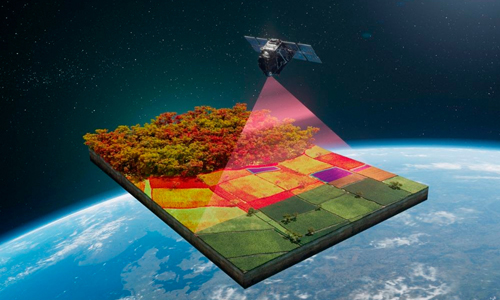
Image generated from Ouster's Rev8 Native Color Lidar system. Image: Ouster.
Ouster, a developer of sensing and perception systems, has announced its new range of OS digital lidar sensors, Rev8, powered by its L4 Ouster Silicon system. Rev8 features what Ouster calls “the world’s first patented native color lidar sensors, providing up to double the range and resolution of Ouster’s previous generation.”
Based on patented Ouster Silicon with embedded Fujifilm color science, the L4 chip results in color data and hardware-enabled HDR. It offers 42.9 GMACs of processing power, detection of up to 20 trillion photons per second and a 40 kHz measurement rate with picosecond timing. The system can process up to 10.4 million points per second and 22.4 gigabits per second of data bandwidth off-chip. The L4 architecture features both the 128 channel L4 and 256 channel L4 Max.
Ouster states that Rev8 “represents a paradigm shift in AI perception with the world’s first native color lidar sensors. To perceive the world in full context requires a combination of structure and color, and Rev8 is the first sensor to unify both. For the first time, a single lidar sensor can understand road signs, interpret brake lights, or simply capture the richness of planet earth in survey-grade, colorized maps.”
The Rev8 sensors are said to “fuse data through physics rather than software”. The single-
REV8 highlights
The Rev8 OS family features redesigned OS0, OS1, and OSDome sensors and adds the flagship 256 channel OS1 Max. The Flagship OS1 Max offers double the range and resolution of Rev7 through a premier 256 channel architecture driven by the L4 Max.
The OS1 Max perceives its environment at up to 200 meters at 10% reflectivity with a maximum detection range of 500 meters, all with a 45° field-of-view. Designed for “h
“Rev8 is the most advanced family of lidar sensors ever released and sets a new standard in sensing,” said Ouster CEO Angus Pacala. “With the L4 Ouster Silicon, we are delivering on the promise of our digital architecture to deliver exponential improvements in performance, doubling our core specs and simultaneously introducing the world’s first native color lidar to give machines 3D human-like sight for the next era of Physical AI.”
Ouster’s announcement concluded by stating that “dozens of technology leaders across the industrial, robotics, automotive, and smart infrastructure markets intend to adopt Rev8 OS sensors, including Google and Volvo Autonomous Solutions.”
 Hesai unveils Picasso 6D full-color SPAD-SoC ETX
Hesai Technology, headquartered in Shanghai, China, a developer of 3D perception systems, hosted its 2026 Technology Open Day on April 17th, showcasing its latest generation of lidar technologies spanning full-color perception, ultra-
A highlight was Picasso, said to be the “first” 6D full-color ultra-sensitive lidar SPAD-SoC, enabling native fusion of spatial and color perception at the ASIC level. Built on this platform, Hesai’s ETX lidar series has been upgraded to support up to 4320 channels and is expected to enter mass production in the second half of 2026.
The firm stated, “Picasso, our
“This 6D full-color capability delivers precise spatial and temporal alignment, resulting in richer environmental understanding and significantly enhancing the perception capabilities of next-generation autonomous systems.”
With photon detection efficiency exceeding 40%, Picasso is said to deliver industry-leading sensitivity, enabling stronger long-range performance, better detection of small objects, and improved performance in low-light environments within the same power envelope.
This, says Hesai, “allows autonomous systems to move from spatial perception to real-time understanding of the driving environment, improving performance in different scenarios such as traffic signals, lane markings, and construction zones.”
• The company also previewed Kosmo, a new spatial intelligence AI hardware product, and outlined a “new direction” in robotic actuation modules for physical AI systems. Kosmo is said to enable scalable spatial data generation and processing: “It helps address the shortage of high-quality data and accelerates the development of world models and embodied AI systems,” Hesai stated.
Singular launches programmable single-photon sensor
September 10 2026
EPFL enhances super-resolution imaging from single camera exposures
September 09 2026
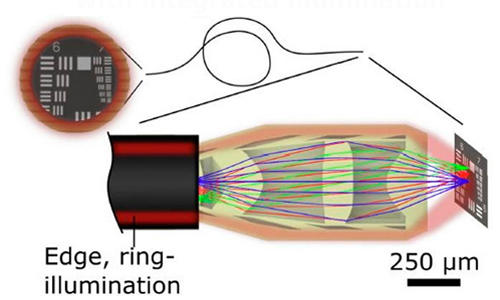
Stuttgart-led group combines illumination and microscopy in fiber bundle
September 09 2026
ESA Earth observation mission FLEX set to launch on September 15th…
September 09 2026