


Novel highly-sensitive gas sensor is based on photo-acoustics
Low-cost and compact format wins developers the Joseph von Fraunhofer Prize 2026.
23 June 2026
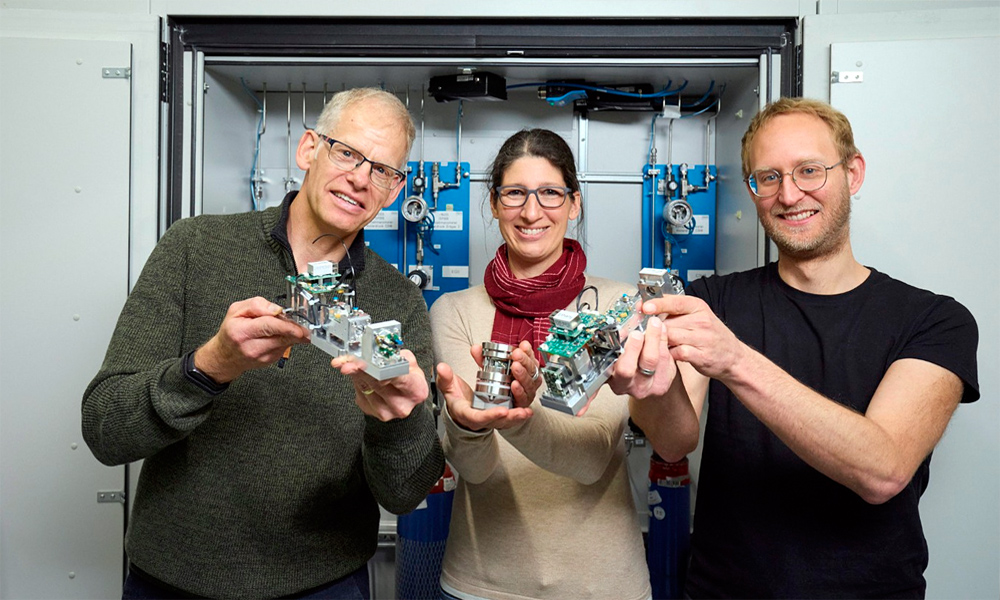
Prize winners: Johannes Herbst, Katrin Schmitt and Christian Weber created a highly-sensitive gas sensor technology in a compact format. © Fraunhofer / Piotr Banczerowski.
By developing a well-known measurement method to be suitable for industrial use, a team at the Fraunhofer Institute for Physical Measurement Techniques IPM has now succeeded in implementing a highly sensitive and compact gas sensor technology – based on the photoacoustic effect – at a fraction of the previous cost. Their efforts have earned the researchers the Joseph von Fraunhofer Prize for 2026.
The photoacoustic effect has been known for over 150 years: gases exposed to light heat up. Pulsing the light generates periodic pressure fluctuations, i.e., sound waves, the frequencies of which can be uniquely assigned to individual gases.
Despite its high sensitivity, the photoacoustic approach has previously only occupied a niche, primarily because it relies on a resonator for acoustic amplification. The resonator is highly sensitive to even the slightest changes in air pressure, temperature or mechanical stress, which can compromise accurate measurements.
LED makes the difference
This is where the team led by Christian Weber, Katrin Schmitt and Johannes Herbst from IPM has now made a breakthrough. They have developed a sensor principle that employs a small LED to continuously determine its own resonant frequency and automatically adjust the optical excitation accordingly.
The team thus made a virtue out of necessity. “The sensor wall absorbs radiation and generates a strong photoacoustic signal. We are now using this wall in combination with a second light source to rapidly measure the resonant frequency,” said Weber, project manager in the Integrated Sensor Systems group at IPM.
The resonant amplification thus remains stable at all times, even under fluctuating conditions. At the same time, the minimal hardware requirements enable sensor prices that are roughly one-tenth of those for conventional devices.
 Market launch
The first major application demonstrates the effect of this simplification. Schütz Messtechnik, a service provider and device manufacturer for power supply companies based in Lahr, Germany, is already using the technology to inspect natural gas networks. The tiniest fractions of methane in the air must be detected here in order to identify leaks at an early stage.
“The measurements are now rapid and precise due to the small measurement chamber volume of roughly four milliliters instead of the four liters previously required,” said Herbst, project manager in the Spectroscopy and Process Analytics group at IPM. “Their small size also makes these systems significantly more portable and versatile.”
Another area of application is in gas-insulated high-voltage systems; the new sensor technology enables continuous, integrated monitoring of the quality of the insulating gas for the first time—a key prerequisite for reliable monitoring and enhanced operational safety.

Exail poised for Thales takeover
July 13 2026

Magic Leap pivots to AR waveguide supply
July 13 2026