


Mini Laser from Fraunhofer IOF to explore Mars’ Moon Phobos for JAXA...
...and ETH Zurich opens center for Earth observation in Lucerne, Switzerland.
20 October 2026
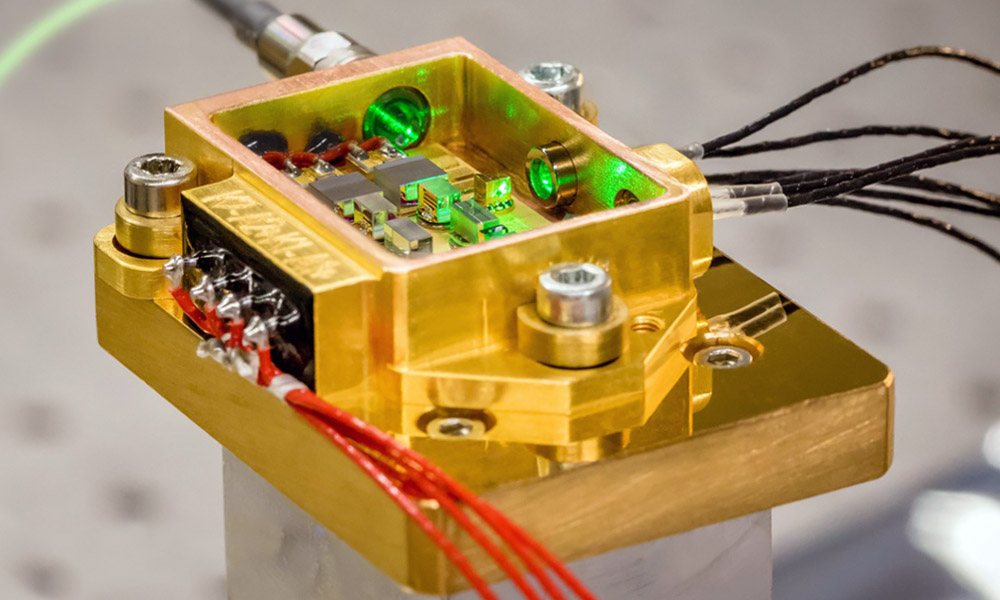
The laser module built by the IOF, in Jena, Germany, combines compact size with robustness. © Fraunhofer IOF.
On October 20, the Japanese space agency JAXA launched its MMX probe to Mars. Its mission is to retrieve a rock sample from Mars’ moon Phobos and bring it back to Earth. On board is a miniaturized laser built at the Fraunhofer Institute for Applied Optics and Precision Engineering (IOF). Originally developed for the European ExoMars mission—whose 2022 launch was canceled—the technology is now being used in the Japanese mission to Mars’ moon.
The “Martian Moons eXploration” mission, or MMX for short, is one of the most ambitious projects in space exploration. The Japanese space agency JAXA plans to send a probe to Mars’ moon Phobos, land there, and then return a sample to Earth. The mission launched on October 20 aboard an H3 rocket from the Tanegashima Space Center in Japan. In approximately one year, it is scheduled to study the Martian moon Phobos up close, and a rover is scheduled to land there in 2029.
To this day, it remains unclear where the two Martian moons, Phobos and Deimos, came from. Were they formed by a massive impact? Or were they originally asteroids captured by the planet’s gravity? MMX is designed to answer questions like these by not only studying Phobos from orbit but also collecting at least ten grams of material from its surface to be returned in 2031. It would be the world’s first samples from the Martian region.
The mission is not limited to sample collection alone. It is also designed to analyze the rock in situ. To do this, the surface of the Martian moon will be illuminated with a small but powerful laser. The characteristic radiation emitted by the rock is then measured using a special Raman spectrometer. This allows researchers on Earth to investigate the composition of the lunar surface from millions of kilometers away.
A team from Fraunhofer IOF in Jena built the laser for this spectrometer. It emits green light with a wavelength of 532 nanometers and an output of more than 100 milliwatts—about 100 times stronger than a laser pointer—while weighing only about 50 grams.
 Special soldering technique
However, the challenge in developing and building such a mini-laser lies not only in making it particularly lightweight. The optical components must withstand strong vibrations during launch as well as radiation and extreme temperature fluctuations (ranging from -130 C to +24 C).
A special key technology from IOF makes this possible, as researcher Marta Gilaberte Basset explained: “Instead of bonding the sensitive optical components using conventional methods, we secured elements of the laser resonator and the secondary optics using a laser-based brazing technique.”
“We cannot readjust the optics for a Mars mission after launch. When brazed, the components maintain their position with high precision for years,” Basset added. Furthermore, the brazing technique prevents potential problems in the instrument that could arise from adhesives outgassing in a vacuum.
Second chance
The laser system was originally developed for the “ExoMars” mission, which had once been planned as a European-Russian partnership. Following Russia’s invasion of Ukraine, the ESA suspended its cooperation with the Russian space agency in 2022.
However, the IOF technology found a new application. Through the Spanish space agency INTA, which had already been involved in developing the measurement technology for the ExoMars rover and has now provided the chance to fly an identical laser unit on the MMX mission, the expertise from Jena was incorporated into the instrument for the Japanese MMX mission.
 ETH Zurich opens center for Earth observation in Lucerne
ETH Zurich has opened the ETH Swiss GeoLab at a new site near Lucerne, Switzerland. During the October 16th opening, guests were greeted by ETH President Joël Mesot and Lucerne Cantonal Councillor Fabian Peter. In his welcome speech, President Mesot recalled the landslide in Blatten and the flash flood in the border region between Tibet and Nepal. Although science cannot prevent disasters like these, he said, it can help to detect them at an early stage and improve the management of their consequences. “The GeoLab will help the authorities to observe changes in the mountains and take action before anyone is harmed,” Mesot said.
Peter commented, “The ETH Swiss GeoLab is a beacon of research and innovation in the Canton of Lucerne which is already showing its broad appeal today.” It was announced in June 2026, for example, that the international aerospace company Axiom Space would be opening a subsidiary in Lucerne.
Natural hazards, forestry and agriculture
Other speakers included GeoLab Director Verena Griess, Professor of Forest Resources Management at ETH Zurich, and Managing Director Dr Felix Seidel, who took stock following a year of setting up the GeoLab. In addition to searching for a site, recruiting a core team and networking with potential partners from the fields of politics, business, public administration and science, their main task was to turn a vision into a specific program.
“The GeoLab concentrates on the early detection of natural hazards and the optimisation of agriculture and forestry with the help of satellite data,” said Griess.
The cooperation with the Swiss National Supercomputing Centre in Lugano and its Alps supercomputer will also play a key role. Around 100 petabytes of publicly accessible NASA Earth observation and climate data have already been transferred to CSCS – a quantity of data that is roughly equivalent to 20 million feature films. This data will be used to develop the AI models.
Together with the companies Gravimon and Gamma Remote Sensing, the GeoLab has already tested two drone-mounted radar systems in the Lötschental valley in September. The drones flew over the Oigschtchummun glacier in order to make surface movements in the ice visible in detail. In the long term, the ETH Swiss GeoLab sees itself as network organisation. By around 2030, an ecosystem of some 100 people is expected to develop around the lean core operating team, which will be in charge of missions, the technology platform and projects.
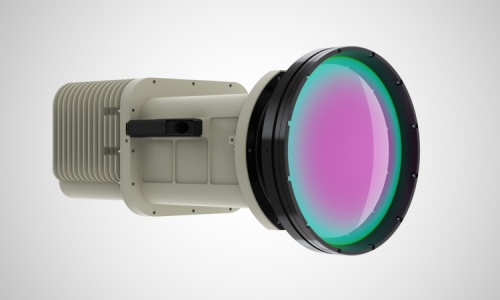
MKS sells Ophir Optics division to PCB maker TTM for $650M
October 22 2026

Photon Bridge lands €10M to scale lasers for data centers
October 21 2026