



Magic Leap pivots to AR waveguide supply
‘Partner-first’ model intended to provide the optical material needed to scale the market for AR glasses.
13 July 2026
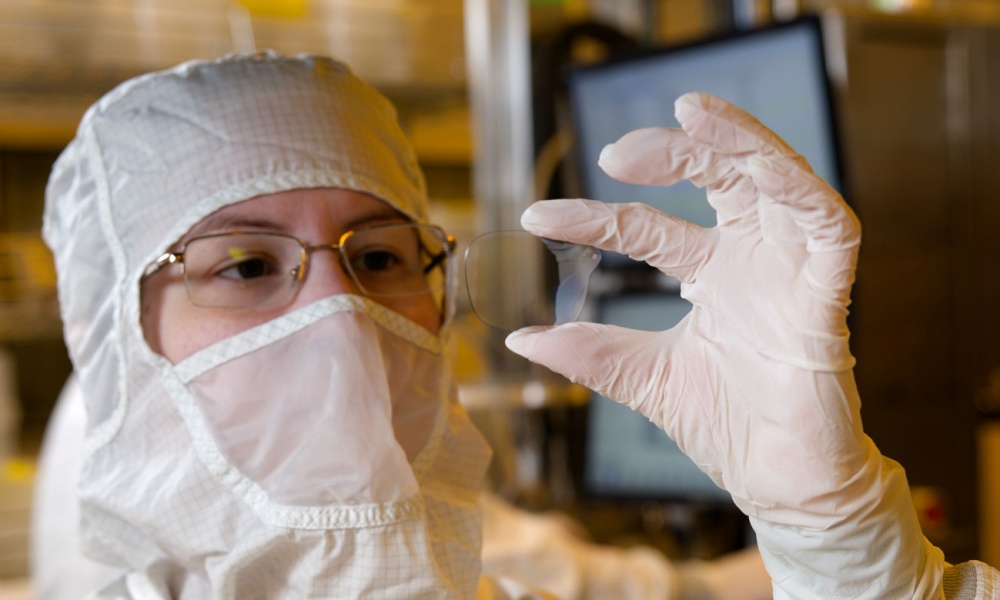
Best known for its early development of head-mounted virtual and augmented reality headsets, Magic Leap has now decided to focus on waveguide supply for near-eye displays - one of the most technically challenging elements of XR glasses. Image: Magic Leap.
Magic Leap, one of the early pioneers of virtual and augmented reality (AR) headsets, has announced a strategic pivot that will see the tech firm instead concentrate on the supply of waveguides.
The Florida-based company says it is shifting from building what it calls “first-party” devices to becoming a critical partner within the AR ecosystem, providing waveguides and device integration expertise for the emerging industry.
“Magic Leap is uniquely positioned to address the market's need for high-performance waveguides,” it claims. “The company’s cost-efficient manufacturing process is built for growth, while its decade-plus of deep AR expertise saves partners years of research, development and expense, dramatically accelerating their time to market.”
Seizing the moment
While Silicon Valley’s “Big Tech” players, notably Meta and Google, have long seen AR glasses as the natural successor to the smart phone handset, that transition is yet to happen - partly because of the technological challenge of integrating high-performance displays with glasses while maintaining a power-efficient and lightweight form factor.
Magic Leap notes that the market for so-called “displayless” glasses - including audio and AI glasses - marks an important milestone for the extended reality (XR) market, pointing out new market research from analyst firm IDC that showed a 44 per cent increase in total XR device shipments in 2025.
“Consumers are proving they will adopt AI wearables when the product is useful, stylish, and affordable,” stated the tech company.
“The next phase is using all-day wearable AR displays to introduce visual AI content. Magic Leap is positioned to advance one of the most challenging parts of the device: the near-eye display waveguide.”
Scott Carden, its senior VP of display engineering and manufacturing, added: “Magic Leap is seizing the moment where our AR innovation and manufacturing expertise create the greatest market impact.
“We’re solving the toughest challenges of scaling waveguide production, from industry-leading waveguide performance to manufacturing and full-device integration.
“Now, we’re using our unmatched expertise to help partners bring AI display glasses to millions of consumers in the fastest way possible through our waveguide technology.”
J-FIL process
Designed for repeatability and volume, Magic Leap’s waveguide manufacturing process is said to offer a structural advantage for OEMs using the material, and outperform competitors with more precise outputs thanks to a Jet and Flash Imprint Lithography (J-FIL) production step.
Another claimed advantage is faster production, with the company using fewer process steps than its competitors to fabricate diffractive waveguides built around surface-relief gratings.
“That speed drives shorter manufacturing cycles, quicker design iteration, and a more direct path from prototype to volume-ready production without sacrificing optical quality,” it states.
Specific advantages to be claimed include a larger field-of-view, higher resolution, integration with most commercially available light engine technologies, a larger eyebox that accommodates a broader population of users, strong brightness and color quality in a compact form factor, and a design focused on the comfort of those wearing the glasses.
Kevin Curtis, Magic Leap’s senior VP of advanced optics, said: “Waveguide performance is what separates AR that consumers want to wear from an expensive demo.
“Magic Leap is laser-focused on producing high-performing waveguides at a cost that supports scale. [Our] elegant, purpose-built waveguide manufacturing process delivers waveguide performance at a price point that makes us the ideal partner to help the industry scale AR wearables.”

Nobel Prize for Medicine goes to optogenetics architects
October 06 2026
Volantis raises $88M with AI memory breakthrough claim
October 06 2026


Fraunhofer IIS detects diseases through body odor
October 06 2026

Expanding Microelectronics UK show reflects sector optimism…
October 01 2026

LZH and Thies Clima develop lidar system for wind measurement
October 01 2026