


LZH project improves thulium fiber lasers
Novel components based on laser-structured triple-clad fibers enable high coupling efficiency and kilowatt-level output.
02 June 2026
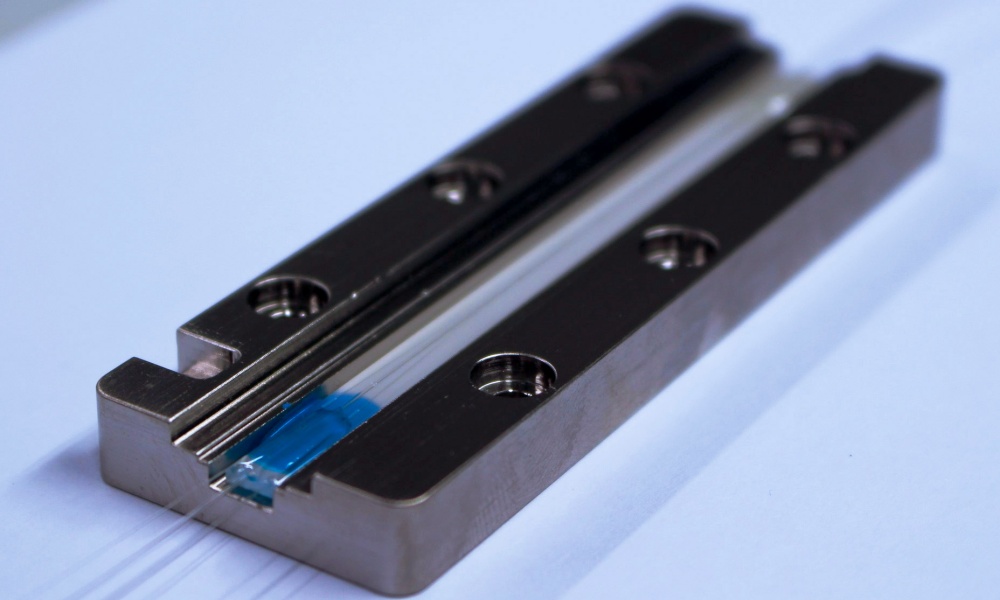
Interior view of the pump light coupler housing developed by LZH and partners to improve thulium fiber laser performance. Photo: LZH.
A Laser Zentrum Hannover (LZH) industrial research project has found a way to improve the performance of thulium-doped fiber lasers, potentially opening up new applications in medicine and other fields.
Working with the German startup firm Futonic Solutions and partners in Korea under the Eurostars-funded “DECOMP” project, the team found that carbon dioxide laser structuring of key photonic components improved optical coupling efficiency between pump diode fibers and fiber cladding.
The results suggest that the design could operate at significantly higher powers than is typical for thulium-doped fiber lasers, making it possible to reach kilowatt-class power output at the 2-micron wavelength emitted.
Patented laser structuring
LZH explains that although various thulium laser sources are available commercially, those offering a combination of high beam quality, kilowatt-level laser power, and the necessary reliability in quasi-continuous-wave (QCW) operation have been lacking.
In a bid to overcome that limitation, the project team utilized an innovative carbon dioxide laser-based processing technology already developed and patented by LZH.
Using this technique, they selectively removed small areas of the outermost glass cladding of the triple-clad fibers, creating lateral access to the pump cladding.
“This technique enables pump diode fibers to be spliced laterally to the pump light cladding, i.e. the inner glass cladding, thereby providing the required pump energy for the laser process,” LZH stated.
“Additionally, the researchers developed cladding mode strippers that efficiently remove unabsorbed pump light from the fiber system through carbon dioxide laser structuring of the triple-clad fiber.”
The resulting signal-pump couplers then achieved an average coupling efficiency of 90.1±2.5 per cent at input powers of up to 475 W, with the available pump power being the limiting factor.
Kidney stones
That efficiency corresponds to the state-of-the-art for couplers with conventional fibers, LZH says, while for the triple-clad fibers used in the latest work it is said to represent a significant new development.
“The low optical losses indicate that the component can also be operated at significantly higher powers, making it possible to reach the targeted 1 kW power class,” reckons the research institution.
For the cladding mode strippers, the LZH-led team achieved an out-coupling efficiency of more than 20 dB with a derived optical power of 250 W.
“These components make the triple-clad fiber design usable for various laser and amplifier configurations and enable higher fiber integration as well as further power scaling in systems with demanding beam quality requirements,” LZH concluded.
Meanwhile, project partner Futonic has just released a new air-cooled thulium fiber laser operating at 1.94 microns that is aimed at medical applications.
“With up to 1200 W peak power in QCW operation and 120 W continuous-wave output power, the laser provides a compact and reliable platform for applications requiring controlled energy delivery, high pulse stability, and efficient system integration,” stated the startup.
The 1.94 micron operating wavelength is close to the absorption maximum of water, making thulium sources particularly suitable for medical applications involving water-rich tissue. One key use case is in urology, where thulium lasers are used to treat kidney stones.
Syntec swings to profit as sales climb
August 19 2026


Hesai goes ‘full-stack’ with extended robotics offering
August 19 2026