


LZH process creates secure glass containers for chemical waste
Laser welding enables high processing speeds and shows excellent potential for automation.
10 July 2026
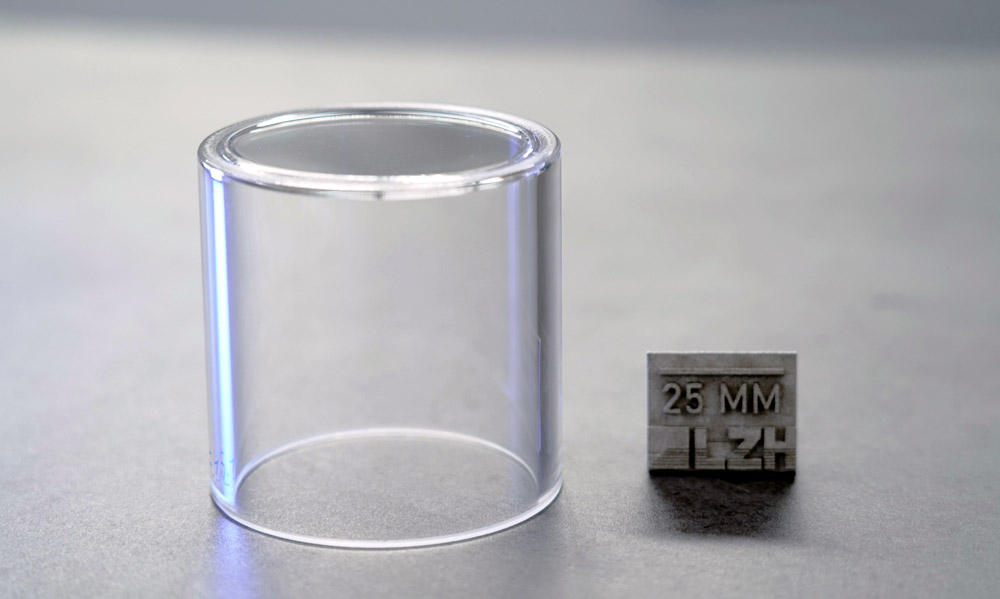
Laser-welded glass containers are suitable for the safe storage of hazardous materials. Photo: LZH.
With the growing adoption of electric vehicles, the volume of battery materials and industrial waste requiring safe storage is also increasing. Scientists at Laser Center Hannover (LZH )have developed a laser-based process for this purpose in the “LasGlaReLa” project.
As the adoption of electric vehicles continues to grow, so does the need for the safe and permanent storage of battery materials and chemical industrial waste. Certain waste streams require disposal in what are known as Category IV landfills, which impose particularly stringent requirements on storage containers. These must simultaneously ensure environmental protection, safe handling, and long-term structural integrity.
Glass is a highly promising material for this application: it is exceptionally chemically inert — meaning it reacts with virtually no other substances — making thick-walled glass containers especially well-suited for the permanent containment of hazardous materials. Glass containers are also of particular interest in the context of potential new recycling methods in the future. The stored residual materials do not react with the containers and can be readily recovered from them.
Until now, these glass containers have been manufactured primarily using thermal gas processes. However, these are limited by uncontrolled heat input, high residual stresses, and restricted automation potential. Laser welding, on the other hand, enables high processing speeds and shows excellent potential for automation. For this purpose, the researchers employed a CO2 laser as the primary laser source. Normally, this laser at a wavelength of 10.6 µm has a low optical penetration depth of just a few micrometers. Combined with the low thermal conductivity of silicate glass, this typically results in incomplete penetration welding.
 Continuous weld seam without micro-gaps
As the scientists were able to demonstrate, it is possible to simultaneously heat both welding partners using a single CO2 laser source, and thus produce automated sealed glass containers. They achieved a continuous weld seam without micro-gaps or voids throughout the entire thickness of the 5 mm-thick flat glass. Furthermore, despite the heat input, mechanical strength is maintained. This was demonstrated through stress tests on samples after two weeks of storage.
The process is unique: the lid sinks during processing due to gravity. Complex handling systems or clamping fixtures become unnecessary, as the joining partners position themselves automatically through gravity. The scientists are now working on further optimization of the edge geometries of the flat glass components. They aim to further reduce friction during the welding process and minimize the formation of protrusions and notches at the joint location.
LasGlaReLa project
The project Novel Manufacturing Technology for Producing Laser-Welded Glass Hollow Bodies for Residual Material Storage (LasGlaReLa) was funded by the Federal Ministry for Economic Affairs and Energy under funding reference VN-KK5111715. More information about the project is in a paper published in Journal of Laser Application.
Leica and Cognex launch AI software module Aivaro to improve inspection
September 30 2026
Photonic monitoring to identify food safety, quality, and animal welfare
September 30 2026
Advances in optics and computation boost coronary intravascular imaging
September 30 2026
Australia’s SKA tests antenna layout for Low telescope
September 30 2026
Artemis merges Optikos with Omega Optical
September 30 2026