


LLNL research shows importance of laser polarization effects in fusion
Discovery at NIF is that using circularly-polarized light can cause less backscatter meaning less damage to optics.
25 June 2026
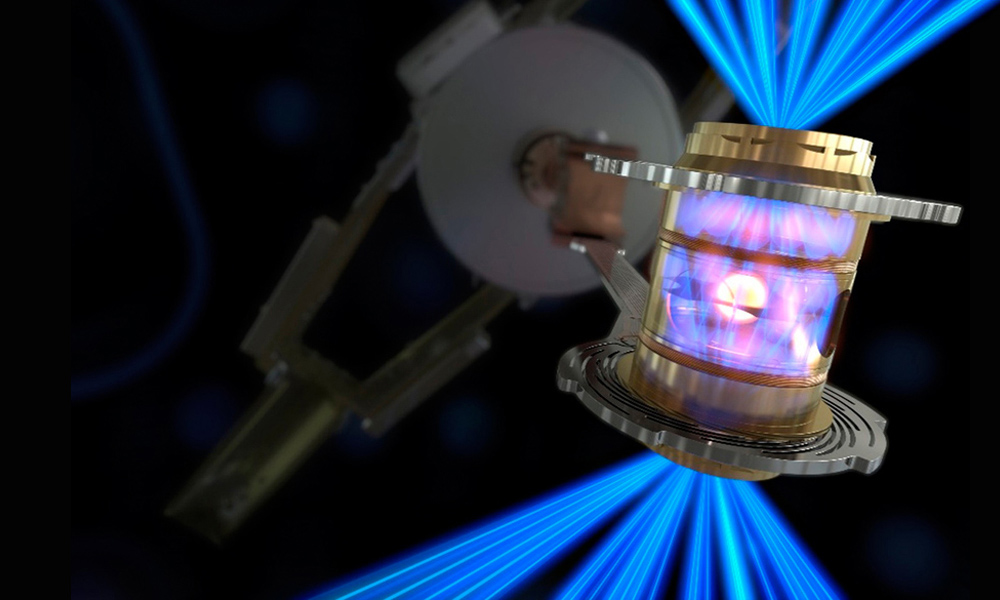
In an inertial confinement experiment on the National Ignition Facility, the lasers converge at tiny entrance holes at the top and bottom of the hohlraum. The intersection of the lasers enables crossed-beam energy transfer, an important factor in maintaining symmetry of implosions. Image: LLNL.
Experiments at Lawrence Livermore National Laboratory’s National Ignition Facility (NIF) require high precision. Each of the 192 lasers is focused to a width of a few millimeters to enter a 3-mm hole at the top or bottom of a 20-mm gold canister known as a hohlraum. As they enter, the beams intersect in plasma and transfer power, a process known as crossed-beam energy transfer (CBET). In designing a NIF inertial confinement fusion (ICF) experiment, the scientists precisely tune the beams’ wavelengths to balance power via CBET and achieve better symmetry.
Small changes in wavelength have delivered big results — CBET is one key factor in achieving ignition on NIF. But what would be the effect of a more significant change in the laser architecture: namely, its polarization state? LLNL scientists have calculated that this change would make the optics more resilient to filamentation damage.
“This could mean that the NIF laser could be operated at higher power, but we also would need to understand what other effects such a change might cause,” said LLNL physicist Pierre Michel, the paper’s lead author. “In examining the effect on CBET, we found that circularly polarized light might cause less backscatter, which means less damage to the optics.”
The results are reported in a new paper, “Laser polarization effects on crossed-beam energy transfer in inertial confinement fusion,” published in Physics of Plasma.
The beams that enter the hohlraum at the same angle form cones where CBET occurs. Beam-to-beam variations in CBET, meaning that some beams enter with significantly higher or lower laser energy than other beams in their cone, can then trigger backscatter instabilities. This can cause increased damage to NIF’s optics.
 Circular polarization boosts CBET
Michel and his team conducted simulations of CBET to compare the effects of linearly polarized light with the effects of circularly polarized light. They found that circularly polarized light improves CBET by reducing variations between beams within the same cone. Implementing circular polarization at NIF is no simple matter. It would require a specialized waveplate element to reorient the electromagnetic field components of transmitted light.
“As of today, there is no known straightforward path to manufacture such a device (a quarter waveplate) at the aperture size and requirements needed for NIF. We’re currently investigating potential fabrication methods including through our patented metasurface technology,” said Jean-Michel Di Nicola, chief laser systems engineer at NIF and co-program director for Laser Science and System Engineering.
For Michel, the next steps are to validate the new theory of circularly-polarized CBET by doing dedicated experiments at a smaller scale facility (such as LLNL’s Jupiter Laser Facility), while continuing to improve the simulation code by adding more physical effects.


Exail poised for Thales takeover
July 13 2026

Magic Leap pivots to AR waveguide supply
July 13 2026