


Kobe develops ‘structural color’ surfaces based on one layer of silicon nanospheres
Technology also promises optical functions: sensing, photocatalysis, and energy management.
08 September 2026
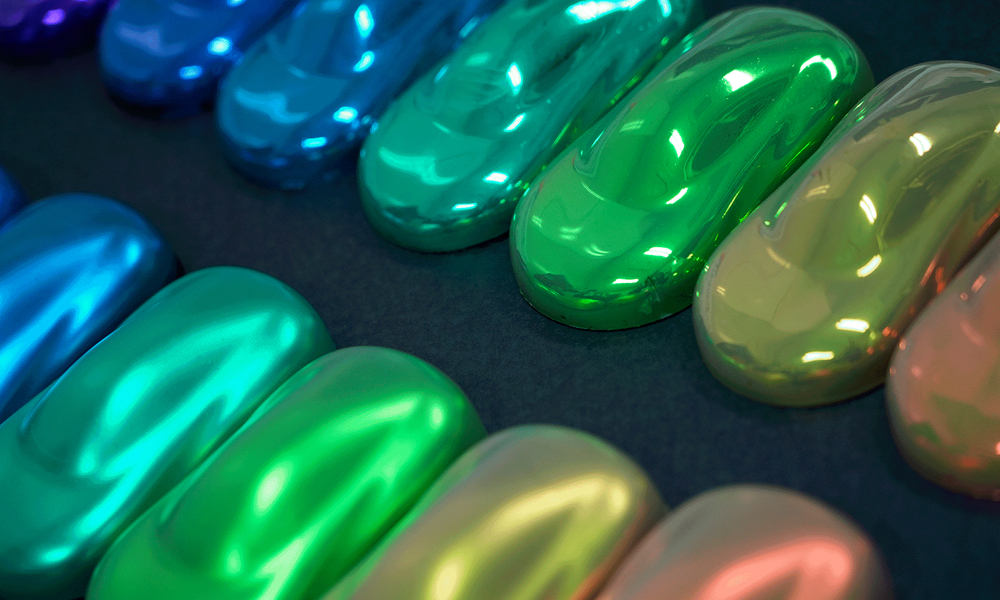
The coating technology achieves high opacity and brightness with only a single layer of silicon nanospheres. Image: Kobe University / CC BY.
Thanks to a new Japan-based research project, it is now possible to have glossy, car-paint-quality color from a coating that contains no pigment at all. The development at Kobe University makes non-fading structural color applicable to complex surfaces at scale, fixes angle-dependent color and allows for applying protective layers for real-world use.
Materials engineer Sugimoto Hiroshi who works in the Department of Electrical and Electronic Engineering at the has developed a structural color coating that is gloss and can be applied to large, 3D surfaces. In addition, his team has showed that adding a protective coating did not significantly change the hue, making the technology useful for real-world applications.
The work is described this week in the journal Small Structures.
“Color coatings are expected to provide vivid color, brightness, gloss, and long-term durability, yet no existing technology satisfies all of these requirements simultaneously,” said Sugimoto. Conventional coatings usually rely on relatively thick pigment layers that fade and add significant weight. While structural color, like that found in peacocks, isn’t subject to the photofading that affects organic pigments, it does require precise alignment and changes color depending on viewing angle. In addition, such structural arrays are incompatible with protective layers.
 Silicon nanospheres
Sugimoto has previously developed silicon nanospheres as a completely new approach to structural color, which creates angle-independent coloration, and more recently, his group achieved ink-jet printing for this technology (link). However, so far, reflectance has been diffuse, meaning that the surfaces lacked luster, but the trick that enabled inkjet printing opened up a path to the solution. “Packing the nanospheres in silica shells not only protects the particles but also controls their spacing and should improve self-assembly into neat arrays,” he said. This should reduce diffuse reflectance, making the color glossy.
In the paper in Small Structures, the team demonstrates glossiness and control over it while applying the coating to large, 3D surfaces. In addition, they show that adding a protective coating did not significantly change the hue. “The most exciting aspect of this work is that it demonstrates glossy, non-iridescent and protection-coated structural color coatings for 3D objects in a single platform, making the technology useful for real-world applications,” said Sugimoto.
The coatings are also lightweight, with high opacity and brightness being achieved by just a single layer of silicon nanospheres. If this were to be applied to wide body airliners, this would make their coatings, which currently add several hundred kilograms in weight, weigh somewhere on the order of several hundred grams — less than a pack of milk for the whole plane.
Also, the nano particles are made from silicon, a non-toxic material sourceable from the semiconductor industry, and silica, one of the most abundant materials in the Earth’s crust. Combine this with their non-fading nature and color coatings might become much less resource-demanding in the future.
Development company
Sugimoto is now involved in setting up a company to scale up production for industrial use. Thinking about the breadth of possible applications, he said, “The process is compatible with scalable coating methods such as spray coating, slot-die coating, and roll-to-roll processing.”
But Sugimoto is also a scientist and his outlook goes beyond color coatings: “We want to expand the possibility of applications for the science behind our technology beyond coloration. Looking ahead, we aim to develop multifunctional silicon nanoparticle coatings that combine structural coloration with additional optical functions such as sensing, photocatalysis and energy management,” he said.
Oxxius looks to grow international footprint with €5M equity support
September 08 2026

Sivers to ramp InP laser production with $30M investment
September 08 2026