



Johns Hopkins shows how skin pigmentation influences laser-induced injury
Quantified data will lead to more inclusive safety standards and laser-based imaging systems.
08 September 2026
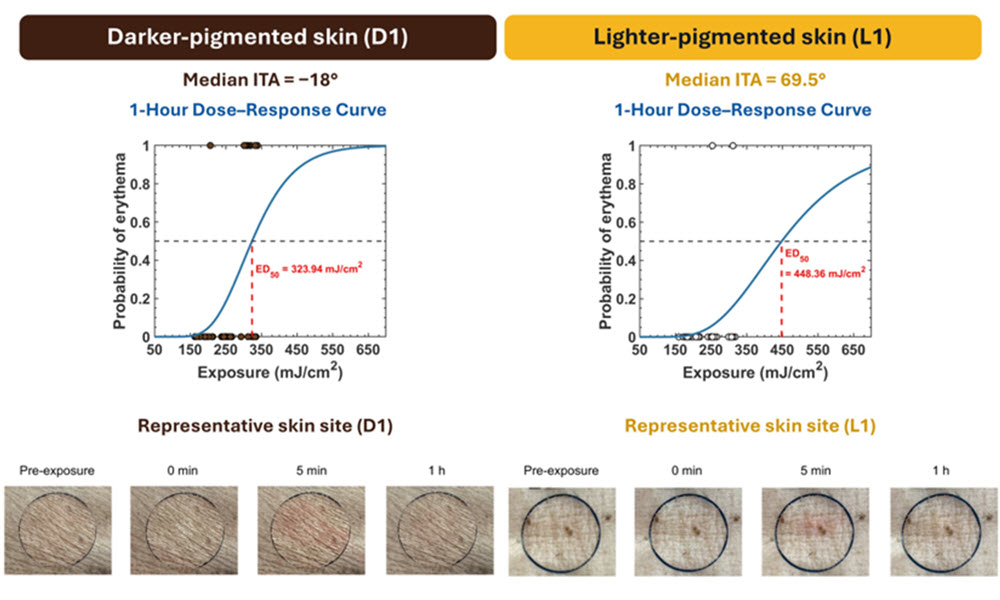
Images show the development of blanching and erythema after laser exposure in dark- and light-skinned swine. Darker-skinned swine developed visible erythema at lower laser energy levels, showing that skin pigmentation influences laser injury thresholds. Credit: Johns Hopkins University.
A project at Johns Hopkins University (JHU) has gathered fresh data about how different skin tones alter the action of the lasers used in medical and imaging applications.
Differences in skin coloration are known to affect the maximum amount of laser energy that can be delivered to the skin without causing injury, since melanin content is related to how much laser energy is absorbed and heat generated. But published safety guidelines often fail to take account of these variations.
Those same skin colorations can also influence the data recorded from the skin by optical devices such as pulse oximeters, creating an inherent bias in results. More data on how skin color and laser action are related is desirable.
The JHU project set out to quantify how skin pigmentation affects the amount of laser energy required to cause visible skin injury, generating quantitative data that could support more inclusive laser safety standards and help guide the development of laser-based imaging systems. Its findings were published in Journal of Biomedical Optics.
"The lack of experimental data quantifying the effect of pigmentation on injury thresholds constrains accurate interpretation when melanin is a primary optical absorber," wrote the project. "This has direct implications for the performance of optics-based imaging methods."
For its experiments the project recruited three Yucatan miniature pigs with different levels of skin pigmentation, ranging from very light to dark, and exposed the skin to single pulses of 750-nanometer irradiation. Baseline skin pigmentation before laser treatment was measured using a colorimeter, and after exposure any skin redness, or erythema, was recorded as an indicator of inflammation.
These observations were then used to determine the ED50 threshold, the laser energy expected to produce visible injury in 50 percent of exposed sites, as a measure of how pigmentation influences the skin's response to laser exposure.
Determining how much laser energy skin can safely tolerate
Data confirmed that the injury thresholds for nanosecond illumination at 750-nanometers were lower for darker skinned animals, whose skin contains higher melanin levels.
"A 27.7 percent lower injury threshold was observed in dark-skinned swine (ED50 of 324 mJ∕cm2) compared with light-skinned swine (ED50 of 448 mJ/cm2), demonstrating that differences in epidermal melanin content translate into measurable differences in exposure tolerance at wavelengths where melanin is a primary optical absorber," said the project in its paper.
Darker skin also developed visible erythema at lower energy levels, reinforcing the link between pigmentation and injury risk. These results showed how melanin plays a significant role in determining how much laser energy skin can safely tolerate, meaning that safety limits which do not explicitly account for pigmentation may not fully capture biological differences related to skin tone.
The results, alongside a mathematical model derived from them by the JHU team, provide a quantitative experimental basis to understand the pigmentation-dependent variability in laser-tissue interactions. This should lead to improvements in techniques such as photoacoustic imaging, one focus of the JHU Pulse Lab, where an allowable laser exposure directly influences signal strength, penetration depth and diagnostic performance.
"This foundational work addresses a previously uncharacterized source of biological variability that is relevant for the interpretation of laser safety margins and the design and evaluation of optics-based systems," said JHU.
Invisible tattoos that appear when illuminated
October 15 2026

Xiver picks up €28M debt finance to aid photonic chip production
October 15 2026
U.S. Army Research Office awards $19.2 million to Florida team
October 14 2026
ASML looks to add more capacity as chip boom continues
October 14 2026