



Improved imaging through complex media offers new views of tissues
UCLA and University of Rochester use physics-based machine learning for real-time imaging.
28 July 2026
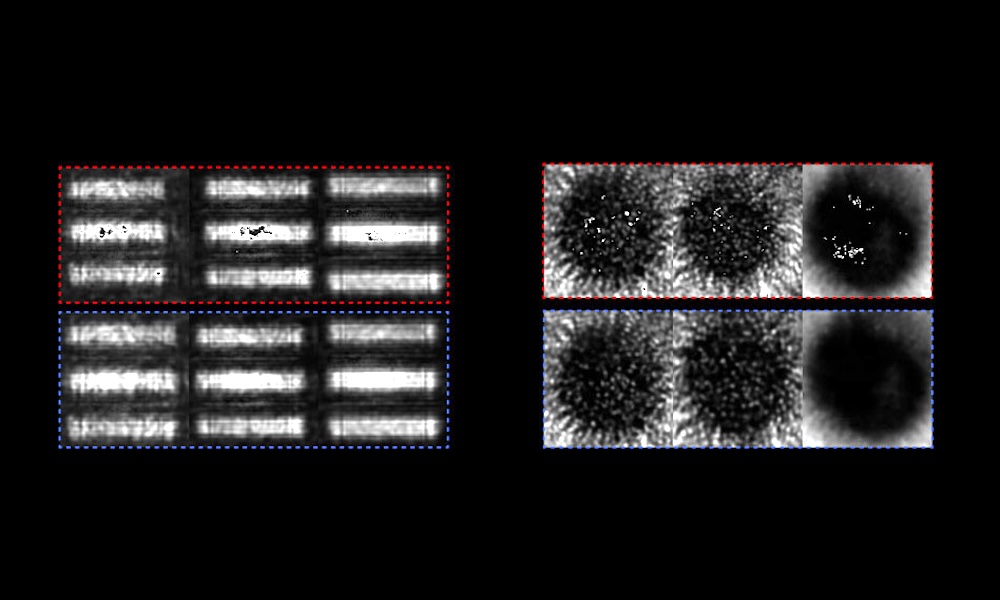
Comparison of two imaging techniques. Top rows (red border) show images with visible white artifacts and noise. Bottom rows (blue border) show cleaner images produced by physics-based machine learning, with artifacts removed. Credit: UCLA Quantum Light-Matter Cooperative.
Accurate imaging within opaque or scattering media is a key goal in both bioimaging and industrial vision systems, critical in scenarios such as seeing structures inside body tissues or detecting obstacles through heavy fog.
These turbid or heterogeneous environments, collectively known as complex media, pose a fundamental challenge to optical imaging, thanks to the scrambling of structured spatial and phase information they cause.
Possible solutions have included the use of light's orbital angular momentum (OAM), a property capable of retaining its state in highly scattering media; and a diffuse optical tomography approach, reconstructing objects obscured within thick scattering media by placing detectors around the scattering volume and modeling the diffused light that emerges from the target.
University of Rochester researchers previously developed a method allowing relatively cheap silicon-based cameras to be used for imaging in complex media, thanks to a special film that lets through some photons and not others, converting scattered light from the near-infrared to the visible range.
A project group including Rochester and UCLA has now built on this approach by designing a new hybrid imaging protocol in which a deep learning framework reconstructs high-fidelity images from nonlinear scattering measurements, and published the findings in Light Science & Applications.
The work exploits four-wave mixing (FWM), a nonlinear effect where interactions between multiple light wavelengths in a medium produce new frequency components; and imaging at epsilon-near-zero (ENZ) wavelength, a material-specific wavelength at which optical upconversion can take place even in scattering media.
A boon for biomedical imaging
"The researchers merged the existing imaging technique with a machine learning framework called DeepTimeGate," commented UCLA.
"It has two stages, starting with an algorithm trained to reconstruct images mathematically. The key addition is the second algorithm, developed at UCLA, which quickly performs a reality check, constraining results based on the fundamental rules of physics."
This combination lets DeepTimeGate treat optics and computation as a single complete imaging system rather than isolated components, according to the project, and accommodate dynamics unique to the FWM and ENZ approach. It also offers a different technique compared to conventional deep-learning-based image resolution methods, which typically rely on statistical inference to remove generic noise.
In trials across different imaging scenarios and varied scattering conditions, the new approach was found to boost average peak signal-to-noise ratio by 124 percent, and improve the structural similarity index (SSIM), a measure of similarity between two images, by 231 percent.
Applications set to benefit could include autonomous-vehicle cameras and quality control vision systems for manufacturing where cloudy liquids or frosted packaging are involved. But a primary target sector will be bioimaging, with the technology offering improved ways to image within living tissue.
"Sensing inside complex media in near-real time using silicon-based cameras would be a boon for biomedical imaging," commented UCLA. "DeepTimeGate may lead to less expensive, more effective imaging to guide surgeries, including endoscopic procedures. Labs that test for dangerous microbes or anomalous cells in cloudy fluids such as blood could use a technology like this to analyze samples without diluting or filtering them."
Aston University improves views through scattering tissues
October 29 2024
Imaging of hidden objects offers route to improved robotic vision
September 14 2020
Syntec swings to profit as sales climb
August 19 2026


Hesai goes ‘full-stack’ with extended robotics offering
August 19 2026