



Ghana Photonics & Optics Lab promises new future for photonics
SPIE funding backs research lab now open at Kwame Nkrumah University of Science and Technology in West Africa.
08 October 2026
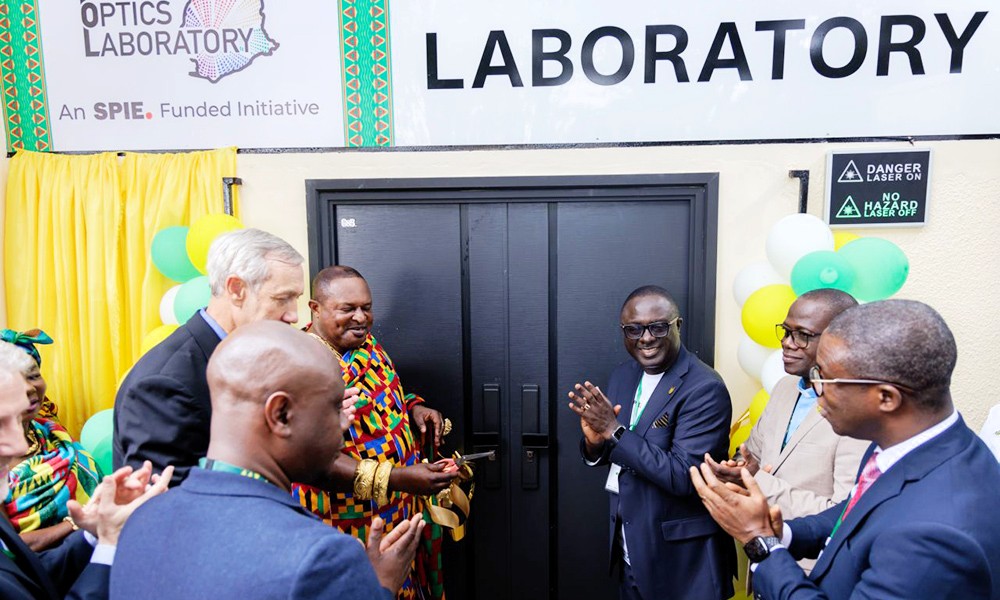
Opening of the Ghana Photonics and Optics Laboratory. SPIE funded the lab, which opened during the NYANSAPƆ Photonics School for Health and Safety. Photo credit: Michael Kwame Dakwa, Team1000words.com
On 22 September, the seed of an idea, a major international collaboration, came to fruition. Kwame Nkrumah University of Science and Technology (KNUST) faculty, Ghanaian scientists, representatives from the Ghanaian village of Bonwire, visiting lecturers, 38 students from six African countries, plus many others from the international optics and photonics community, came together for the opening ceremony of the Ghana Photonics and Optics Laboratory (GPOL). The two-year endeavor was guided by a clear vision: “To be a center of excellence in photonics and optics in West Africa, training the next generation of scientists and innovators, advancing research, and connecting Ghana to the global photonics community through collaboration, shared resources, and impactful scientific discovery.”
The launch happened during the inaugural NYANSAPƆ Photonics School for Health and Safety, a six-day event featuring plenary talks, guest lecturers, and hands-on laboratory sessions for students. Conversations carried on beyond the lab and programming sessions, making it clear that educators and students alike are ready and eager to dive into this new resource.
KNUST already has a well-established SPIE Student Chapter that conducts outreach in the area to advance awareness of and excitement for light-based science in Ghana. Building a complete laboratory to educate the next generation of scientists and researchers was a natural next step. Conceived and led by KNUST faculty members Dr. Akyana Britwum and Dr. Michael K.E. Donkor, the GPOL is a place where students will develop the knowledge and skills to further real-world applications of optics and photonics in the West African region.
SPIE is invested in the long-term advancement of optics and photonics in Ghana. Chief Engagement Officer Allison Romanyshyn, Board Members Daewook Kim and Samuel Achilefu, and 2025 President Dr. Peter de Groot, who also serves as Chair of the GPOL Advisory Board, attended the celebration. The organization supported the full lifecycle of the lab. From providing $100,000 in funding for foundational equipment and studentships for the GPOL’s first cohort of master’s students to backing the formal launch during NYANSAPƆ Photonics School. SPIE covered the students' costs for attendance, accommodation, and meals. SPIE has also provided advisory support and international visibility through initiatives such as a fully supported Optics and Photonics Africa Scholarship and Africa-focused programming at major SPIE convenings.
“The investment will support the Ghana Photonics and Optics Laboratory in growing beyond a single laboratory into a center of excellence for photonics in Ghana and this region,” said KNUST Pro Vice-Chancellor Prof. David Asamoah during the opening ceremony.
Before the establishment of the GPOL, limited resources had hindered the advancement of photonics in the region. Equipment needed to be imported, a major financial undertaking for KNUST. If anything broke, repairs were cost-prohibitive, and therefore equipment sat, unusable. Now, the lab is stocked with high-quality measurement and educational kits, multispectral spectrometers, optical tweezers, 3D printers, and other equipment students will use to gain hands-on training. Partnerships have created capacity for photonics instrumentation to be built locally. Students are learning from faculty and guest lecturers, covering areas including spectroscopy, medical optics, and microscopy, plus gaining hands-on experience.
Designed specifically for the GPOL and revealed at the opening ceremony was a traditional, handwoven Ghanaian textile called a Kente. The GPOL Kente, titled “Nimdeɛ Akwan”, was designed by master weaver Isaac Gyasi and handwoven by him and his team in Bonwire, Ghana, the heart of Kente.
When presenting the Kente, Nana Bobie Ansah II, the Bonwirehene (chief) of Bonwire, expressed that he is “particularly impressed by the story behind the Nimdeɛ Akwan” and how modern scientific knowledge and technology contributed to its design.
“[It] demonstrates that science, technology, art, and our rich cultural heritage can work together beautifully…. It is my hope that this laboratory would not only advance the study and application of photonics and optics but will also become a bridge between science, innovation, culture, and traditional craftsmanship. I am proud to be part of this important occasion.”
Inspired by concepts of optics and photonics, the GPOL Kente is set against a rich black background, with vibrant geometric patterns. The patterns were reimagined and adapted for the Kente loom to maintain the cultural tradition of symbols, colors, and shapes within the piece.
“In this way, we observe and respect the distinction between established Kente symbols and color schemes that are filled with historical cultural meaning, and new design concepts that are compatible with traditional weaving methods,” said de Groot.
By collaborating with institutions and researchers worldwide, SPIE expands educational opportunities, strengthens the field, and builds lasting connections. The Ghana Photonics and Optics Laboratory is one example of how SPIE invests in the optics and photonics community while creating a model for building capacity globally.

Nobel Prize for Medicine goes to optogenetics architects
October 06 2026
Volantis raises $88M with AI memory breakthrough claim
October 06 2026

Fraunhofer IIS detects diseases through body odor
October 06 2026