



Germany to launch three new fusion hubs for research and industry
In laser and magnetic fusion, fuel cycle, materials development, towards opening a fusion power plant.
04 August 2026
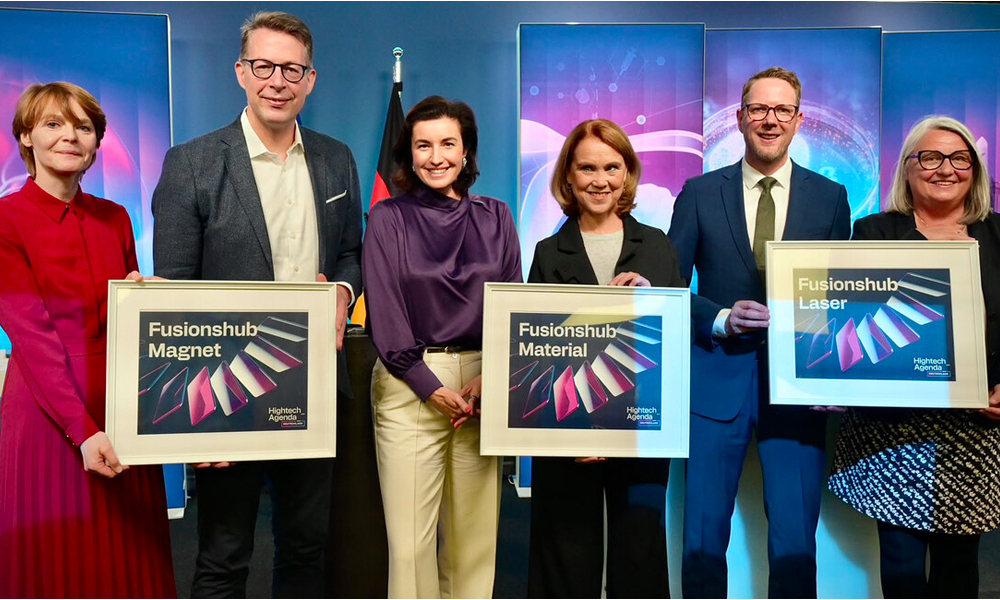
Federal Research Minister Dorothee Bär, together with State Secretary Christoph Degen, State Minister Markus Blume, Minister Petra Olschowski, State Secretary Susanne Bowen, and Minister Dr. Dorit Stenke, announcing the new hubs. © BMFTR.
Three new centers will soon be established as a network of fusion expertise in Germany. As part of the Hightech Agenda Germany and the action plan known as “Germany on the way to a fusion power plant”, three hubs will be established in the disciplines of laser fusion, magnetic fusion, fuel cycle, and materials development.
With the three new fusion hubs, the Federal Ministry for Research, Technology and Space (“BMFTR”) is creating new structures for the development of fusion technology in Germany. The fusion hubs are intended to serve as central locations where companies, research institutions, and industry collaborate on-site and virtually on technological solutions for future fusion power plants. The federal and state governments are working in close coordination on this.
Key objectives
- To combine existing expertise from business and science,
- To focus research and development even more strongly on the fusion power plant,
- To accelerate the transfer of scientific knowledge into industrial application.
The BMFTR is initially providing €125 million ($144 million) for this purpose. Three hubs are solving key challenges on the path to a fusion power plant. The three selected hubs focus on three key technological areas:
- VEGA is dedicated to laser fusion and is coordinated by specialist firms Marvel Fusion and Focused Energy. The hub aims to consolidate existing expertise in Germany in photonics, optics, laser technology, and the development and manufacturing of targets. Targets are small spheres or cylinders containing the fusion fuel. These technologies will be used to develop application-oriented fusion technologies.
- STRIDE focuses on magnetic fusion, particularly stellarator technology. Germany boasts an internationally leading research landscape in this field. The hub, coordinated by Proxima Fusion, Gauss Fusion, and the Max Planck Institute for Plasma Physics, aims to facilitate the translation of scientific findings into industrial developments.
- MAT-TRIX is coordinated by the Karlsruhe Institute of Technology and addresses the cross-cutting topics of fuel cycles and materials development. These include, among other things, the production and handling of the fusion fuel tritium, the development of so-called breeding blankets, and materials that can withstand the extreme conditions in a fusion power plant over the long term.
The hub structures are designed to be open. In the future, further companies, research institutions and stakeholders from the high-tech industry, value chains and supply chains are to be integrated.
 Construction starts now
With the announcement of the fusion hubs on July 29th, their development has now begun in earnest. The partners will initially create joint structures for their collaboration. These include plans for research and development, the management of intellectual property, and the recruitment of skilled personnel. The first joint research projects will start shortly. The hubs will gradually expand their work until 2029.
Funding from the Federal Ministry for Digital and Economic Affairs (BMFTR) can be supplemented by investments from industry as well as contributions from the federal states and international partners.
The BMFTR is already funding research projects into laser and magnetic fusion, the development of new research infrastructures, and junior research groups. The new hubs will complement these measures by structuring the technology fields, pooling activities, and establishing lasting networks between research and industry.
For its next step, the BMFTR is planning “milestone-based financing”, intended to support application-oriented developments by merged companies
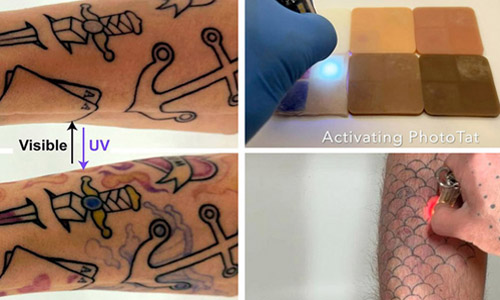
Invisible tattoos that appear when illuminated
October 15 2026

Xiver picks up €28M debt finance to aid photonic chip production
October 15 2026
U.S. Army Research Office awards $19.2 million to Florida team
October 14 2026
ASML looks to add more capacity as chip boom continues
October 14 2026