


Fusion firm Focused Energy to create spin-off ‘Sourcelight’
The aim is to bring Laser-Driven Radiation Sources technology to industrial applications.
17 June 2026
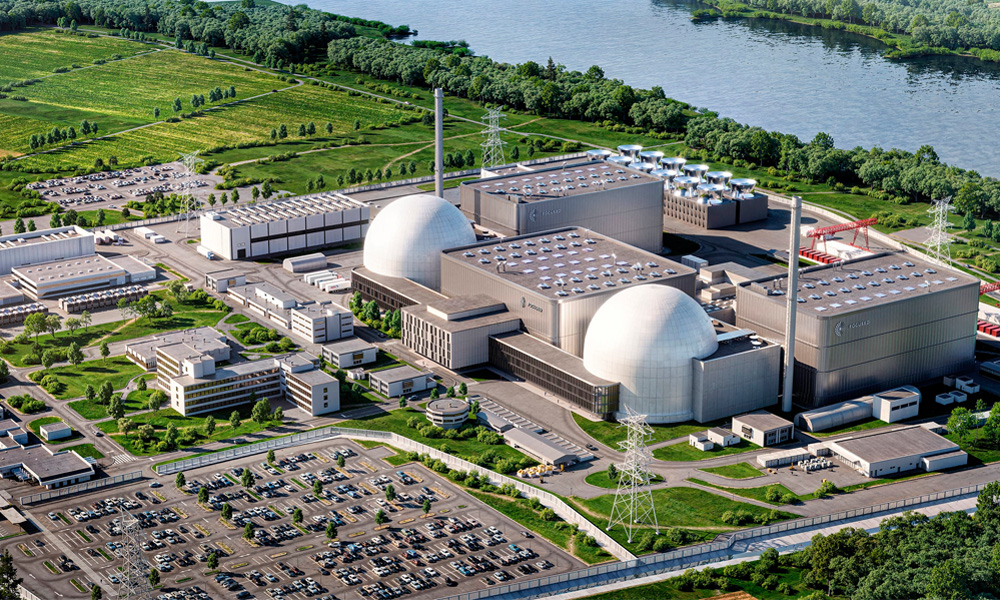
Rendering of Focused Energy’s world-first laser fusion power plant in Biblis, Germany, near the base of RWE, a Germany-based multinational energy company. Image: Focused Energy.
Following its successful $240 million financing round, Focused Energy is continuing to work to advance the industrialization of laser fusion as its core business. At the same time, the company plans to consolidate its activities in the field of laser-driven radiation sources into an independent entity under the name Sourcelight.
With this move, Focused Energy says it is “laying the groundwork for the industrial transfer of selected technological building blocks emerging from its laser fusion development. The spin-off demonstrates how cutting-edge research can give rise to new industry: scientific excellence is translated into industrial applications with strong value creation and growth potential,” the company stated this week.
Sourcelight is intended to bring the LDRS (Laser-Driven Radiation Sources) technology developed by Focused Energy into targeted industrial applications. The technology combines laser-driven high-energy X-rays and neutrons in a single system.
This approach enables not only high-resolution imaging, but also additional insights into material composition—particularly in areas where current inspection methods still face limitations in penetration depth, resolution, material identification, or operational flexibility.
Focused Energy sees relevant fields of application in the characterization and qualification of nuclear waste, in security and customs inspections at container ports, in industrial quality assurance, and in the non-destructive testing of safety-critical components. In all of these areas, demand is growing for methods that can penetrate deeply into materials, operate non-invasively, and at the same time provide additional information about internal structures and material composition.
The technological foundations date back to work by Focused Energy co-founder Prof. Markus Roth and colleagues on laser-driven particle acceleration in the early 2010s. A key milestone in the industrial orientation of this work is the collaborative PLANET project, led by Focused Energy and launched in 2024 together with partners from industry and research.
 Technology transfer
“Focused Energy is pursuing the goal of making laser fusion industrially viable with full force. At the same time, technologies are emerging along this path that can generate tangible industrial impact at an earlier stage. Sourcelight is our way of clearly structuring and purposefully advancing this application perspective for laser-driven radiation sources,” said Thomas Forner, CEO and co-founder.
“With Biblis [a German town near Mannheim], where we are also building the world’s first laser fusion power plant, we have a location with tremendous potential and visibility. It is also where the first industrial prototype of the LDRS technology is being developed. This will allow us to repeatedly demonstrate in Biblis how research can be translated into tangible industrial value creation, jobs, new technologies, and new companies.”
LDRS describes the approach of using high-power lasers to provide compact sources of high-energy X-rays and fast neutrons. The technology opens up new possibilities for the non-destructive characterization of large components, closed containers, and complex material structures from the outside.
A central technological element of LDRS is the use of high-intensity laser pulses to generate pulsed X-ray and neutron radiation. The interaction of the laser with a specially designed target enables radiation sources that are more compact and more flexibly deployable than traditional large-scale accelerator infrastructures.
The combination of X-rays and neutrons is particularly significant from a technological perspective because the two modalities provide different types of information: while X-rays primarily reveal density and structural information, neutrons can offer additional insights into material composition. This multimodality opens up new possibilities for analyzing sealed, shielded, or otherwise difficult-to-access objects.
“Sourcelight is designed to turn technological innovation into industrial application. To achieve this, we are prioritizing concrete markets, validating use cases together with our partners, and building a platform that is scalable in the long term,” said Sebastian Wojczik, Vice President LDRS.
Much like the Apollo space program triggered technological developments far beyond its original objective, laser fusion research is already producing applications today that create tangible benefits in other industries.
Exail poised for Thales takeover
July 13 2026
Magic Leap pivots to AR waveguide supply
July 13 2026