


Fraunhofer ISE breaks own PV module record by optimized interconnection of solar cells
Shingle Matrix tech combined with space PV creates “world’s most efficient solar module”.
16 June 2026
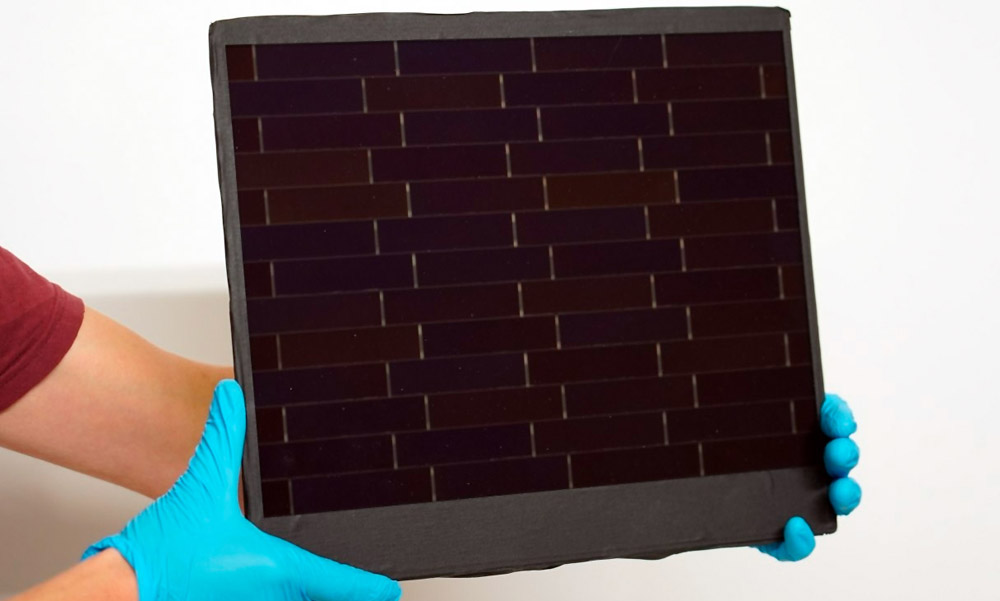
III-V germanium PV module with an efficiency of 34.4 percent – a new world record. © Fraunhofer ISE / Photo: Daniel von Kutzleben.
Scientists at the Fraunhofer Institute for Solar Energy Systems (ISE), Freiburg, Germany, have succeeded in breaking their own module record through an optimized interconnection of the solar cells.
Their III-V germanium PV module achieves a conversion efficiency of 34.4 percent. The solar cells were developed by Azur Space, a company based in Heilbron, Germany, while the anti-reflective coatings on the front glass were provided by Temicon.
Visitors to Intersolar / The Smarter E 2026 (at Messe Munich, between June 22 to 25, 2026) can see the world’s most efficient PV module demonstrated at the ISE’s booth A1.440.
In early 2026, an ISE research team working on the “Vorfahrt” project built an 833-square-centimeter module with an efficiency of 34.2 percent—a new world record. The module consists of triple III-V germanium cells, which the research project coordinator, Azur Space, further developed for the solar module. To achieve this, the manufacturer adapted its triple solar cell technology—originally optimized for space applications—to the terrestrial solar spectrum, enabling it to be produced in comparable quantities and on the same wafer formats.
A few months later, the project team has now surpassed its own achievements: By using shingled matrix technology to interconnect the solar cells, they were able to increase the module’s efficiency to 34.4 percent.
For several years, the ISE has been collaborating with a German mechanical engineering partner to develop the interconnection of solar cells using shingle-matrix technology, which is also used in commercial modules manufactured in Germany. The shingle-matrix approach represents a fundamental departure from traditional photovoltaic module construction, in which solar cells are cut into narrow strips and then arranged in a shingle-like pattern—overlapping and offset from one another—and connected using electrically conductive adhesives.
This architecture enables direct cell-to-cell contact, thereby eliminating the need for traditional solder-coated copper ribbons. The key advantage: By eliminating cell interconnects, no active cell area is shaded. The resulting exceptionally high area utilization was a key factor in achieving the record efficiency.


Exail poised for Thales takeover
July 13 2026

Magic Leap pivots to AR waveguide supply
July 13 2026