



EuroBLECH 2026: Trumpf AI-powered laser welding cell speeds part production
With AI programming, new TruLaser Weld 3000 is “significantly faster and easier to use”.
07 September 2026
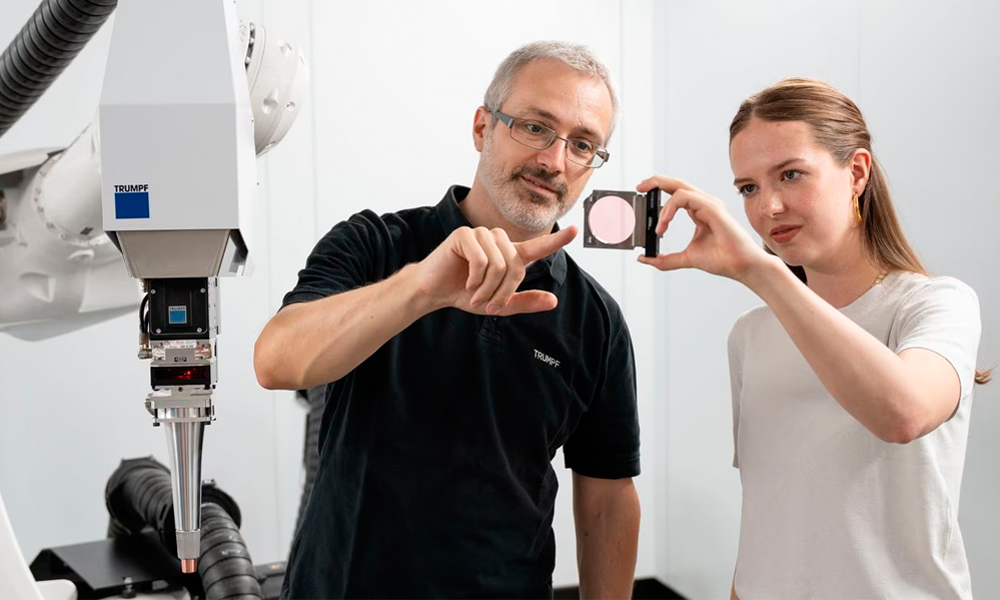
At EuroBLECH 2026, Trumpf is introducing the new TruLaser Weld 3000, which can be programmed faster with AI. Source: Trumpf.
A shortage of skilled workers, frequently changing components, and limited production space pose challenges for many manufacturing companies. At forthcoming industrial expo EuroBLECH 2026 (taking place in Hanover, between 20-23 October), Trumpf is to introduce its new TruLaser Weld 3000, a compact robotic laser welding cell that can be programmed significantly faster thanks to AI while requiring very little space.
“The TruLaser Weld 3000 provides advantages, particularly for companies that manufacture high-quality sheet metal assemblies and housings in small batches with a wide variety of variants. It enables stable processes, short cycle times, and thus a high degree of flexibility in production,” said Moritz Berger, product manager at the company.
The TruLaser Weld 3000 can be programmed either directly at the machine in the conventional way or offline using the TruTops Weld software, such as from the [plant] office. This is advantageous when working with frequently changing components: employees can create new programs on the computer while the machine continues production. In addition, welding programs based on CAD data are created significantly faster than with conventional programming.
The “TeachLine Touch” function can then be used to correct minor deviations. Weld points can be repositioned simply by tapping on the machine screen. This reduces programming and set-up time by up to 50 percent, claims the manufacturer. An AI-based process detects deviations in the weld points and corrects the robot path according to the actual component configuration.
Smaller welding optics
Newly developed welding optics – approximately 40 percent smaller – expand the range of applications for the TruLaser Weld 3000. The welding robot can reach even hard-to-access areas within a component, such as the interiors of deep housings, crates, or boxes. This enables users to automate the production of a wider range of parts and reduce manual rework.
Trumpf relies on proven laser welding technologies to ensure process stability and weld quality. These include BrightLine Scan, which is a combination of a high-frequency scanner and motorized focus adjustment. It enables greater gap bridging of up to 0.4 mm and wider welds for better tolerance compensation. The BrightLine Weld function distributes the laser power between an inner and outer core in the laser light cable. This reduces spatter – particularly during deep welding. For larger gaps of up to approximately 1.5 mm or materials that require filler metal, FusionLine combines the laser with filler wire for targeted material deposition.
 Compact footprint
The TruLaser Weld 3000’s protective enclosure has a footprint of 3.65 m x 3.65 m, making it about 24 percent smaller than the smallest version of the TruLaser Weld 5000. Despite its compact design, the machine can process pallet-sized components by using its KUKA Iontec robot with a 2,100-mm reach.
With a laser power of three or four kilowatts, the TruLaser Weld 3000 welds stainless steel and structural steel up to eight millimeters of material thickness, as well as aluminum up to six millimeters. Typical applications include equipment and plant engineering, sheet metal components for data centers, medical technology, and the kitchen and food industries.
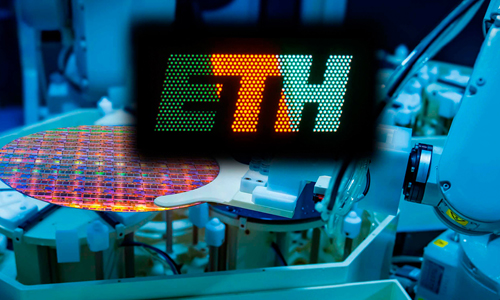
ETH Zurich develops new organic material for color-emitting OLEDs
September 24 2026
Siloton develops specialized OCT for pediatric eye tests
September 23 2026
Cognex to acquire RealSense for $500 M in cash-and-investment deal
September 23 2026
ECOC 2026 showcases new optical communications launches
September 23 2026
Ramona gets $25M to scale multi-camera microscopy
September 23 2026