



ETH Zurich develops pixels that both create and analyze images
Suggests development of devices that function as camera and display at same time.
29 June 2026
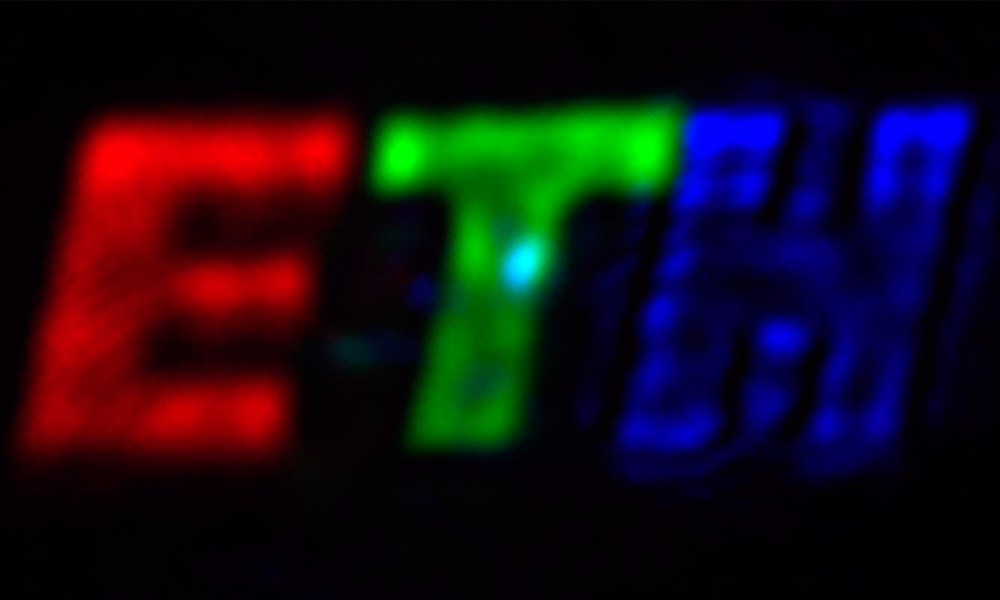
The colored logo was created using the new pixels. The letter “E” is roughly 1 mm tall on the camera. Image: Glauser YM, Vonk SJW, et al., Nature 2026.
Researchers at ETH Zurich, Switzerland, have developed pixels that can not only create images, but also analyze them. In the future, they say, this could lead to the development of devices that function as camera and display at the same time.
In 1927, the term “picture element”, later abbreviated to “pixel”, appeared for the first time in the American technology magazine Wireless World. Today, pixels are everywhere: in computer screens and television sets, where they create colorful images; but also in cameras, where they capture images. In any case, however, they do one or the other: either they control light, as in the case of a display; or they analyze it in a camera sensor. Until now, there have been no pixels that could do both.
A research team led by David Norris, Professor at the Optical Materials Engineering Laboratory at ETH Zurich, has now developed such pixels for the first time. These pixels can both steer light and analyse it. Not only the intensity of the light, but also its oscillation phase and polarisation can be controlled and analysed. In the future, such so-called bidirectional pixels could lead, for instance, to the development of camera–displays that combine the two functions in a single device.
Overlapping lightwaves
The new results, which are described in a paper in Nature, are based on a fundamental physical effect: the so-called interference of light waves. When light is scattered by a surface, the waves originating from different points on the surface overlap. The shape of the surface determines the oscillation phases with which the waves propagate further. If the phases are equal, the light waves reinforce each other, but if they are opposed, the waves cancel out.
Norris and his collaborators use this effect to precisely control light with wave-shaped sculpted surfaces. They developed this processing method, which is precise to within a few nanometres, already a few years ago. For steering, the pixel—that is, the area on the chip where the material has been processed—first transforms the incoming light into a surface wave (a so-called surface plasmon polariton) propagating along the surface of the chip.
At a different position within the pixel, the surface wave is scattered back out of the material as a light wave. Through interference of the light waves, patterns and images can be created. Using mathematical Fourier analysis, the researchers can calculate what these images will look like and what kind of surface pattern is needed for a specific image.
 Controlling phase and polarisation
“In addition to light intensity, meaning the bright and dark areas from which images are created, our Fourier pixels can also control other properties of the light waves, for example their polarisation,” said doctoral student Yannik Glauser. Polarisation indicates the direction in which the electric field of the light wave oscillates. To generate light with an arbitrary polarisation direction, they use surface waves with different polarisations, which overlap on the Fourier pixel. The polarisation of the scattered light then depends on the surface shape of the pixel.
They can also precisely control the oscillation phase and thus, for instance, create light beams that have a hole in the middle—doughnut-shaped light beams, as it were. All of this even works with light of different wavelengths, so that colored images can also be generated.
“We can also, however, apply the principle of interference and Fourier analysis in the opposite direction to analyse light using the Fourier pixel,” said postdoctoral researcher Sander Vonk. For instance, the researchers can make the oscillation phase of the light visible by superimposing the lightwave and a reference wave on the pixel. They capture the interference pattern of the scattered light from both waves with a camera. From this pattern, they can then calculate the phase of the light. In a similar way they can also analyse its polarisation state.
Multiple functions
“Thanks to the fact that the relevant surface profiles of the pixels can be determined using Fourier analysis, we can combine the control and analysis of amplitude, phase and polarisation on a single pixel”, said Vonk. Furthermore, Fourier analysis is mathematically simple and does not require complex models.
Light is used in many technologies ranging from television to mobile phone cameras to fiber-optic cables for the internet. “Our new pixels for control and analysis could, therefore, become a useful tool in many areas,” said Norris.
As the surface waves can be used to perform mathematical calculations directly on the pixel material, it is even conceivable that Norris’s pixels could react to a captured image and, without going through a computer, produce corresponding light patterns. According to Norris, a more short-term goal is the extension of the method to a matrix made of many Fourier pixels. Such a matrix could then be used to realise more complex camera display devices that, just like conventional cameras or displays, operate with a multitude of pixels. The ETH Zurich research has led to a patent application that has been nominated for this year’s Spark Award.
Syntec swings to profit as sales climb
August 19 2026


Hesai goes ‘full-stack’ with extended robotics offering
August 19 2026