



ESA selects TNO to explore laser satellite technology for LEO layer of IRIS² network
Focus is on optical terminal driven by PICs to validate data services between satellites and IRIS².
22 September 2026
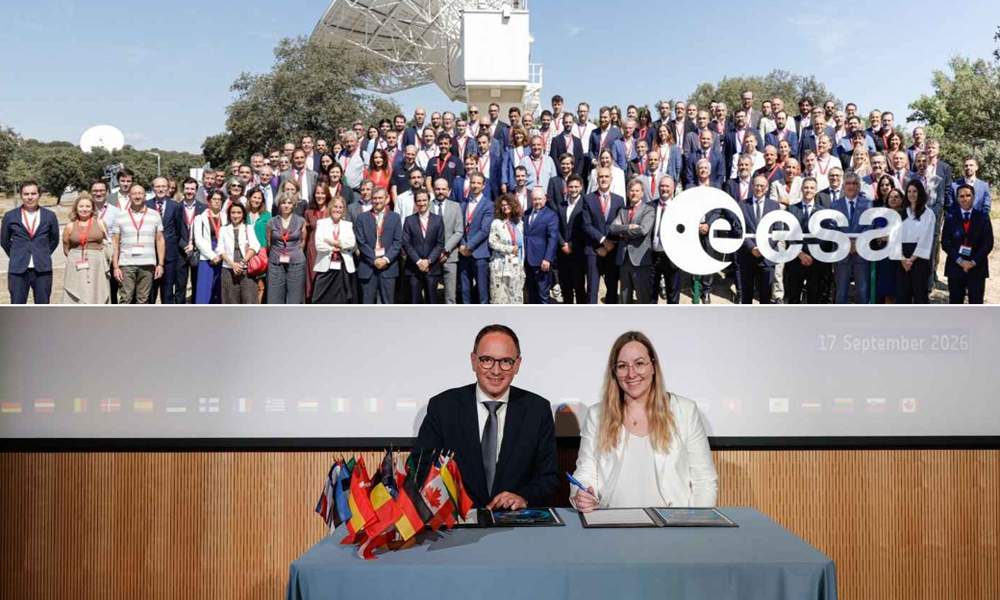
It's a deal: the signing ceremony between ESA and TNO to develop Low Earth Orbit IRIS². Photo: TNO / ESA.
The European Space Agency (ESA) has selected Netherlands-based research agency TNO to study next-generation laser satellite communications services, with the aim of shaping the future of Europe’s secure IRIS² constellation. The research focuses on an innovative optical terminal powered by photonic integrated circuits (PICs), paving the way for in-orbit validation of data relay services between Earth observation satellites and the IRIS² network.
“Europe needs communication networks that are powerful, resilient and built on home-grown innovation. Enabling secure links by utilising next-generation optical terminals right here strengthens European sovereignty and unlocks massive growth opportunities for the Dutch high-tech sector,” commented Kees Buijsrogge, Director Space at TNO.
The study belongs to the “Consolidation Phase” of the IRIS² Low-LEO Pre-operational and De-risking Activities, part of ESA’s Programme Related to EU Secure Connectivity.
De-risking photonic chips
Under the initiative, TNO will lead the system design, validate technical feasibility, and resolve critical risks early with the support of FSO Instruments. By de-risking this light-based technology, stated TNO, this week, “the study lays the groundwork for a future in-orbit demonstration, bringing next-generation optical terminals closer to operational space deployment.”
Laser satellite communications enable secure, high-capacity, and interference-free data transfer across space networks. Because optical links offer clear dual-use benefits, they can serve commercial infrastructure and environmental monitoring as effectively as sensitive governmental communications. “This capability underpins Europe’s broader push for technological sovereignty and resilient connectivity,” added the TNO statement.
Supported by the Netherlands Space Agency (NLSA), the study also positions the Dutch high-tech and photonics ecosystems to play a central role in manufacturing and supplying critical hardware for upcoming IRIS² rollout phases.
About ESA’s program
Under the management of the European Commission, IRIS² is aiming to build a space-based secure and resilient connectivity network that elevates Europe’s strategic autonomy and competitiveness. ESA acts on behalf of the European Commission as the qualification and validation authority for the governmental infrastructure of the Union Secure Connectivity Programme.
It manages development and validation contracts supporting the initial space and ground segments, verifies end-to-end system, service, and security performance against EC requirements, and coordinates these activities with ESA’s own programme.
Within this programme, the IRIS² Low-LEO Pre-Operational and De-Risk Activities components provide a rapid and recurrent mechanism for validating potential new governmental services and associated mission concepts in orbit up to a pre-operational level, subject to successful maturation and later programme level decisions of integration into the operational EU IRIS² baseline.
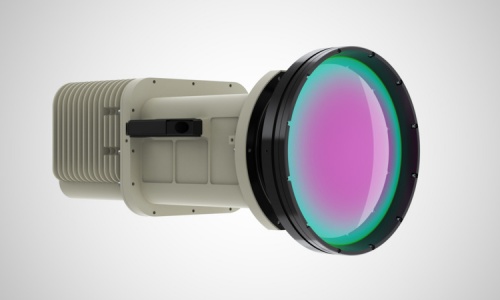
MKS sells Ophir Optics division to PCB maker TTM for $650M
October 22 2026


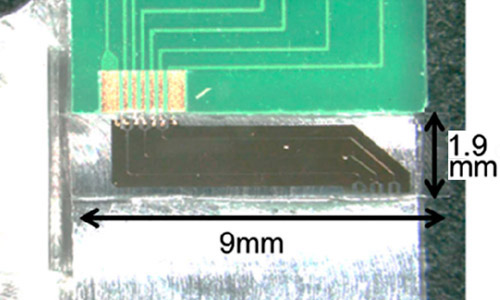
Photon Bridge lands €10M to scale lasers for data centers
October 21 2026