



EPFL speeds up volumetric 3D printing
Phase-encoded approach now 70-times more efficient than previous equivalent technique.
26 May 2026
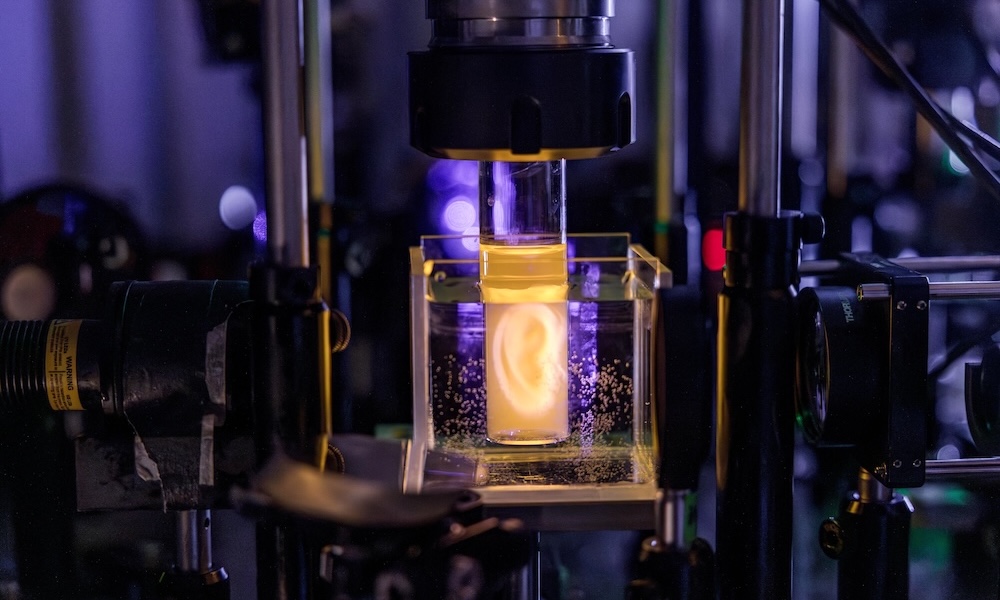
Holographic projection of a human ear model on a sample vial. Credit:Adrien Buttier/EPFL.
A project at Switzerland's EPFL research center has enhanced a volumetric approach to 3D printing to achieve ultra-efficient, fast and precise volumetric additive manufacturing.
Described in Light Science & Applications the new approach builds on EPFL research into how a laser-driven 3D printing operation can be designed so that the phase of the incident light is involved in triggering a photopolymerization process, rather than just the light's amplitude.
The Laboratory of Applied Photonics Devices (LAPD) at EPFL has been studying "layerless 3D techniques," also termed volumetric additive manufacturing or VAM, in which volumes of feed material are solidified at once by selectively delivering energy to all points in a 3D space via a digital micromirror device.
VAM could help eliminate poor surface quality and avoid directional variations in mechanical properties; but efficient light delivery via micromirror device has remained a challenge. Typically, the light projection efficiency in such binary amplitude modulator-based systems is just a few percent, according to EPFL.
So the project has developed a new approach termed tomographic volumetric additive manufacturing (TVAM), using a holography approach to modulating the phase of light waves shone into a rotating vat of feedstock, and encoded 3D-shape information in the patterning illumination. The result is "a 70-fold increase in laser power efficiency," commented the project.
In addition EPFL has now used a new MEMS phase-only modulator, rather than a digital micromirror, to further accelerate and optimize the TVAM procedure.
Bioprinted implants at near-clinical scale
In trials EPFL applied its new TVAM approach to the printing of 3D objects across different scales, from hundreds of micrometers to centimeters, using various materials from acrylate-based resins to soft hydrogels, including cell-laden hydrogels with a concentration of 1 million cells per mL. It also used the technique with a particular gelatin Thiol/Norbornene feedstock as a route to large-scale objects up to 3 x 3 x 4 cm3, and found that such items could be manufactured within 2 minutes using only a 150 mW laser diode.
The researchers printed a life-sized human ear as a step toward bioprinted implants for reconstructive medicine. And using a smaller print construct of 64 mm3 and cell-laden hydrogels, the researchers confirmed that after six days the embedded living cells were still viable and had formed organized networks.
The next steps will involve further study into the limits of beam shaping for printing in bioresins with high cell densities, along with better ways to print directly onto or around existing objects, and new methods for shaping microscopic details more accurately by predicting how chemicals inside a resin react during printing.
The latter method notably leverages holographic volumetric additive manufacturing, commented EPFL, to fabricate objects simply by projecting a hologram onto a vial of resin without needing to rotate it. Phase control also enables holographic printing with self-healing beams, which produce higher-fidelity 3D-printed objects in light-scattering media such as those containing living cells.
"Our method has demonstrated efficiency and precision, and finally makes it possible to bioprint tissue-like structures at near-clinical scale," said Christophe Moser, head of LAPD. "We have printed structures substantially larger than those achieved with previous holographic approaches, despite increased light scattering caused by the embedded cells."
IPG and Renishaw double up for faster additive manufacturing
November 27 2024


iPronics raises $125 M to scale optical networking for AI data centers
September 03 2026
Nanjing University miniaturizes OCT for imaging within the brain
September 02 2026
Inleap Photonics gets €20M for laser drone defense
September 02 2026