


EPFL builds photonic chip that rivals much larger laboratory lasers
Source delivers short high-energy pulses, could reshape medical diagnostics, optical atomic clocks.
04 June 2026
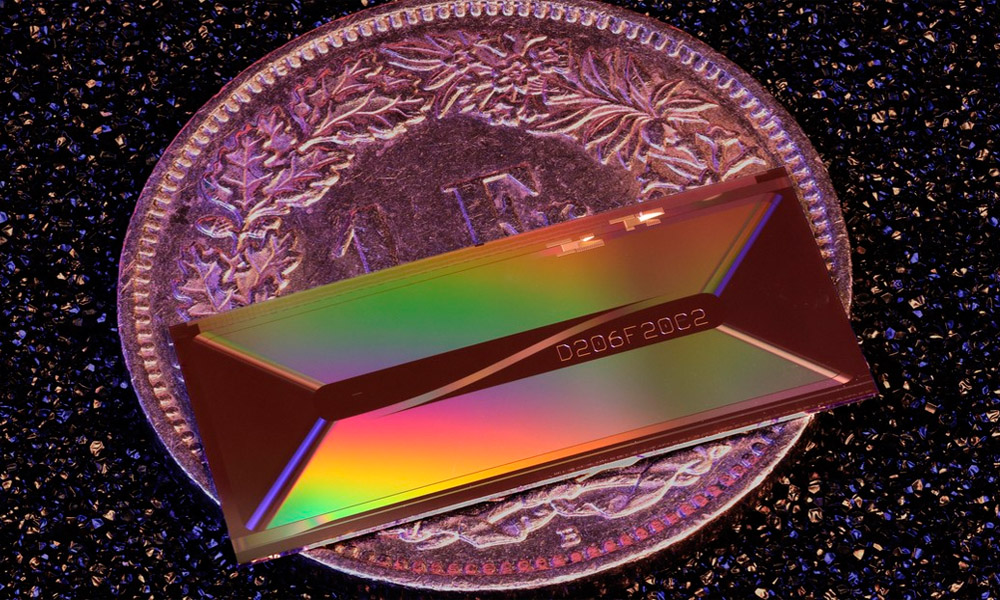
Placed on a 1 CHF coin for scale (diameter = 23.2 mm), EPFL's photonic chip shows how a laser architecture once confined to table-top systems can be shrunk to the millimeter scale. © 2026 EPFL / Zheru Qiu.
Researchers at EPFL (École Polytechnique Fédérale de Lausanne, Switzerland) have built a photonic chip, which, they say, “rivals much larger laboratory lasers, delivers extremely short, high-energy optical pulses, and could reshape technologies like medical diagnostics and optical atomic clocks.”
Ultrafast lasers enable applications from precision micromachining, eye surgery to optical frequency combs, behind today’s most precise optical atomic clocks. Yet despite more than two decades of effort, ultrafast lasers have largely remained bulky, expensive systems confined to optical tables, says EPFL.
Now a team led by Prof. Tobias J. Kippenberg at EPFL has been able to place ultrafast lasers onto a photonic chip. Described in Nature (03 June 2026), the researchers report the first integrated ultrafast laser that rivals table-top femtosecond lasers, delivering 1.05 nJ in pulses as short as 147 fs.
Overlooked design
“For more than twenty years, a high-pulse-energy femtosecond laser on chip was widely regarded as a holy grail of integrated photonics,” said Kippenberg. “Our result shows that it is not only possible, but that it can be achieved with a surprisingly elegant architecture that the integrated-photonics community had overlooked.”
The EPFL team turned to a “largely overlooked” laser design known as the Mamyshev oscillator. In the laser cavity, a nonlinear waveguide sits between two optical filters that each let through a different slice of the color spectrum. When a strong pulse travels through the waveguide, it broadens into a wider range of colors, allowing part of it to pass through both filters and keep circulating. Weak light does not broaden enough and is rejected.
“This design is especially attractive because it does not require any component that is difficult to make on this erbium-doped silicon nitride chip,” said Zheru Qiu, a co-leading author of the paper.
 Small laser, big impact
On the chip, the 42-cm-long laser cavity can be folded into a space the size of a match head, far smaller than optical fiber-based lasers. Because these photonic chips can be manufactured at wafer scale, much like computer chips, more than 1000 laser cavities could be produced at once, opening a path toward much lower-cost ultrafast lasers for sensing, spectroscopy and metrology.
“With kilowatt-level peak powers, the chip can drive demanding applications that have long depended on large, expensive laboratory lasers,” said Qiu.
The result could lead to portable and affordable tools for detecting pollutants, revealing hidden defects and performing medical diagnostics, while opening a path toward compact optical atomic clocks for future communication and navigation.

Trumpf hopeful of a recovery as orders tick up
July 28 2026
Computational optics startup Elio raises $21M
July 28 2026