



Counter-drone system adopts lidar for short-range interception
Germany’s Argus collaborates with lidar provider Ouster to enhance effectiveness of net-based capture method.
26 May 2026
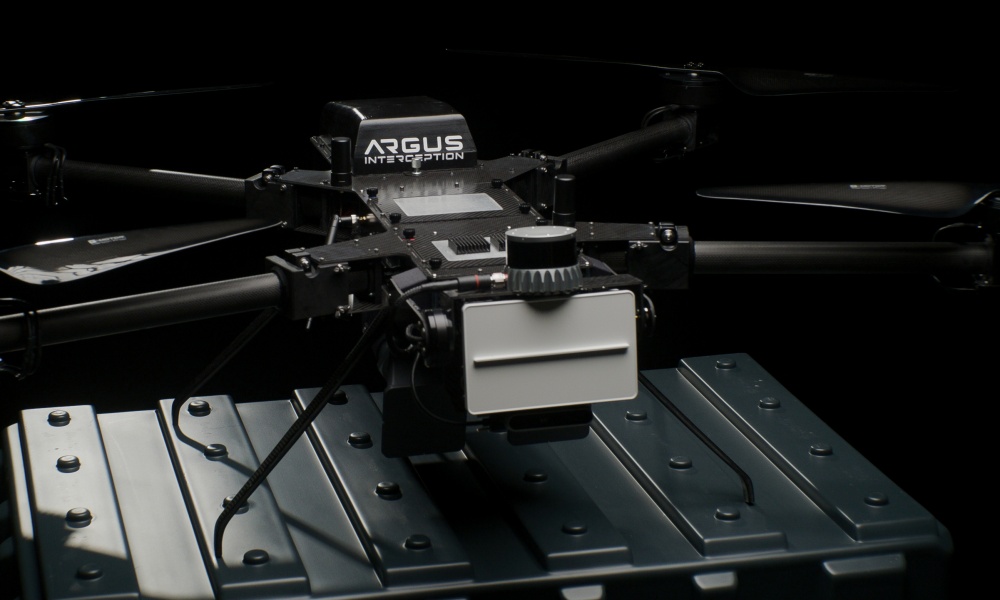
A counter-UAS interception drone from Argus, equipped with Ouster's digital lidar sensor unit. Photo: Ouster.
Argus Interception, a technology company set up by former members of Germany’s armed forces, has struck a deal with US-based Ouster that will see lidar sensors deployed in counter-drone capture systems.
Under a strategic agreement between the two firms Argus will equip its “A1-Falke” systems, which use a net to intercept rogue drones, with the photonics technology.
“By installing Ouster lidar, Argus aims to enhance the effectiveness of responsible, non-kinetic counter-UAS operations and offer a minimally invasive response option for complex environments where traditional kinetic measures are unviable,” stated the Rotenburg firm.
According to Argus the A1-Falke is designed to capture, recover, and secure uncooperative drones, protecting critical infrastructure such as airports and power plants, as well as public buildings and events.
Rev8 sensor evaluation
Built around a drone featuring two integrated net launchers, the system uses a combination of radar, lidar, and depth-sensing cameras to monitor the defined airspace, detect invasive drones, intercept them in an automated and controlled manner with a net, and bring them to the ground intact for follow-up evaluation.
Under the strategic agreement, Ouster will supply its digital lidar for integration directly into the Argus system to optimize the precision and reliability of the net-based interception process, especially in the decisive close-range phase.
“The integration strengthens the operational chain from initial target acquisition to controlled interception and capture, particularly in complex, safety-sensitive environments and when protecting critical infrastructure and public spaces,” stated the two firms.
Argus CEO and co-founder Dennis Rauscher added: “Responsible counter-UAS measures depend on reliable sensors and controllable procedures.
“With Ouster, we are integrating lidar technology that further strengthens the precision and reliability of our net-based interception capability, supporting our customers’ operational effectiveness in safety-critical environments.”
As part of the collaboration, Argus will also explore next-generation interception capabilities with Ouster’s new “Rev8” units, which are described by the firm as “the world’s first native color lidar sensors”. Developed with FujiFilm, they are said to be capable of capturing life-like imagery more associated with a video camera.
For drone countermeasures, the advantages should include longer-range detection for high-speed applications to bring “human-like” sight and unmatched situational awareness to automated defensive systems.
Situational awareness
Ouster’s newly appointed chief revenue officer Cyrille Jacquemet said: "As rogue drones present increasingly sophisticated threats to critical infrastructure and public safety, precise situational awareness at close range is paramount.
"By supplying our digital lidar for integration into the A1-Falke, we are providing the high-resolution, low-latency 3D perception required for advanced counter-UAS operations.”
Ouster introduced the Rev8 sensors earlier this month and since then the company has announced collaborations with Nvidia aimed at autonomous vehicles, Gecko Robotics for advanced robots, and Dxomark for image quality evaluation.
CEO Angus Pacala commented at the time: “We are continuing the momentum of our unified sensing and perception platform with the introduction of our revolutionary Rev8 OS family, powered by our next-generation L4 Ouster Silicon.
“This launch represents a paradigm shift in AI perception as Rev8 sets a new standard for sensing, featuring the world’s first native-color lidar sensors with industry-leading resolution, range, and reliability designed for functional safety, affordability, and scale.”
According to its latest results announcement, Ouster posted an operating loss of $19.2 million in the March quarter, despite a near-50 per cent year-on-year rise in sales revenues to $49 million as it shipped around 8000 lidar sensors.
Singular launches programmable single-photon sensor
September 10 2026
EPFL enhances super-resolution imaging from single camera exposures
September 09 2026
Stuttgart-led group combines illumination and microscopy in fiber bundle
September 09 2026
ESA Earth observation mission FLEX set to launch on September 15th…
September 09 2026