


Combining fluorescence and phosphorescence shows new details of Alzheimer's
University of Virginia studies oxygen availability as a factor in disease development.
20 October 2026
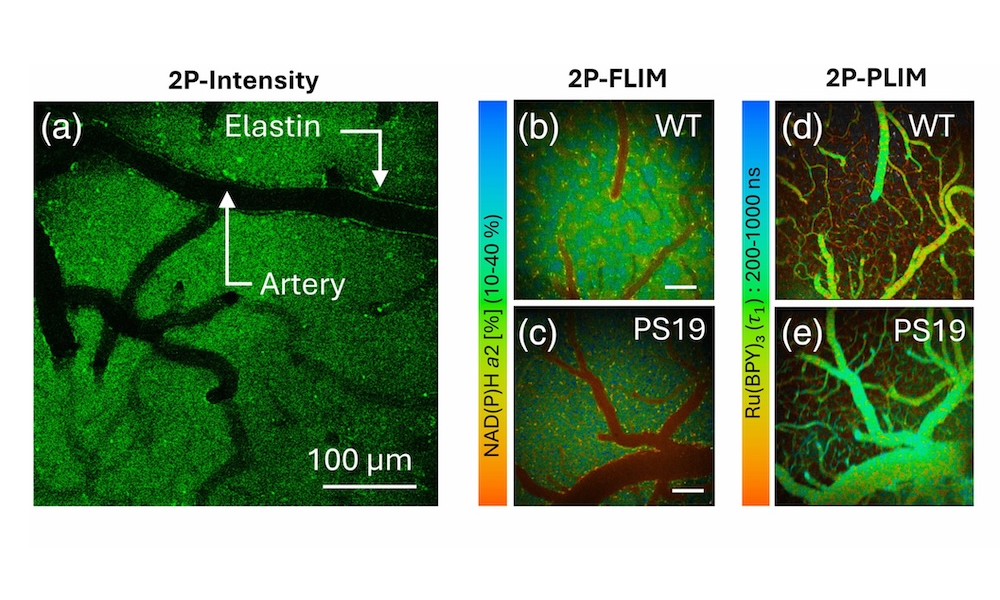
Two-photon fluorescence lifetime imaging microscopy, or FLIM, combined with phosphorescence lifetime imaging microscopy, or PLIM, to provide information about metabolism and oxygen. Credit: V.K. Sagar et al/Neurophotonics.
A project at the University of Virginia (UVA) has developed a new route to imaging oxygen use in a living brain, as a means of monitoring Alzheimer's disease.
Published in Neurophotonics, the study provides fresh data to help understand the mechanistic aspects of Alzheimer's and its neuropathology.
Connections between blood flow, oxygenation and Alzheimer's disease have been the subject of study for some time. Earlier in 2026 a project at USC Keck School of Medicine combined near-infrared spectroscopy and transcranial ultrasound to monitor cerebral hemodynamics, assessing how well oxygen reaches brain tissue and how fast blood moves when it gets there.
The new project at UVA's W.M. Keck Center for Cellular Imaging also combined two different modalities in its imaging operation, employing simultaneous two-photon fluorescence and phosphorescence lifetime imaging, 2P-FLIM and PLIM.
In this approach FLIM records fluorescence from a particular protein termed NAD(P)H, as a measure of metabolic state at the locations of interest. At the same time phosphorescence lifetime of an oxygen-sensitive probe, Ru(BPY)3, introduced into the tissues indicates the partial pressure of oxygen present.
For trials on mouse model subjects, UVA modified commercial microscopy platforms to allow both modalities to operate at the same time, while also taking steps to compensate for absorption and scattering by the overlying cortical tissue and avoid phototoxicity.
"FLIM and PLIM simultaneous measurement requires precise synchronization between the Zeiss two-photon microscope and the Becker & Hickl lifetime-imaging electronics," commented UVA's Ammasi Periasamy. "This lets us capture metabolism and oxygen tension at the same moment, in live animals."
Concurrent changes underway in Alzheimer's disease
The imaging data showed differences between the two forms of emission. FLIM from the cortices of the Alzheimer’s disease model mice showed a higher protein-bound fraction of the fluorescent protein than those of wild-type animals, showing that the mitochondrial metabolic activity had been altered by progress of the disease.
At the same time, PLIM indicated that oxygen partial pressure in the general cortical vascular network was lower in the Alzheimer’s model than in the wild-type mice. The researchers interpret this as evidence that greater oxygen consumption is taking place in the Alzheimer’s-affected cells themselves.
The work demonstrates the value of viewing brain physiology through several measurements at once, with "2P-FLIM-PLIM" providing metabolic and oxygen information in living tissue with relatively little disruption, letting researchers examine relationships that are harder to resolve from isolated measurements.
These current results do come from a mouse model, noted the UVA project, so they do not establish that the same metabolic and oxygen patterns necessarily occur in humans with Alzheimer’s disease.
Even so the study provides an imaging framework for investigating how oxygen availability and mitochondrial metabolism change together as neurological disease develops. Measuring both processes in vivo may give researchers a more complete view of the physiological changes that accompany Alzheimer’s disease.
"Taken together, the findings suggest that changes in cellular energy metabolism and oxygen use can be detected concurrently in the living Alzheimer’s disease mouse brain," said UVA's Andrés Norambuena. "That connection matters, because mitochondrial dysfunction and impaired cerebral oxygenation have both been implicated in Alzheimer’s disease, yet they are often investigated separately."
MKS sells Ophir Optics division to PCB maker TTM for $650M
October 22 2026




Photon Bridge lands €10M to scale lasers for data centers
October 21 2026