



ams Osram touts microLED array and optical interconnect progress
Austrian sensor and optoelectronic component maker still looking to reduce headcount by 2000.
04 August 2026

ams Osram has posted sales revenues of €805 million for the second quarter of the year, up slightly on the same period last year as the Austria-headquartered operation continues to evolve to a more focused photonics company.
Having recently sold its non-optical sensor business to Infineon, and with the divestment of its fabless CMOS image sensor unit to Indie Semiconductor pending, ams Osram is consolidating its efforts around what it calls its “digital photonics” strategy.
Digital photonics is described as the core driver of the company’s long-term growth strategy, combining advanced, pixelated emitters, sensors and electronics to digitally controlled light emission and optical sensing.
“This technology enables dynamic lighting, light-based sensing, projection, directed energy and high-speed data communication,” ams Osram explains.
Smart glasses and interconnects
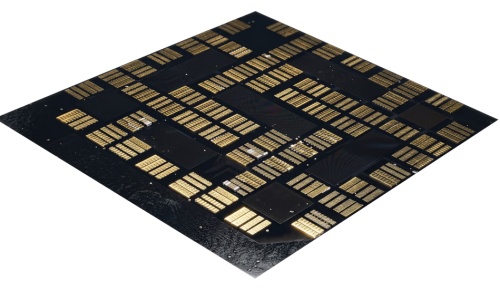
The company highlighted recent developments including a key milestone with microLED array light engines destined for next-generation smart glasses, and a new line of “micro-photodiode” arrays for AI data center interconnects.
“We are sharpening our focus on digital photonics as a key growth driver,” commented CEO Aldo Kamper, whose team is expecting substantial growth in the adoption of mixed reality smart glasses through 2030, with upwards of €50 of ams Osram content per set of glasses envisaged.
The company also pointed to particular progress on the “transmit” element of its interconnect solution, with full product development for the "receive" channel now initiated with a view to targeting so-called “slow-and-wide” interconnects touted by the likes of the freshly venture-funded UK-US startup OLIX.
“This development increases potential bill-of-materials content and supports the company’s longer-term objective of offering a complete optical engine,” stated ams Osram. “Such architectures offer compelling advantages in power efficiency, thermal management, reliability and system scalability.”
Sensor solutions
Kamper and colleagues also pointed to advances in the development of a multi-zone time-of-flight sensor that is said to advance 3D depth-sensing performance, by offering up to 48×32 measurement zones compared to the more typical 8×8 resolution in today’s sensors.
“The [TMF8829] product is expected to enter commercial robotics and smart phone applications, enabling enhanced spatial awareness for autonomous systems and improving imaging performance in mobile devices,” they said.
Meanwhile the ams Osram executive team is still working to streamline the company through the “Simplify” strategic program announced in February, which is expected to see the firm’s headcount reduced by 2000 employees - including 1000 in Europe - to save an annual €200 million.
With the recent divestments set to realize €700 million, the firm’s balance sheet has received a significant boost in the current quarter, helping to offset a net debt position previously standing at around €1.3 billion.
In their outlook for the September quarter, Kamper and colleagues said that strong orders in the automotive sector should help push sales revenues to somewhere between €770 million and €870 million, with the full-year forecast unchanged.


Nobel Prize for Medicine goes to optogenetics architects
October 06 2026
Volantis raises $88M with AI memory breakthrough claim
October 06 2026


Fraunhofer IIS detects diseases through body odor
October 06 2026

Expanding Microelectronics UK show reflects sector optimism…
October 01 2026