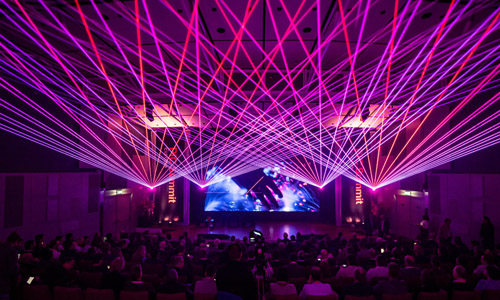
ams Osram sees AI photonics potential with thin-film VCSEL links
Austrian firm’s transformation effort tipped to benefit from novel micro-emitter links for data centers.
18 November 2026

Photonics device manufacturer ams Osram has posted sales revenues of €829 million for the third quarter of 2026, down slightly on the same period last year but with contributions from the firm’s Opto Semiconductors (OS) business unit growing 9 per cent to €399 million.
Discussing the latest trading period with investors, ams Osram’s CEO Aldo Kamper said that technology trends in the firm’s traditional market of automotive applications, plus an emerging opportunity in AI data centers were both fueling optimism for the future.
“The [car] windshield is becoming a wide-screen display. And we are a key technology supplier enabling it,” he said, adding: “Instead of looking down at multiple screens, navigation, safety alerts and other relevant information can be brought directly into the driver’s natural field of view.”
‘Wide-and-slow’ AI photonics
The company, with twin headquarters in Austria and Germany, has long provided high-brightness LEDs that are tailored to the automotive environment and central to such deployments, with Kamper citing a recent report from market analyst Omdia suggesting that panoramic head-up display volumes are expected to grow from less than one million units today to more than eight million units in 2031.
While automotive and smart phone deployments of ams Osram’s myriad components still represent the firm’s cash cows, Kamper is hopeful of securing a major new line of business from data centers.
“AI photonics, targeting data center optical interconnects, moves closer to commercialization,” he said, while pointing out that although traditional optical solutions provided reach, they have also tended to add cost, power, and complexity when multiplied across the huge number of “scale-up” connections required by hyperscalers.
“Our answer is ‘wide-and-slow’,” he told investors, explaining that this meant distributing bandwidth across many more parallel optical channels than is typical, with each channel operating at a relatively slow data rate compared with state-of-the-art links.
“This is not about replacing every existing optical architecture,” he said. “Silicon photonics and indium phosphide will remain important, especially in scale-out. Wide-and-slow is designed for a different optimization point: massive parallelism in tightly coupled AI systems.”
Credo wants standardized parallel optics
ams Osram’s ambition is to move from its traditional role as a supplier of individual optical components to offer an increasingly integrated photonics platform for high-volume applications.
“We combine micro-emitters, photodetectors, CMOS know-how, thin-film processing, through-silicon-via integration, advanced wafer-level packaging and test within one industrial platform,” the CEO said.
“A key differentiator is our thin-film technology, which enables top-emitting devices and is designed for dense, highly parallel architectures.”
Kamper has high hopes for the firm’s new thin-film microVCSEL platform emitting at 850 nm, while ams Osram is a key partner in a new project led by optical interconnect provider Credo that is aiming to industrialize the “wide-and-slow” approach.
Last month Credo revealed details of that effort, saying: “Micro-emitter technology brings new ways of moving volumes of data, while dramatically improving reliability, power efficiency, and bandwidth density.
“Arrays of micron-scale light sources make up the transmit side of an optical link. Rather than pushing a few optical channels to extreme data rates, many micro-emitters operate in parallel at optimal individual speeds, enabling layer zero redundancy to improve reliability.”
It is hoped that the new specification will address requirements for link power, efficiency, signaling, parallelism, and physical form factors - including module and connector footprint, link budget, and compliance.
L.K. Bhupathi, Credo’s associate VP of product, stated at the time: “As AI workloads scale from thousands to tens of thousands of accelerators, the industry needs a standardized approach to wide, parallel optical connectivity - not a patchwork of components that do not fit together or interoperate.”
Credo CEO Bill Brennan discussing "wide-and-slow" optical links at last month's Open Compute Project event in San Jose, California:
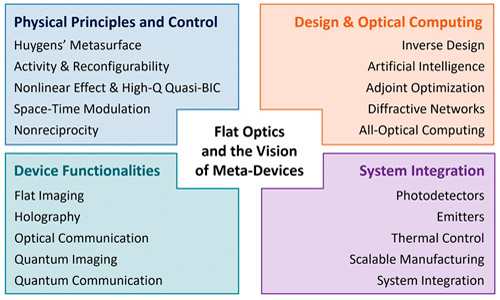
Innovations driving optical metadevices toward real-world deployment
November 18 2026

Exosens signs massive night vision supply deal
November 17 2026