



AKL Laser Technology Congress recognizes industrial laser innovations
LEAF Business Unit at 4JET microtech takes top prize and €10,000 for laser surface treatment; other placed firms for microLED and fiber delivery advances.
28 April 2026
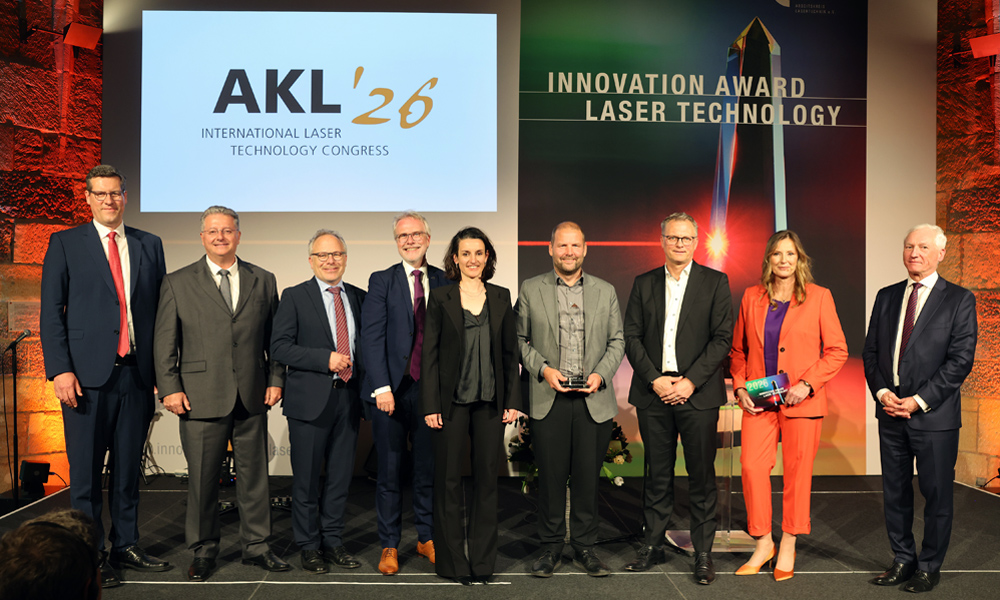
AKL Award winners 2026: From left to right: Dr. Claus Schnitzler, Ulrich Berners, Dr. Jochen Stollenwerk, Dr. Lutz Aschke, Gwenn Pallier, Dr. Tobias Dyck, Dr. Oliver Haupt, Kristina zur Mühlen, Dr. Markus Kogel-Hollacher. Image (C) Fraunhofer ILT, Andreas Steindl.
The Innovation Award Laser Technology 2026, presented last week at the AKL International laser Technology Congress in Aachen, Germany, which comes with a prize of €10,000, has been awarded to Dr. Tobias Dyck, Head of the LEAF Business Unit at 4JET microtech GmbH in Alsdorf, Germany.
Presented by the Arbeitskreis Lasertechnik e.V. on April 22, 2026, in Aachen’s historic Coronation Hall, the award recognized Dr. Dyck and his team for their groundbreaking project called “LEAF Laser Riblets – Shark Skin for Greener Aviation.” Chosen by a ten-member international jury from a highly-competitive pool, the work stood out among three distinguished finalists. The ceremony welcomed approximately 350 industry leaders, researchers, and guests to celebrate this milestone in applied photonics.
The awards evening opened with a keynote by Dr. Lutz Aschke, President of the European Technology Platform Photonics21. He reflected on Europe’s remarkable progress in photonics and laser technology, outlined a forward-looking vision for the sector, and emphasized that maintaining this momentum would require sustained strategic political support and targeted investment – a call that was very well received by the audience.
Awarded biennially, the Innovation Award Laser Technology honors manufacturers, industrial users, researchers, and developers who have successfully translated application-driven laser research into real-world industrial solutions. The prize is administered by the Arbeitskreis Lasertechnik e.V., a network of over 200 members dedicated to fostering collaboration, knowledge exchange, and technological advancement across the rapidly evolving laser sector.
Winners and projects
The 2026 Prize winners and their projects are summarized as follows:
- 1st place: “LEAF Laser Riblets – Shark Skin for Greener Aviation”
- Team all from 4JET microtech, Alsdorf, Germany.
This project focuses on laser-based fabrication of riblet structures on surfaces. Inspired by shark skin, these microstructures reduce drag and improve aerodynamics. Using 4JET's Laser Enhanced Air Flow (LEAF) technology, riblets can now be incorporated directly into the paint layer of components over large areas for the first time. This process uses a high-power CO₂ laser system with interference technology that generates multiple microstructures simultaneously, making it significantly faster than previous methods.
This technology has great potential in aviation, say its developers. Riblet structures on aircraft surfaces can reduce fuel consumption by up to three percent. This equates to savings of around $ 2.5 billion per year and a reduction of almost ten million tons of CO₂ in long-haul passenger traffic. Furthermore, LEAF technology opens up new possibilities for more efficient wind turbines, ships, and high-speed trains because improved aerodynamics and hydrodynamics contribute to higher energy efficiency and lower emissions.
- 2nd place: “Beyond free-space beams – Stable and robust fiber delivery opening new frontiers for ultrafast lasers”
- Project partners and team from Cailabs, Rennes, France; and PT Photonic Tools, Berlin, Germany.
The PureBeam project addresses a key challenge in the industrial application of ultrashort-pulse lasers – beam guidance. Until now, this aspect of an ultrashort-pulse laser system has been complex and prone to failure. Although femtosecond lasers enable high-precision manufacturing processes, it is precisely because of this hurdle that their use in industrial applications has so far been limited.
The Canunda-USP PureBeam by Cailabs enables stable coupling in hollow-core fibers and reliably ensuring and maintaining beam quality, even when the input beam is subject to interference. This makes manufacturing systems more robust and efficient and makes USP lasers easier to integrate.
Its developers say that this technology "unlocks new fields of application and, for the first time, enables true industrial-scale mass production in sectors such as semiconductor manufacturing, consumer electronics, medical technology, and the automotive and aerospace industries. This represents a major breakthrough on the path to scalable, cost-effective use of ultra-short-pulse laser manufacturing."
- 3rd place: “Laser mass transfer of microLEDs – A breakthrough to Commercialization Using a Holistic System Approach”
- Project partners and team all from Coherent LaserSystems, Göttingen, Germany.
The company is developing innovative laser mass transfer technology for manufacturing MicroLED displays. This technology addresses a key challenge facing the display industry: achieving cost-effective and scalable production. Although MicroLEDs have great potential for long-lasting, high-resolution displays, their widespread market introduction has been limited thus far due to high manufacturing costs and low yields.
Coherent LaserSystem’ integrated approach enables the ultra-fast, contactless transfer of Micro-LED chips as part of a holistic solution that combines fast, contactless Micro-LED laser transfer, a high-precision system architecture and a comprehensive software package – including AI functionality – to optimize transfer strategies and parameters from wafer to panel. The result is a significant increase in throughput and yield, whilst manufacturing costs are noticeably reduced.
The developers comment: “This technology will open up new applications in the display industry, as well as in microelectronics and optical communications in the future. It will also help make MicroLED displays economically viable and scalable.”
MKS sells Ophir Optics division to PCB maker TTM for $650M
October 22 2026

Photon Bridge lands €10M to scale lasers for data centers
October 21 2026