



Advances in optics and computation boost coronary intravascular imaging
Cardiology Discovery review identifies technology trends and a need for standardized validation.
30 September 2026
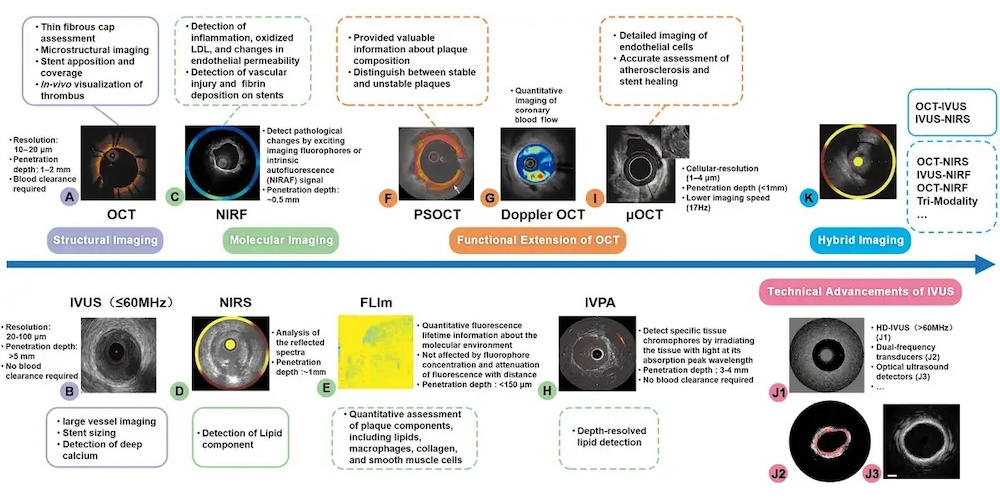
This figure presents the unique characteristics of each imaging modality and their respective clinical applications (dashed lines indicate areas requiring further clinical validation). Credit: Cardiology Discovery.
The journal Cardiology Discovery has published a review of recent advances in coronary intravascular imaging, highlighting new technology and potential hurdles to adoption.
Led by authors at Shanghai Jiao Tong University, the review suggests a trend towards simultaneous anatomical, compositional and functional coronary assessment, although widespread clinical adoption will require the technology to be supported by both robust validation and ways to ensure that incorporation into clinical procedures is a practical proposition.
"Coronary artery disease (CAD) remains the leading cause of morbidity and mortality worldwide," wrote the group.
"While coronary angiography is the gold standard for diagnosing and treating CAD, it provides only a 2-dimensional silhouette of the vessel lumen and fails to visualize plaque pathology. Intravascular imaging techniques have been developed to directly visualize coronary artery structures and pathophysiology with exceptional precision."
One conclusion of the report is that although piezoelectric ultrasound examination remains the most widely used modality for intravascular imaging, an all-optical ultrasound variant whereby light is used for ultrasound generation and detection has emerged as a promising alternative. These platforms currently remain complex and expensive, however, with extensive in vivo validation in humans still to be done.
OCT has been a focus of intravascular imaging research for some time, with significant strides made in device miniaturization to allow imaging in areas such as the brain. The report identifies micro-OCT (µ-OCT) as a significant advance, utilizing 800-nanometer ultra-broadband OCT sources and alleviating the trade-off between depth of field and lateral resolution. At present µ-OCT features limited penetration depth and higher system complexity, with in vivo human imaging still at an early stage.
Reliability of AI tools and rigorous validation remain crucial
Near-infrared spectroscopy (NIRS) has also made strides in intravascular imaging, although it cannot provide the structural information delivered by OCT. Combining NIRS with OCT or ultrasound in hybrid imaging platforms is a route towards more comprehensive data and has been a key development focus, according to the review.
Emerging modalities surveyed include near-infrared fluorescence (NIRF), in which near-IR light excites fluorophores within blood vessel walls to visualize molecular features of arterial plaques; and fluorescence lifetime imaging (FLIm), "a powerful new tool for the diagnosis and biological characterization of high-risk plaques."
"It is reasonable to believe that a system capable of acquiring OCT, ultrasound and fluorescence data concurrently has the potential to become a promising research tool for more comprehensive plaque visualization," said the report.
Computational methods will play a key role in the potential advances identified by the review, but at present clinical adoption remains challenged by dataset and algorithmic bias, imaging artifacts, and insufficient validation of results. The review states that ensuring the reliability and generalizability of AI tools in intravascular imaging will need robust datasets, bias-mitigation strategies and large-scale studies to confirm the results.
"These developments establish a unified intravascular imaging paradigm through which structural visualization, plaque composition characterization and functional evaluation can be performed simultaneously," conclude the authors. "While promising, widespread clinical adoption will require rigorous technical validation, standardized multicenter studies, and seamless integration into interventional workflows."
New views of cerebral blood flow from near-IR spectroscopy
January 11 2023
Philips snaps up intravascular imaging pioneer SpectraWAVE
December 16 2025
Leica and Cognex launch AI software module Aivaro to improve inspection
September 30 2026

Photonic monitoring to identify food safety, quality, and animal welfare
September 30 2026
Australia’s SKA tests antenna layout for Low telescope
September 30 2026
Artemis merges Optikos with Omega Optical
September 30 2026

PicoJool to scale VCSEL production with $27.5M round
September 29 2026