


Infleqtion and NASA taking quantum gravity sensor into space
With $20 M funding so far, Quantum Gravity Gradiometer Pathfinder Mission is intended to “advance U.S. space sensing”.
16 February 2026
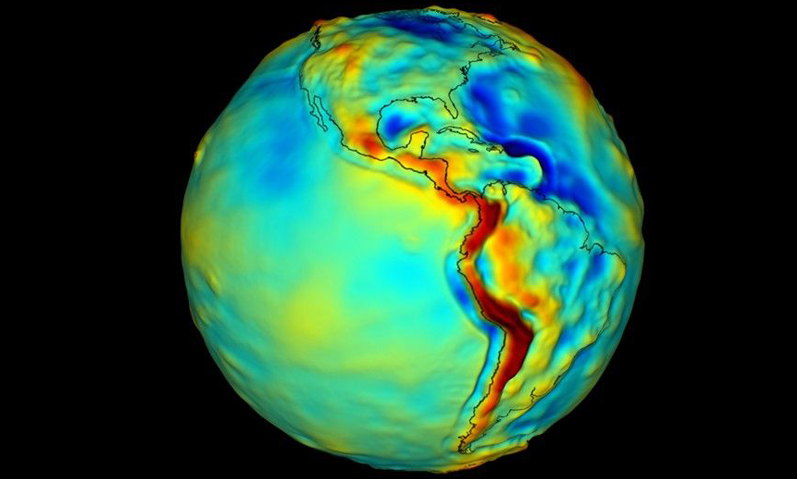
Red indicates areas of the world that exert greater gravitational pull, while blue indicates areas that exert less. A science-grade quantum gravity gradiometer could one day make maps like this with unprecedented accuracy. Credit: NASA.
Infleqtion, a developer of quantum sensing and quantum computing systems powered by neutral-atom technology, is collaborating on NASA’s Quantum Gravity Gradiometer Pathfinder (QGGPf) mission.
Led by NASA’s Jet Propulsion Laboratory (JPL), the mission is intended transport the first quantum sensor capable of measuring the Earth’s gravitational field and its gradients; signals that are used today to monitor mass dynamics on the planet's surface. The quantum instrument will be aboard a dedicated satellite in low Earth orbit (LEO). This program follows Infleqtion’s September 2025 announcement to go public through a merger with Churchill Capital Corp X.
The QGGPf mission is designed to demonstrate quantum sensor technologies that could transform how Earth’s gravity is measured from space. The quantum sensor is designed to monitor mass dynamics across the planet’s surface, including changes in water, ice and land, while operating in microgravity, which enables longer interaction times and correspondingly improved measurement sensitivities.
$20 M funding
With more than $20 million in contracted mission funding to date, the QGGPf mission, with contributions from NASA’s Goddard Space Flight Center, the University of Texas at Austin, Infleqtion, Monarch Quantum, and Jemba9, will fly the first standalone quantum gravity sensor in orbit.
“Quantum sensing opens an entirely new domain for U.S. space leadership,” said Dana Anderson, Chief Science Officer at Infleqtion. “By deploying this technology in orbit, we are demonstrating the feasibility of quantum gravity sensing in space and laying the groundwork for future capabilities that can deliver unprecedented insight into our planet.”
By directly measuring subtle variations in Earth’s gravitational field, the mission aims to demonstrate technologies that will help reduce risk for future quantum gravity instruments. These future systems could enable higher-resolution insights into how underground water, ice, and natural resources shift over time, critical data for understanding planetary health, strengthening national resilience, and supporting long-term economic and security planning. The one-year mission is expected to launch in 2030.
At a glance
- What is a quantum gravity gradiometer? A quantum gravity gradiometer is an advanced sensor designed to measure tiny differences in Earth’s gravitational field. Those differences can reveal subtle changes in mass below and on the surface, such as shifting water, ice, and geological structures.
- Why measure gravity from space? From orbit, gravity measurements can provide consistent, global coverage over time. That makes it possible to track large-scale changes, like groundwater movement, ice loss, and resource shifts, across regions that are difficult to monitor from the ground.
- What makes this mission “quantum”? The instrument uses clouds of ultra-cold atoms controlled by lasers as a highly stable measurement reference. Operating in the microgravity environment of space helps enable longer measurement times and supports the demonstration of key technologies for future quantum sensing missions.
- Technologies involved QGGPf relies on rubidium atoms collected and cooled by lasers into a small cloud within a magneto-optical trap (MOT). The cold atoms are shuffled from the source preparation region to a dedicated atom interferometer region by introducing a slight frequency shift between pairs of lasers. Two clouds are prepared and positioned about 0.5 m apart. Three controlled laser pulses are applied to the two clouds in a time span of few seconds to facilitate simultaneous atom interferometers. After the three interferometer pulses, an interferogram on each cloud registers local acceleration during the interferometer time. The gravity gradient is derived from the difference of the accelerations.
Diffraqtion aims high with $10M for 'quantum' camera platform
September 01 2026