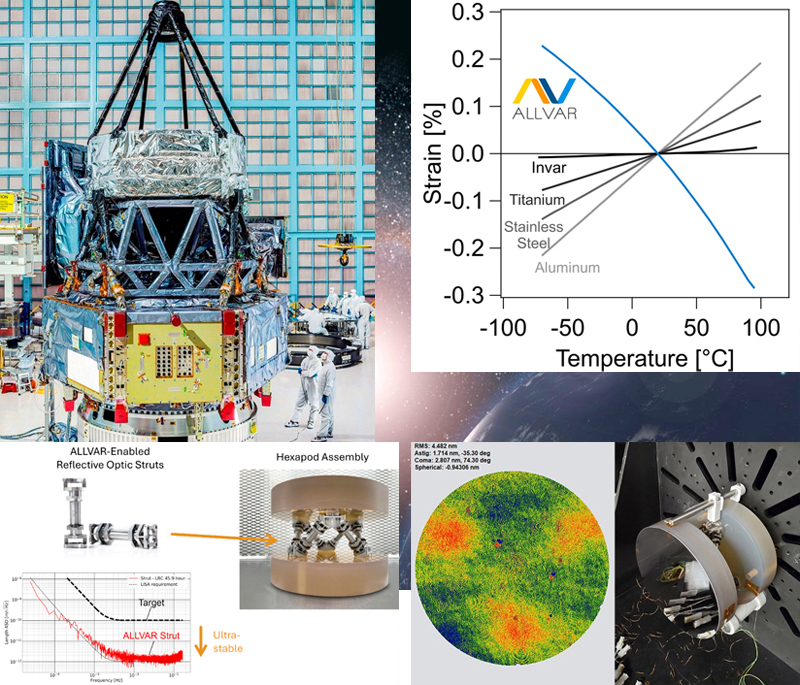
| Left, upper: NASA’s Nancy Grace Roman Space Telescope sits atop the support structure and instrument payloads. The long black struts holding the telescope’s secondary mirror will contribute roughly 30% of the wave front error while the larger support structure underneath the primary mirror will contribute another 30%. Credit: NASA/Chris Gunn.
Right, upper: While other materials expand while heated and contract when cooled, Allvar Alloy 30 exhibits a negative thermal expansion, which can compensate for the thermal expansion mismatch of other materials. Credit: Allvar.
Left, lower: The hexapod assembly with six Allvar Alloy struts was measured for lon
g-term stability. The stability of the individual struts and the hexapod assembly were measured using interferometry at the University of Florida’s Institute for High Energy Physics and Astrophysics. The struts were found to have a length noise well below the proposed target for the success criteria for the project. Credit: Allvar / Simon F. Barke, Ph.D.
Right, lower: The Allvar-enabled hexapod assembly undergoing testing between 293K and 265K. RMS changes in the mirror’s surface shape are visually represented (left). The three roughly circular red areas are caused by the thermal expansion mismatch of the invar bonding pads with the Zerodur mirror, while the blue and green sections show little to no changes caused by thermal expansion. The surface diagram shows <5 nm RMS change in mirror figure. Credit: NASA’s X-Ray and Cryogenic Facility. |