‘Digital twin’ of the chest simulates photonic treatment of pneumonia
Computational model predicts path of light in the body to tailor noninvasive therapies to patient anatomy.
29 October 2026
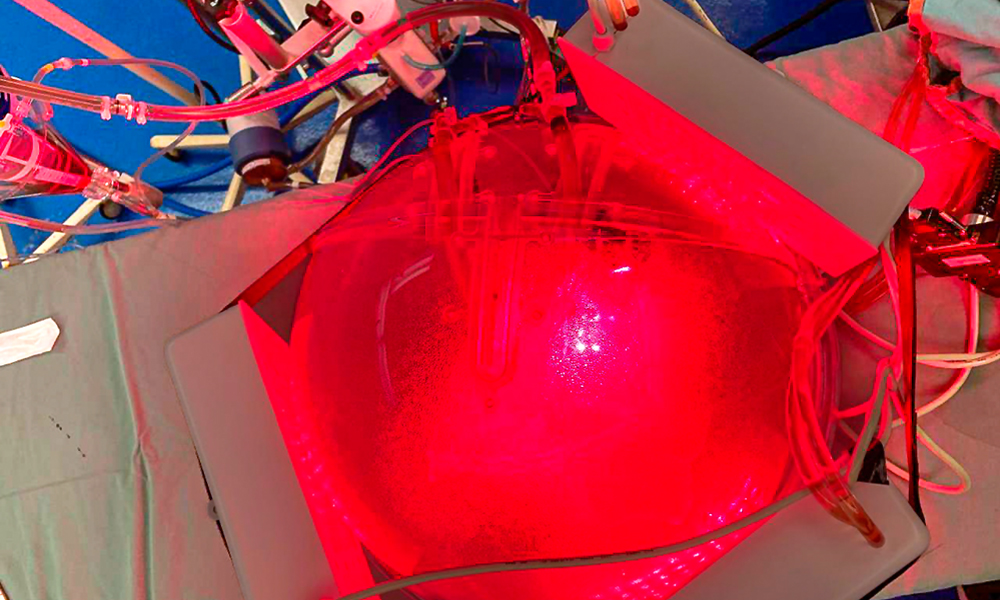
Light-based therapy applied to a lung intended for transplantation. Credit: Cristina Kurachi / USP.
Researchers at the University of São Paulo (USP), Brazil, and international collaborators have created a computational model that can generate a “digital twin” of the human thorax. The goal is to personalize the treatment of respiratory diseases using a special type of light. Described in a paper published in PNAS, the new technology uses CT scans to predict the path that light radiation will take inside the body. This makes it possible to calculate the exact dose needed to combat infections and inflammation directly in the lungs by simply illuminating the person from the outside.
Light-based therapies have been used to treat inflammation or infections in various organs. The two main approaches are photodynamic therapy, which uses light to activate a photosensitive substance that generates reactive species capable of destroying microorganisms in the presence of oxygen, and photobiomodulation, which uses low-intensity light to modulate cellular processes and inflammatory responses. However, in the case of the lungs, the use of these techniques presents a significant challenge.
To reach the organ noninvasively, the externally applied light must pass through the skin, fat, muscles, bones, and other chest tissues, undergoing absorption and scattering along the way. Thus, the same amount of light applied to two people’s chests can produce very different effects in their lungs.
The authors combined computed tomography images, three-dimensional anatomical reconstructions, and computational simulations accelerated by high-performance computing. This process created a “digital twin” of each patient’s chest. This information makes it possible to estimate how much light will reach different regions of the lungs and which configuration would be most appropriate for each anatomy and pathological condition.
“Since our strategy uses external illumination, we need to know how much light reaches the lung and if the dose is sufficient to activate the drug in photodynamic therapy or induce the biological response in photobiomodulation,” said Cristina Kurachi, a professor at the São Carlos Institute of Physics at the University of São Paulo (IFSC-USP) who coordinated the study alongside Vanderlei Bagnato, also from IFSC-USP. Researchers from the Hospital das Clínicas of USP Medical School (HC-FM-USP), Texas A&M University, and Victoria University of Wellington in New Zealand also participated.
The lung is a difficult target for light-based therapies. One alternative would be to deliver light to the organ via bronchoscopy, which uses a thin tube with a camera (bronchoscope) inserted through the nose or mouth. However, the procedure is invasive and may worsen the patient’s condition.
“External illumination is much simpler. However, air, lung tissue, blood vessels, and regions altered by inflammation or collapse have different optical properties. Focal pneumonia [concentrated in a specific region], diffuse pneumonia [in various regions of both lungs], and COVID-19, for example, alter the distribution and density of lung tissues in distinct ways,” said Bagnato.
This complexity makes the idea of applying the same light intensity to all patients, for the same duration and in the same position, inappropriate in principle. “Our solution was to use patient images, incorporating the anatomy of the tissues, to create a digital twin. In it, we included the optical properties of the tissues to try to predict the amount that actually reaches the lung and thus result in individualized dosimetry and a more effective therapeutic response,” said Kurachi.
The first step involves converting the images obtained by computed tomography into a three-dimensional model of the patient. The tomography volumes are segmented, meaning the computer identifies and separates the various anatomical structures. In the study, 12 common types of tissue and structures were represented.
 Monte Carlo simulation
“With all this data incorporated into the model, Monte Carlo simulation comes into play. Rather than attempting to find a single analytical solution for light propagation in extremely heterogeneous anatomy, the simulation calculates the fate of millions of photons as they travel, scatter, or are absorbed by different tissues,” said Bagnato.
Monte Carlo simulation is a computational method that uses repeated random sampling to obtain numerical solutions to complex problems involving many variables and probabilistic behaviors.
“Based on the collective behavior of the photons, the system constructs three-dimensional maps of the distribution of light and the energy absorbed within the body. In the study, the platform was fed CT scans of people with various pulmonary conditions. The group included four individuals from HC-FM-USP: one control subject without lung disease and three patients with predominantly focal bacterial pneumonia, diffuse bacterial pneumonia, and viral pneumonia caused by COVID-19, respectively.
“Two other volunteers participated in optical measurements used for the experimental validation of the model. The CT images were used to construct the ‘digital twin,’ and light distribution measurements were obtained from the volunteers, which allowed us to assess the model’s performance,” said Kurachi.
The reconstructions clearly showed the extent to which disease alters the organ. In the healthy patient used as a reference, approximately 91% of the organ was normal tissue capable of filling with air to facilitate respiration. However, in the patient with focal pneumonia, the healthy area decreased to 58.9%. In the case of diffuse pneumonia, the healthy area was even smaller, at just 54.1%.
The patient with COVID-19 showed a significant loss of lung function, retaining only about 69.9%. This lost functional space was eventually taken up by inflammation, collapsed areas that can no longer facilitate gas exchange, and an increase in blood vessels. These major physical changes make the organ denser and alter its interaction with light.
Next steps
The next steps include further experimental and clinical validations, as well as real-time measurement of the light dose in the future. The goal is to develop personalized treatments that determine how much light to apply to the skin and how much should reach the intended region of the lung.
However, for Bagnato, technological sophistication must go hand in hand with another concern. “We’re scientists committed to the relevance of our research. We want to solve problems, but we also operate with social responsibility. We don’t want to create technology that’s too expensive, can’t be integrated into the Unified Health System [SUS], or used widely. A good treatment must be accessible to the population. The economic reality must be taken into account in what we’re developing,” he said.
MVTec to present how machine vision and digital twins work together
MVTec Software GmbH, a developer of software for machine vision, is to demonstrate at the forthcoming SPS 2026 – Smart Production Solutions expo (Nuremberg, Germany, between November 24 to 26) how machine vision and digital twins can work together to open up new possibilities for the automation of manufacturing processes.
The company explained, “In the digital twin, the camera, lens, lighting, and test object are simulated and transmitted as a virtual image to machine vision software such as MVTec’s HALCON. This makes it possible, for example, to visualize changes to parameters and their effects on image processing. MVTec will showcase the digital twin in a demo developed in collaboration with its technology partner machineering.”
The demonstration is intended to show how machine vision and digital twins can be combined, enabling industrial processes to be virtually developed, validated, and tested even before their actual implementation. In addition, MVTec will provide information on the new versions of its software products, HALCON and MERLIC, as well as their diverse applications in industrial automation. Visitors can get a firsthand look at these at the booth through a second demo and discuss current developments and specific application scenarios with MVTec experts.

Europe-Japan group to industrialize flexible perovskite solar cells
November 03 2026

Marvell set to acquire Lumentum in $115BN all-stock deal
November 03 2026

Fiber business powers sharp sales uptick at Corning
October 29 2026