 |

17 Nov 2025
Under blue laser light, LLNL’s resin cures and solidifies; under UV, it degrades to liquid.
Additive manufacturing, or 3D printing, is normally an irreversible process. In a digital light processing (DLP) printer, a structured pattern is projected onto a layer of liquid resin, which cures and solidifies. This builds an object up, layer-by-layer. Traditionally, if the printed product is malformed, there is no easy way to fix it after manufacture – so it usually needs to be disposed of.In a new study, published in Advanced Materials Technologies, researchers at Lawrence Livermore National Laboratory (LLNL) have developed a hybrid additive and subtractive manufacturing system with a special resin that enhances traditional 3D printing by introducing reversible dual-wavelength behavior.
Under blue light, the novel resin cures and hardens. Under ultraviolet light, it degrades back into a liquid. The hybrid printing system enables corrective manufacturing, provides improved print resolution and allows for upcycling and recycling of parts.
“Imagine if a company needed a part to fit a certain machine but it’s a prototype and they are not quite sure what design they want,” said LLNL scientist and author Benjamin Alameda. “They could theoretically print with our resin. And if there were defects or something they wanted to change about it, they do not have to print a whole new part. They could just shine another wavelength on it and modify the existing part. That’s useful and less wasteful.”
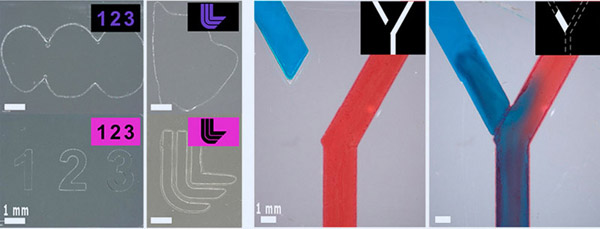
As an example, the researchers printed a fluidic device with two separated channels. Using the degradation response of their resin, they were able to connect the channels post-printing.
“We made it like this intentionally. But if this was actually a true failure to connect the channels, you would have to redo the entire print,” said LLNL scientist and author Johanna Schwartz. “Now after the fact, it is just a very simple correction.”
The patented resin technology is available for commercialization through LLNL’s Innovation and Partnerships Office (IPO). It allows all light-based printing systems to create more intricate, detailed parts with higher resolution, to smooth surfaces and correct errors, as well as to add and remove temporary support structures.
The technology — produced using unique LLNL facilities, capabilities and expertise — can be licensed by advanced manufacturing companies and used in existing 3D printers to save time and materials cost by enabling editable, recyclable 3D prints.
Photo-chemical effects
The resin is the key to the success of this dual-function printing: the authors optimized each component of its chemistry. Blue light causes the molecules in the resin to combine into a cross-linked network, a standard technique in 3D printing. In a new twist, ultraviolet light generates acid in the resin. The molecules are specifically tailored to respond to acid, breaking back down into a liquid.
Balancing the stability and degradability was a challenge. The team designed the resin to harden and degrade quickly, but not so quickly that it would degrade on its own. They noted that standard coatings can prevent parts from breaking down in the sun’s natural ultraviolet radiation.
Going forward, the scientists are further expanding the capability of this hybrid manufacturing by integrating on-machine metrology and feedback control to automatically and autonomously correct the print errors on-the-fly.
“Besides DLP printing, we are also planning to transfer this method to volumetric additive and subtractive manufacturing, which shines light to a rotating vial of resin and fabricates a 3D part all at once,” said author and LLNL scientist Liliana Dongping Terrel-Perez.
 |  |  |  |  |  |  |
| © 2025 SPIE Europe |
|