 |

20 Aug 2025
…and portable spectroscopy enables detection of vaginal microbes.
Scientists have developed a faster method for measuring the elasticity of airway walls, a property that can reveal important information about respiratory health. The technique, reported in the Journal of Biomedical Optics, could help assess conditions such as airway obstruction or burn injury during a standard bronchoscopy exam, without adding significant time or risk to the procedure.The development team comprises scientists from the University of North Carolina at Chapel Hill School of Medicine and Physical Sciences Inc., Andover, MA, USA. They reported their achievement in the Journal of Biomedical Optics/
Airway wall elastography, performed with endoscopic optical coherence tomography (OCT), can detect subtle changes in how airway tissue deforms with breathing. By combining OCT’s high-resolution imaging with a pressure sensor, clinicians can calculate cross-sectional compliance; how much the airway expands or contracts under pressure. However, current methods require relatively long scan times, which can be impractical in clinical settings.
‘Sawtooth pattern’ scanning
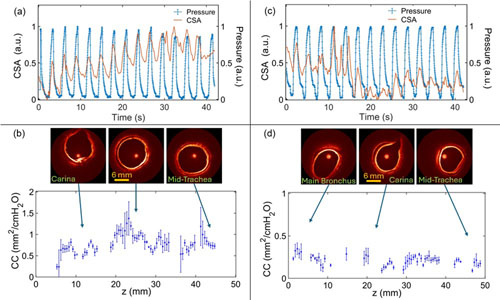
The new approach uses a “retrospective, respiratory-gated” 4D OCT scanning method. Instead of imaging the airway in sequence from one end to the other, the researchers move the scanning catheter in a sawtooth pattern along a 50 mm section. This allows each location to be captured at different points in the breathing cycle, both high and low pressure. Afterward, the data are sorted by position and phase of respiration to calculate compliance at each point, with a spatial resolution of 0.5 mm.
The team validated the method first in simulations, then in rigid and flexible models, and finally in live pigs. In a rigid 3D-printed model, the system reproduced the geometry to within 0.11 mm of the true dimensions. In a uniform silicone tube, compliance measurements varied by only about 4 percent, demonstrating high repeatability.
Tests on a structured balloon successfully mapped areas of high and low elasticity. Finally, in live pigs, the system measured compliance values consistent with earlier studies, while capturing clinically relevant variations along the airway. Significantly, the entire 50 mm scan took less than 42 seconds—about 0.42 seconds per measurement—making it feasible for routine use during bronchoscopy. The authors suggest it could be valuable for diagnosing and monitoring upper airway disorders, assessing injury, and potentially guiding treatment decisions.
Spectroscopy detects vaginal microbesVaginal health is tightly linked to the balance of bacteria in the microbiome, especially certain species of Lactobacillus. When this balance is disturbed—a condition known as dysbiosis—it can lead to increased risk of infections, complications during pregnancy, and other long-term health concerns.
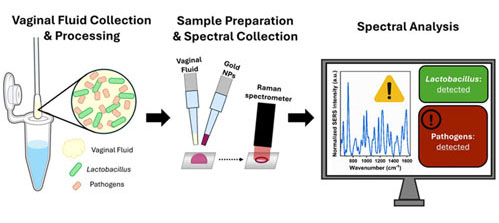
Despite this risk, existing diagnostic methods often fall short, especially in detecting Lactobacillus iners, an important vaginal bacterium, which does not always show up under a microscope or in lab cultures. Researchers at Vanderbilt University (and VU Medical Center), led by Andrea K. Locke, are working to change that by using a powerful optical technique known as surface-enhanced Raman spectroscopy (SERS) to analyze the biochemical fingerprints of vaginal fluid.
In a pilot study published in Biophotonics Discovery, the researchers collected vaginal fluid samples from 19 participants during routine gynecological exams. They used two different devices—a laboratory Raman microscope and a portable Raman spectrometer—to record the SERS spectra of each sample.
These spectra reveal the biochemical makeup of the fluid, including the presence of proteins, lipids, organic acids, and sugars. The team then used a molecular technique called quantitative PCR to identify whether key microbes were present, focusing on Lactobacillus iners, Lactobacillus crispatus, Gardnerella vaginalis, and Streptococcus agalactiae.
By comparing the SERS spectra of samples with different microbial compositions, the researchers found consistent biochemical signatures. The presence of Gardnerella vaginalis (G. vaginalis), a microbe linked to bacterial vaginosis, was marked by increased protein and lipid signals and decreased organic acid content—trends that align with what’s known about its role in disrupting the vaginal environment. In contrast, Lactobacillus iners (L. iners), a protective microbe that can be difficult to detect with current methods, was associated with elevated levels of organic acids and reduced signals from proteins and polysaccharides. These patterns were visible not only with the high-end lab equipment but also with the more accessible portable device.
Notably, the samples containing G. vaginalis were from participants without any diagnosed infections or symptoms. This suggests that SERS may be able to identify early-stage or subclinical shifts in the microbiome before they become clinically evident—a critical advance for prevention and early intervention. The findings also highlight how SERS could be used in routine monitoring of vaginal health, especially if integrated into point-of-care devices. The portable Raman system produced results similar to the benchtop microscope, showing that accurate biochemical readings do not necessarily require a full laboratory setup.
• Both of these articles were first published on spie.org.
 |  |  |  |  |  |  |
| © 2025 SPIE Europe |
|