



Real-time control boosts CHARA observatory’s stellar imaging powers
Delay line control system intended to improve precision and interferometric capabilities.
18 March 2026
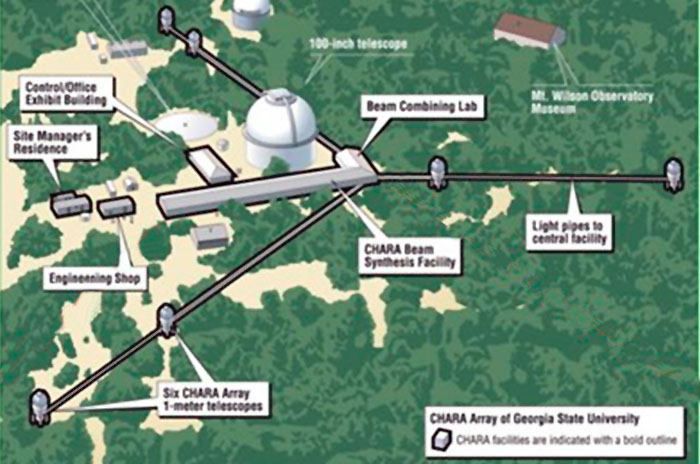
The delay lines of the CHARA Array interferometer, an essential element for astronomical observations, underwent a major modernization effort to replace the aging software and hardware elements in their control system. Credit: Anugu et al, Journal of Astronomical Telescopes, Instruments, and Systems (SPIE).
Progress in astronomy over the past decades has enabled astronomers to image the surfaces of stars, track stellar eruptions, and probe planet-forming dust disks many light-years away. Facilities such as the CHARA Array at Mount Wilson Observatory allow astronomers to image stellar surfaces, monitor eruptions, and study planet-forming disks around distant stars.
To maintain image quality, these systems must control the optical path of incoming starlight with nanometer precision as Earth rotates and atmospheric conditions change.
At the core of this process are delay lines—movable mirror assemblies that adjust the light path so beams from multiple telescopes arrive in sync. For more than two decades, CHARA relied on a control architecture that engineers developed in the early 1990s. Although reliable, the aging system depended on increasingly obsolete components, making maintenance difficult and limiting future expansion.
In the Journal of Astronomical Telescopes, Instruments, and Systems, researchers report a comprehensive modernization of CHARA’s delay line control system that the team implemented with AZ Embedded Systems between 2021 and 2024.
Independent control improves fault detection
The upgrade replaces the legacy VME-based electronics with a hybrid architecture that combines field-programmable gate arrays for time-critical processing and Linux-based computers for higher-level control tasks. Each telescope now operates with an independent control computer, improving fault detection, maintenance efficiency, and operational flexibility. CHARA’s delay lines are essentially specialized mirrors mounted on carts sitting on rails, and operators adjust their positions to modify the light path.
The updated version employs field-programmable gate arrays—reconfigurable chips to handle time-critical tasks—and Linux-based computers for higher-level control tasks. Notably, each telescope now has its own control computer, which makes detecting faults easier and speeds up maintenance. The team also added detailed telemetry logging to monitor performance during observations.
The researchers note that the modernization effort did not always proceed smoothly, and early testing revealed unexpected issues. For example, timing irregularities inside the new control loop caused cart position errors large enough to significantly hinder performance.
The team traced the problem to small mismatches in how internal clocks counted time, which they fixed through firmware changes. They also identified mechanical vibrations from a power supply that affected one telescope and then physically isolated the source. After these corrections, the upgraded system achieved residual tracking errors of approximately 12 nanometers and a control bandwidth of 100–130 Hz, maintaining legacy precision while improving stability.
Beyond sustaining performance, the new architecture enables advanced observing modes. These include dual-field interferometry, where one star stabilizes the signal while another fainter target is observed, and high-contrast nulling techniques, which aim to suppress starlight to better detect nearby objects. Although not yet demonstrated at CHARA, the upgraded delay lines now make these modes possible. The modernization also supports future expansion of the array.
“The new modular architecture simplifies future expansion of the delay line system if additional telescopes are added to the array. For example, the CHARA Michelson Array Pathfinder project aims to extend the maximum baseline of the array, which is the distance between the outermost telescopes, to 1 km, thereby increasing angular resolution,” said staff scientist Dr. Nasireddy Anugu. The team also emphasizes the broader value of their analysis; by documenting the system’s timing, response speed, and limits, the study provides a benchmark for future interferometers.
“Our paper is a reference for current and future use of the CHARA Array and for next-generation instrument design and FPGA based modernization of delay lines at other facilities,” said Anugu.
• This article was first published on spie.org.
PicoJool to scale VCSEL production with $27.5M round
September 29 2026
Blood flow scanner offers clearer views of tissue health
September 29 2026

ETH Zurich develops new organic material for color-emitting OLEDs
September 24 2026
Siloton develops specialized OCT for pediatric eye tests
September 23 2026