



Mantis Space lands $10M for laser-based space 'grid'
Albuquerque startup emerges from stealth mode with approach to power satellites while they are in Earth's shadow.
18 March 2026
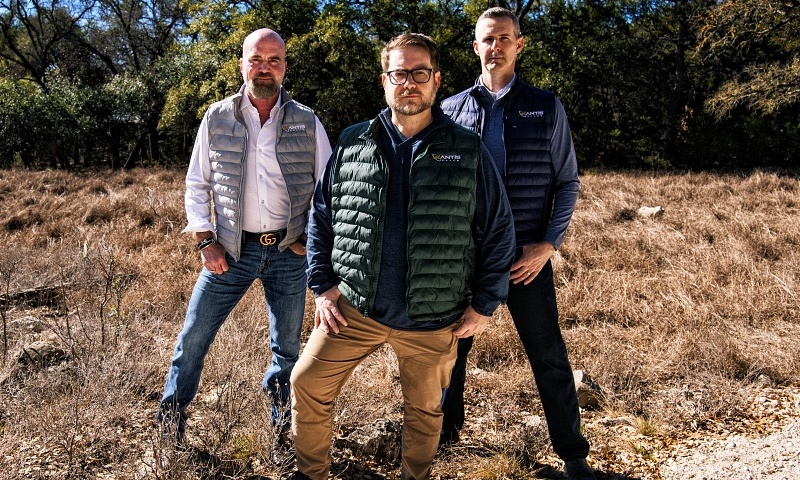
The Mantis Space founding team, and gilet fans (l-r): chairman Hugh Wyman Howard III; CEO Eric Truitt; and COO Jeremy Scheerer. Photo: Mantis Space.
Mantis Space, a startup company based in working on optical infrastructure to power low-Earth orbit satellites more effectively, has emerged from stealth mode with a seed funding round worth $10 million.
The Albuquerque, New Mexico, company is aiming to build a constellation of spacecraft that remain almost continuously in sunlight and can transmit power to satellites operating in eclipse.
That infrastructure would allow satellites, space stations, and orbital compute platforms to receive laser-transmitted power through their solar arrays in real time, regardless of their position relative to the sun.
“Satellites rely on solar energy for power, but when they pass behind Earth they enter eclipse and temporarily lose access to sunlight,” Mantis explains. “During these periods, spacecraft must rely on limited onboard batteries.
“Mantis Space helps overcome this constraint by delivering supplemental power when sunlight is unavailable. Using optical systems with modern laser technology, we beam power to satellites wirelessly and directly to their existing solar arrays.”
Space power grid
That approach is expected to help extend a satellite’s life, increase its revenue potential, and enable more missions on every orbit. Future satellites could spend more time in their most productive orbital positions rather than chasing sunlight, with less focus on solar arrays and batteries required.
At present, satellites spend on average nearly one-third of their life in Earth's shadow. During these periods, energy production stops, systems rely on battery reserves, and operational performance declines, limiting return on investment for every satellite.
To compensate, many satellites are placed in orbits designed primarily to maximize exposure to sunlight rather than optimize mission productivity or revenue generation.
“The ever-popular Sun Synchronous orbits leave satellites outside of their revenue-generating and mission areas up to 70 per cent of every day,” Mantis states. “Orbital power infrastructure changes that equation.”
In a release announcing the funding, CEO and co-founder Eric Truitt added: "We are at the beginning of a space infrastructure supercycle. Launch has scaled. Manufacturing has scaled. But performance in orbit is still constrained by physics.
“Every asset going up whether it's a defense sensor, a broadband satellite, or an orbital compute node has the same power problem. We're building the grid that makes all of it work.”
Optical expertise
Truitt, who founded Mantis alongside COO Jeremy Scheerer and chairman Hugh Wyman Howard III, has previous experience in space ventures, having helped BlueHalo successfully exit in a $4.5 billion deal.
Wyman Howard III served 32 years in Naval Special Warfare and joint special operations, while Scheerer previously led defense and intelligence portfolios at MapLarge and Georgia Tech Research Institute (GTRI).
Heading up the firm’s optics side is director of optical engineering Greg Brady, who has played key roles delivering both the James Webb Space Telescope, and the diffractive optical element at the heart of Apple’s Face ID system.
And there is further optical expertise in the form of chief engineer John Sandusky, who recently retired after more than 20 years of service leading space, solar, and laser programs at Sandia National Laboratory.
The seed funding was led by Rule 1 Ventures alongside Montauk Capital, with Montauk CEO Philip Krim saying: “Shared energy in orbit is a prerequisite for the next phase of commercial and defense expansion in space. We funded Mantis Space to create that foundation."
PicoJool to scale VCSEL production with $27.5M round
September 29 2026
Blood flow scanner offers clearer views of tissue health
September 29 2026
ETH Zurich develops new organic material for color-emitting OLEDs
September 24 2026
Siloton develops specialized OCT for pediatric eye tests
September 23 2026