


Brain blood flow and oxygenation offer new signs of early Alzheimer's risk
Stevens INI uses near-IR and ultrasound to study links between hemodynamics and disease.
25 February 2026
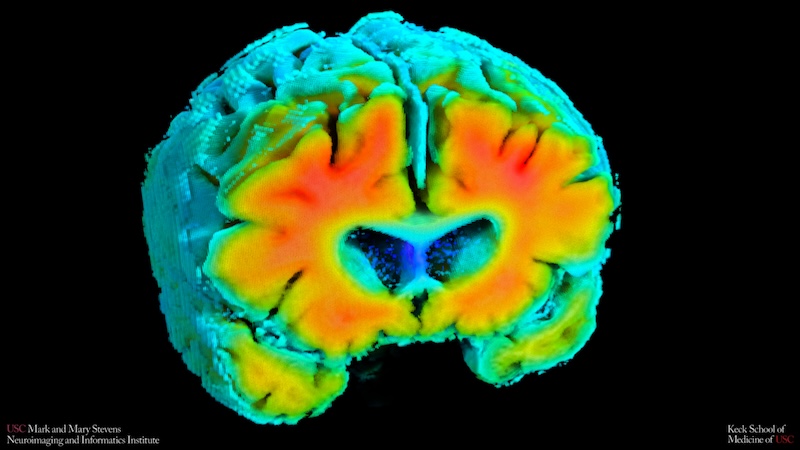
Amyloid imaging studies plaque buildup in the brain. Credit: Stevens INI.
A project at USC Keck School of Medicine has studied how brain blood flow and oxygenation provide early clues to a patient's risk of Alzheimer's disease.
Published in the journal Alzheimer's & Dementia the study may indicate new less invasive routes to detecting and monitoring the condition.
The team combined near-infrared spectroscopy and transcranial ultrasound to monitor hemodynamics, with both techniques potentially easier to deploy and more convenient for patients than the MRI and PET scans typically used to study neurodegenerative disease.
Measures of cerebral hemodynamics may be potential candidate biomarkers of early cerebrovascular dysfunction associated with mild cognitive impairment and dementia, noted the project in its paper. However, human studies examining how cerebral hemodynamics relate to neuroimaging markers associated with Alzheimer’s disease and related dementias are limited.
"Amyloid and tau proteins are often considered the primary players in Alzheimer's disease, but blood flow and oxygen delivery are also critical,” said Amaryllis A. Tsiknia from USC's Mark and Mary Stevens Neuroimaging and Informatics Institute (Stevens INI).
"Our results show that when the brain's vascular system functions more like it does in healthy aging, we also see brain features that are linked to better cognitive health."
In the project's study, near-infrared spectroscopy measured how well oxygen reaches brain tissue near the surface of the cortex, while transcranial Doppler ultrasound assessed how fast blood moved through major brain arteries. Mathematical models summarized these signals into indicators that reflect how well the brain adjusts blood flow and oxygen delivery in response to natural changes in blood pressure and carbon dioxide levels.
Spectroscopic data opens new doors for early detection
Near-IR spectroscopy has proven itself a valuable tool for studying hemodynamics in several clinical scenarios. USC Keck School of Medicine previously demonstrated how speckle contrast optical spectroscopy (SCOS) could assess the movement of blood cells through capillaries and blood vessels as a way to assess stroke risk in patients.
Elsewhere medical device developer Infraredx developed a hybrid ultrasound/infrared system for imaging blocked coronary arteries, using the spectral response of lipids in the blood to evaluate dangerous plaques that may be present.
In the Stevens INI trials on a total cohort of 200 participants, hemodynamic measurements were carried out alongside control measurements using MRI and PET scans. The cerebral hemodynamic markers could then be related to neuroimaging phenotypes associated with dementia in cognitively impaired and unimpaired older adults.
Results showed that higher values of blood flow and oxygentation, indicating brain blood vessels behaving more like those of cognitively healthy adults, were linked to lower levels of amyloid plaques and larger hippocampal volume. Both of these brain features are associated with a lower risk of Alzheimer’s disease.
The study also found that participants with mild cognitive impairment or dementia had poorer vascular indicators than cognitively normal adults, reinforcing the idea that declining cerebrovascular function is part of the Alzheimer’s disease continuum.
"These findings add to growing evidence that Alzheimer’s involves meaningful vascular contributions in addition to classic neurodegenerative changes," said Arthur W. Toga, director of the Stevens INI. "Understanding how blood flow and oxygen regulation interact with amyloid and brain structure opens new doors for early detection and potentially prevention."
Infrared spectroscopy to tackle blocked coronary arteries
August 02 2018
Diffraqtion aims high with $10M for 'quantum' camera platform
September 01 2026