


MBI Berlin and DESY present plasma lens that focuses attosecond pulses
Opening up new opportunities for studying ultrafast electron dynamics.
05 November 2025 Research & Development
 A team of researchers from the Max Born Institute (MBI), in Berlin, and DESY, in Hamburg, has demonstrated a plasma lens capable of focusing attosecond (as) pulses. The team says this achievement "substantially increases the attosecond power available for experiments, opening up new opportunities for studying ultrafast electron dynamics."
The results have been published in Nature Photonics ("open access").
The team describes attosecond pulses as "essential tools for observing and controlling electronic motion in atoms, molecules, and solids". However, focusing these pulses, which lie in the extreme-ultraviolet (XUV) or X-ray region of the electromagnetic spectrum, has proven highly challenging due to the lack of suitable optics.
Mirrors are commonly used, but they offer low reflectivity and degrade quickly. Lenses, though the most straightforward tool for focusing visible light, are not suitable for focusing attosecond pulses, because they absorb the XUV light and stretch the attosecond pulses in time.
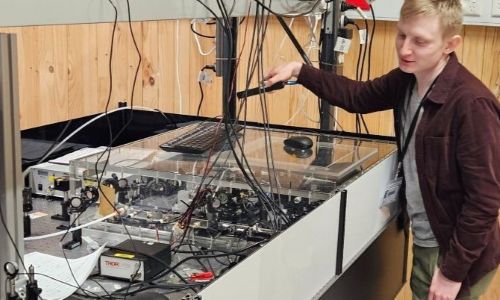
MBI and DESY solved this problem by generating a plasma lens. To create it, they send strong electrical pulses through hydrogen gas inside a tiny tube (see figure, above). This process strips the hydrogen atoms of their electrons, creating a plasma.
The electrons naturally move outward toward the edges of the tube, shaping the plasma like a concave lens. Normally, such a lens would spread light out rather than focus it. But because plasma bends light differently than ordinary materials, it instead focuses the attosecond pulses.
Plasma lens 'an effective filter'
In the Nature Photonics article, the researchers show that the plasma lens can focus attosecond pulses across different ranges of XUV light, with a tunable focal length controlled by the plasma density. They also achieved a high transmission rate of more than 80%.
Significantly, the team found that the plasma lens serves as an effective filter for the infrared driving pulses, which normally require thin metal filters. This means those filters are no longer necessary, allowing more attosecond power to pass through. With stronger pulses now available, scientists have new opportunities to run attosecond experiments that are often limited by weak light sources.
To better understand how the focused attosecond pulses behave over time, the scientists ran computer simulations. They discovered that the pulses stretch only slightly, from 90 to 96 as. Under more realistic conditions - where different colors of the attosecond pulse arrive at slightly different times in a phenomenon known as chirp - the plasma lens actually shortened the pulses. In this case, the pulse duration decreased from 189 to 165 as.
By experimentally demonstrating an attosecond plasma lens, the researchers have addressed a major limitation in attosecond science. The technique offers simple alignment, high transmission, and the ability to focus light across different colors. These advantages open the door to a wide range of applications, from mapping electron dynamics in complex materials to advancing quantum technologies and enabling the next generation of ultrafast microscopy.
Diffraqtion aims high with $10M for 'quantum' camera platform
September 01 2026